Black and Yellow Caterpillars: Identification Guide
You found a caterpillar striped in black and yellow and now you’d like a name before you pick it up. That’s a sensible instinct. The color combination means very different things depending on the species: some are perfectly safe to handle, a couple leave rashes on skin, and one of them grows into the most traveled butterfly in the world.
There’s also a lookalike problem. “Black and yellow caterpillar” covers everything from smooth, banded larvae on milkweed to fuzzy, hair-covered species on oak leaves, and a few look similar until you check the right details.
The 4 field marks that separate them quickly: body texture (smooth vs. hairy), size, the specific arrangement of the color, and what plant the caterpillar is sitting on. Host plant is often the fastest shortcut; it narrows 20 possibilities down to 2 or 3.
Black and yellow caterpillars in North America include the monarch, black swallowtail, spotted tussock moth, and American dagger moth. Most are safe to handle. Tussock moth and dagger moth caterpillars have stiff, barbed hairs that irritate skin. The striking color warns predators that these insects taste bad or can cause contact injury.
Most Common Black and Yellow Caterpillars in North America
North America hosts dozens of black and yellow caterpillar species, and several appear in gardens and yards every summer. The monarch caterpillar (Danaus plexippus) is the most recognized: its yellow, black, and white transverse bands signal toxicity absorbed from milkweed, which it feeds on through a larval stage lasting 10-14 days. The black swallowtail caterpillar (Papilio polyxenes) ranges across all lower 48 states and southern Canada; mature larvae are mostly green with black bands studded with yellow or orange spots, and the larval stage lasts 3-4 weeks. The spotted tussock moth caterpillar (Lophocampa maculata) ranges from Alaska to Mexico and feeds on over 30 tree species including oaks, maples, and willows; its yellow body has long black pencil hairs at each end and reaches about 35-40 mm at maturity. All 3 use color as a warning to predators: the monarch is genuinely toxic, the swallowtail mimics danger, and the tussock moth relies on irritating hairs.
Monarch Caterpillar
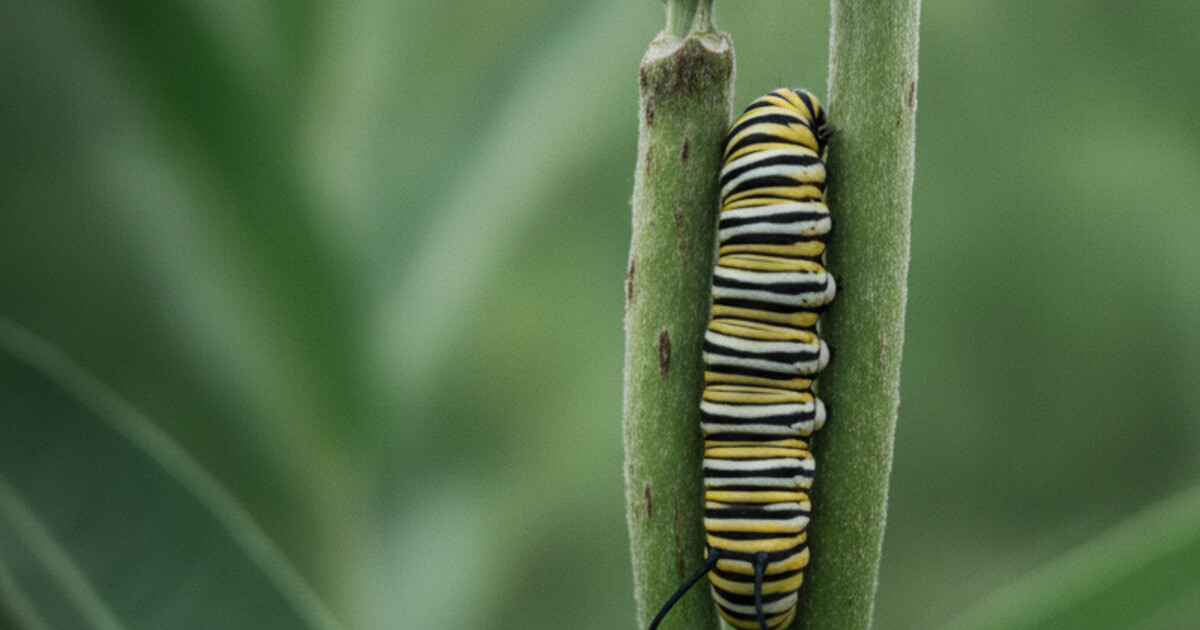
The monarch caterpillar (Danaus plexippus) is probably the one you’re picturing: smooth, chunky, and banded in repeating yellow, black, and white stripes that look almost painted on. It feeds exclusively on milkweed (Asclepias spp.), so if your caterpillar is on any other plant, it isn’t a monarch.
Full-grown larvae reach about 45-55 mm. A pair of black filaments protrudes from just behind the head, with a shorter pair at the tail end. These appendages are consistent field marks that distinguish monarchs from other striped caterpillars on milkweed.
The banding isn’t decorative. Monarch larvae absorb cardenolides, cardiac glycoside compounds, from milkweed. Those chemicals make the caterpillar genuinely toxic to most birds. A scrub jay that samples one once rarely tries again, and the vivid yellow and black pattern is the warning label.
Black Swallowtail Caterpillar
Black swallowtail caterpillars (Papilio polyxenes) look very different at different life stages. Young larvae are black with a white saddle patch and convincingly mimic a bird dropping. By the final instar the caterpillar has grown to about 45-55 mm and turned green, crossed with black bands that each carry a row of small yellow or orange spots.
Look for them on plants in the carrot family: parsley, dill, fennel, Queen Anne’s lace. If you’re seeing this caterpillar on your garden herbs, it’s almost certainly a black swallowtail.
When disturbed, these caterpillars can evert a soft, forked orange gland from behind the head called an osmeterium. It smells strongly of citrus. It’s a deterrent, not a stinger, and touching one won’t hurt you.
Fuzzy Black and Yellow Caterpillars
A hairy caterpillar with black and yellow coloring narrows the options significantly. Three species turn up regularly across North America.
Spotted Tussock Moth Caterpillar
The spotted tussock moth caterpillar (Lophocampa maculata) has a distinctive silhouette: a yellow-orange body capped with long, dense black pencil hairs at both ends. From a distance it looks like a yellow brush dipped in black ink at the tips. The central section is tufted with shorter, pale hairs.
It feeds on a wide range of deciduous trees, including oaks, maples, willows, birches, and alders. Its range runs from Alaska through the Pacific Northwest and across the northern states.
The black hairs at each end are barbed. Direct skin contact can cause mild irritation, a localized red patch. It’s not serious for most people, but handling with gloves or tongs removes the risk entirely.
American Dagger Moth Caterpillar
The American dagger moth caterpillar (Acronicta americana) is covered in dense, pale yellow-white hairs with 5 pencil-like black tufts projecting upward along the back and tail. The 5 black tufts are the identifying detail; no other common hairy caterpillar in eastern North America has quite that configuration. At full size it’s about 45-50 mm.
It’s widespread east of the Rockies and feeds on oaks, maples, elms, hickories, birches, and willows. You’ll often spot it lower on tree trunks in late summer when it’s descending to find a pupation site.
The long black pencil hairs break off easily and can embed in skin, producing a localized rash. Wear gloves or use a stick to move one. If you leave it alone, there’s no risk at all.
Cinnabar Moth Caterpillar
The cinnabar moth caterpillar (Tyria jacobaeae) has bold transverse bands in orange-yellow and black. The color reads closer to orange than pure yellow, but it’s vivid enough that people searching for black and yellow caterpillars regularly find it. At full size it’s about 25-30 mm, noticeably smaller than the species above.
This caterpillar was deliberately introduced to the US and Canada as a biological control for tansy ragwort, an invasive European weed toxic to horses and cattle. The caterpillar sequesters the plant’s pyrrolizidine alkaloids and becomes toxic to predators as a result.
If you find a small, boldly banded orange-and-black caterpillar on a yellow-flowered weed with feathery leaves, especially in Pacific Northwest fields and roadsides, cinnabar moth is the likely answer.
Are Black and Yellow Caterpillars Dangerous?
Texture matters more than color here.
Smooth caterpillars like the monarch and black swallowtail are safe to handle. Monarch cardenolides don’t transfer through skin in meaningful amounts. The toxicity is a problem for a bird that eats the whole caterpillar, not for someone who picks it up.
Hairy caterpillars are the ones to approach with care. Spotted tussock moth and American dagger moth caterpillars have barbed hairs that break off and can cause contact dermatitis, a red, itchy patch at the contact site. It’s not a medical emergency for most people, but wash your hands and avoid touching your eyes after handling any fuzzy caterpillar.
Cinnabar moth larvae are fine to handle briefly. The pyrrolizidine alkaloids they carry are a problem if ingested, not absorbed through skin.
If the caterpillar you found had stiff branching spines rather than soft hair, it belongs in a different group — spiky caterpillars covers the stinging species and how to tell a genuinely painful spine from a harmless bristle. For the pale, densely furry ones, see white fuzzy caterpillars. And if you’d rather just photograph it and get an answer, we compared the tools in best caterpillar identification apps.
For birds, the warning coloration operates at a different level. Scrub jays, chickadees, and many songbirds that forage in garden and meadow habitats have learned to skip over monarch caterpillars on milkweed entirely. If you’re curious which birds are sharing that patch of garden with the caterpillars, our guide to birds with red heads covers many of the species that frequent the same meadow and garden habitats.
What Do Black and Yellow Caterpillars Become?
The smooth species turn into some of the most recognizable insects in North America.
The monarch caterpillar pupates inside a jade-green chrysalis with a row of gold dots at the top edge. The adult monarch butterfly (Danaus plexippus) emerges orange and black, with white dots edging the wings. Eastern monarchs migrate up to 3,000 miles to overwintering sites in the oyamel fir forests of central Mexico.
The black swallowtail caterpillar forms a greenish or brown chrysalis and emerges as the black swallowtail butterfly (Papilio polyxenes): dark wings with rows of yellow spots along the margins, blue scaling across the hind wing, and an orange eyespot at the lower corner.
The fuzzy species produce considerably quieter adults. The spotted tussock moth caterpillar becomes the spotted tussock moth, cream-yellow with rows of brown and white spots, active at night. The American dagger moth caterpillar becomes the American dagger moth, a midsized gray moth with black dagger-like markings on the forewing.
Woodland edges where tussock and dagger moths lay eggs often host the same birds that hunt bark for other larvae. Our guide to black and white birds covers several of the species, including nuthatches, chickadees, and woodpeckers, that you’re likely to find in those same oaks and maples.
How Animal Identifier Can Help
Written descriptions of caterpillars only go so far. Color varies between individual larvae of the same species, and early and late instars of the same caterpillar can look almost unrelated. A photo takes most of the guesswork away.
Animal Identifier lets you photograph a caterpillar and get a species ID in seconds. The app covers insects across a wide taxonomic range, so it works on a monarch in a milkweed patch as well as an unexpected cinnabar moth larva on a roadside weed. After the identification, the built-in chat lets you ask follow-up questions: is it safe to handle, what does the adult look like, what does it eat.
It’s free to start, with 2 identifications a day at no charge. Download Animal Identifier for iOS or Android next time you find a caterpillar you can’t place.
Frequently Asked Questions
Is a black and yellow striped caterpillar poisonous?
Monarch caterpillars absorb milkweed toxins that make them unpalatable to birds, but brief skin contact is safe for people. Spotted tussock moth and American dagger moth caterpillars have barbed hairs that cause localized skin irritation. Cinnabar moth larvae carry alkaloids that are toxic if ingested but not dangerous to handle briefly. None of the common North American species pose a serious risk from ordinary handling.
What does a monarch caterpillar look like?
A mature monarch caterpillar is about 2 inches (45-55 mm) long, smooth, and banded in alternating yellow, black, and white transverse stripes. Two black filament-like appendages extend from just behind the head, with a shorter pair at the tail. You’ll only find it on milkweed; it feeds on nothing else.
Are fuzzy black and yellow caterpillars safe to touch?
Spotted tussock moth and American dagger moth caterpillars have stiff, barbed hairs that break off in skin and cause a localized rash in many people. Gloves or a stick to move them avoids the problem. Smooth black and yellow caterpillars, like the monarch and black swallowtail, don’t carry that risk.
How do I tell a black swallowtail caterpillar from a monarch?
A black swallowtail caterpillar is primarily green (not yellow) with black transverse bands and yellow or orange spots in each band. Look for it on carrot-family plants like parsley, dill, and fennel. A monarch caterpillar is yellow, black, and white banded, found only on milkweed, and has visible black filaments at both ends.
What month are black and yellow caterpillars most common?
Most species are most visible from July through September. Monarch caterpillars peak in August and September as the final generation prepares to migrate. Black swallowtail caterpillars appear from late spring through early fall, with multiple generations in the southern US. Tussock moth caterpillars are most common on deciduous tree foliage in late summer.