16 Black and White Birds and How to Tell Them Apart
You spotted a black and white bird at the feeder, watched it for about 8 seconds, and then it was gone. That’s usually all the time you get. Around 40 North American species wear some version of black and white plumage, and several of them look nearly identical until you know what to check.
Here’s the useful part: you can narrow it down quickly once you stop looking at color and start looking at size, where the white sits, and what the bird was doing.
Most black and white birds in North America fall into 4 groups: woodpeckers (checkered or barred backs), chickadees and nuthatches (solid black caps over white cheeks), juncos and phoebes (a dark hood above a clean white belly), and magpies (very long tail, bold white wing patches). Size and pattern placement separate them faster than color ever will.
Why Pattern Beats Color on a Black and White Bird
High-contrast plumage is common because it works. Sharp black and white edges break up a bird’s outline against dappled bark and bright sky, which makes it harder for a hawk to track in flight. That means the pattern itself carries more information than the colors do.
Start with 3 measurements, taken in this order. First, body length compared to a bird you already know: a house sparrow runs about 6 inches, an American robin about 10, an American crow about 17. Second, where the white sits, whether that’s on the back, the belly, the wing, or the face, because that placement stays consistent within a species even when individual birds vary. Third, posture and behavior, since woodpeckers and nuthatches cling to vertical trunks, chickadees hang upside down from thin twigs, and phoebes sit upright on open perches and flick their tails. Someone who logs those 3 things can usually reach a species without once mentioning the word black. Color tells you almost nothing here, because nearly every candidate shares it, and roughly 40 North American species carry some version of this plumage. Size alone eliminates most of them before you examine a single marking.
So work the checklist in that order. Size first, pattern second, behavior third.
Small Black and White Birds at the Feeder
Most sightings land here. These are the birds people describe as a small black and white bird, and there are 5 you’ll run into constantly.
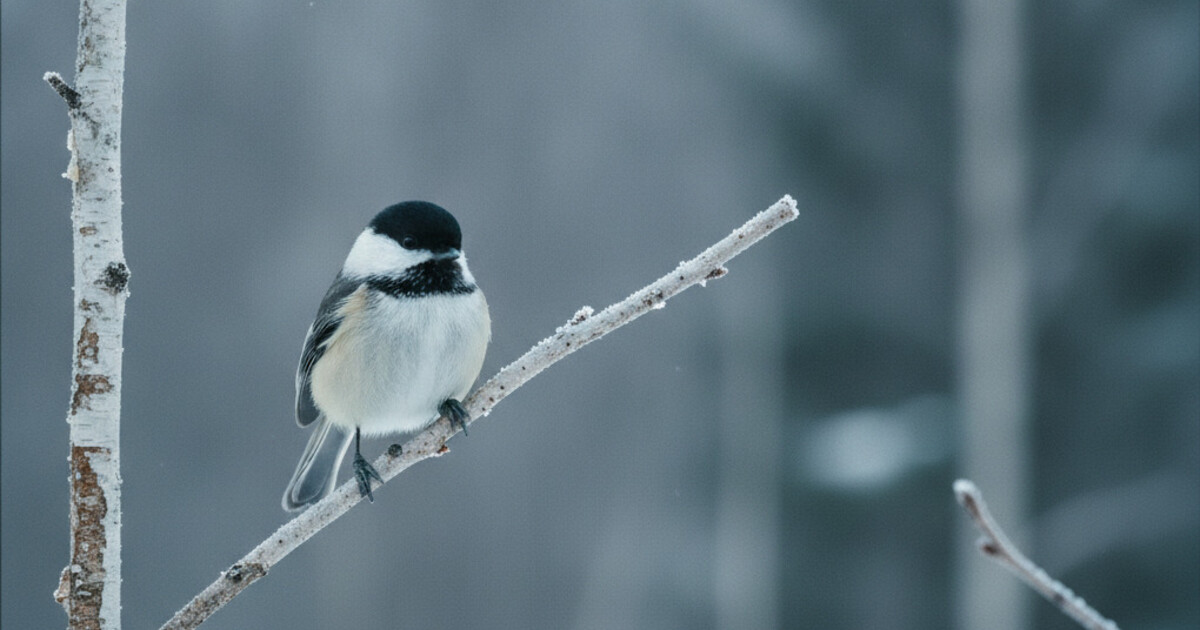
Black-capped Chickadee (about 5 inches). Solid black cap and black bib, bright white cheeks, soft gray back and wings. It’s the only common feeder bird with that clean white cheek patch stamped between a black cap and a black throat, and it rarely sits still.
White-breasted Nuthatch (about 5.5 inches). Black cap, blue-gray back, white face and underparts, with a slightly upturned bill. The giveaway is posture: nuthatches walk straight down tree trunks head-first, which no other backyard bird does.
Downy Woodpecker (about 6 inches). Checkered black and white wings, a white stripe down the center of the back, and a stubby bill. Males show a small red patch on the back of the head.
Black-and-white Warbler (about 5 inches). Streaked black and white over the entire body, including the crown, so it reads as striped rather than blocky. It creeps along trunks and branches like a nuthatch, which fools a lot of people.
Dark-eyed Junco (about 6 inches). Slate-dark hood and back with a crisp white belly, a pale pink bill, and white outer tail feathers that flash when it flies. Common on the ground under feeders in winter.
Downy vs Hairy Woodpecker: The Hardest Pair
These two are the classic mix-up, and plenty of experienced birders still pause on them. Both are black and white, both have a white back stripe, and males of both have a red nape patch.
Size is the first clue: a Downy is about 6 inches (sparrow-sized) while a Hairy is about 9 inches (close to a robin). Bill length is more reliable, because size is hard to judge on a lone bird. A Downy’s bill is clearly shorter than the width of its head, while a Hairy’s is nearly as long as its head is wide and looks almost too big for the bird.
Check the bill against the head, not the bird against your memory.
Black Birds With a White Belly
A dark bird with a bright white underside is a specific and much smaller group, which makes this one of the easier descriptions to solve.
Black Phoebe sits upright on a low perch near water, sooty black from head to chest with a sharply cut white belly, and pumps its tail steadily. It’s mostly a western and southwestern bird.
Tree Swallow looks dark blue-green above (often just reading as black) with clean white underparts, and it’s almost always seen in fast, swooping flight rather than perched.
Dark-eyed Junco turns up here too, since the hood-over-white-belly look matches this description closely.
Eastern Kingbird is larger, dark above and white below, with a distinctive white band across the tip of the tail.
Behavior sorts these out quickly. If it’s perched low and flicking its tail, look at phoebes. If it’s hawking insects in open air, look at swallows and kingbirds.
Black and White Birds With Red Markings
Adding a third color narrows things dramatically, and the position of the red is what matters.
Red on the chest: an adult male Rose-breasted Grosbeak has a black head and back, a white belly, and a triangular red patch across the breast that looks almost spilled. It’s about 8 inches with a heavy, pale, seed-cracking bill.
Red on the back of the head: male Downy and Hairy Woodpeckers both show a small red nape patch. Use the bill test above to tell the two apart.
Entirely red head: the Red-headed Woodpecker has a fully crimson head, a solid black back, and large white wing patches that show as bright blocks in flight. It’s unmistakable once seen, and much less common than the other two.
Red crest: the Pileated Woodpecker is crow-sized at roughly 17 inches, mostly black with white neck stripes and a flaming red crest.
Larger Black and White Birds
If the bird was clearly bigger than a robin, the list gets short.
Black-billed Magpie (about 19 inches, over half of that tail). Iridescent black with white shoulders and belly, and huge white wing flashes in flight. Western North America.
Common Loon in breeding plumage has a black head, a checkerboard back, and a banded white necklace. On water, not at feeders.
Pileated Woodpecker, described above, is the largest woodpecker most people will ever see.
Bufflehead and Common Goldeneye are small diving ducks whose males read as sharply black and white on the water at a distance.
Quick Comparison Table
| Bird | Size | Key field mark | Where it usually is |
|---|---|---|---|
| Black-capped Chickadee | 5 in | White cheek between black cap and bib | Hanging off twigs, feeders |
| White-breasted Nuthatch | 5.5 in | Walks down trunks head-first | Vertical tree trunks |
| Downy Woodpecker | 6 in | Bill shorter than head width | Trunks, suet feeders |
| Hairy Woodpecker | 9 in | Bill nearly as long as head width | Trunks, larger trees |
| Black-and-white Warbler | 5 in | Striped all over, including crown | Creeping along branches |
| Dark-eyed Junco | 6 in | White outer tail feathers flash | Ground under feeders |
| Rose-breasted Grosbeak | 8 in | Red triangle on white chest | Mid-canopy, feeders |
| Black-billed Magpie | 19 in | Very long tail, white wing patches | Open country, west |
How Animal Identifier Helps When the Bird Won’t Wait
Field marks are only useful if the bird holds still long enough for you to run through them, and often it doesn’t. That’s the gap a photo fills. If you managed to get any picture at all, even a mediocre one through a window, Animal Identifier will name the species from it and give you the habitat, diet, and behavior details that confirm whether the answer makes sense for your area.
The follow-up chat is the part that helps most with lookalikes. After an identification you can ask directly how to separate a Downy from a Hairy, or whether a Rose-breasted Grosbeak is expected in your region this month, and get an answer tied to the bird you just photographed. Every identification is saved to your history, so a bird you couldn’t name in January is still there when a similar one turns up in spring.
It covers mammals, reptiles, and insects too, so the same app handles whatever else you point it at. You get 2 free identifications a day on iOS and Android, without signing up.
Frequently Asked Questions
What is the most common black and white bird in North America?
The Black-capped Chickadee and the Downy Woodpecker are the two most widely reported. Chickadees turn up at feeders across most of the northern United States and Canada year-round, and Downy Woodpeckers have the broadest range of any North American woodpecker.
What small bird is black and white with a red head?
Most likely a male Downy or Hairy Woodpecker, both of which have a small red patch on the back of the head rather than a fully red head. If the entire head is red, it’s a Red-headed Woodpecker, which is a much less common sighting.
How do I tell a Black-and-white Warbler from a woodpecker?
Look at the streaking. A Black-and-white Warbler is striped over its whole body including the top of the head, and it has a thin, pointed warbler bill. Woodpeckers have a solid dark crown, blockier white patches, and a stout chisel-shaped bill.
Is a magpie the same as a crow?
No. Crows are entirely black and roughly 17 inches long. Black-billed Magpies are black and white with a tail longer than their body, and they’re limited mostly to western North America.
Why do so many birds have black and white plumage?
High contrast disrupts a bird’s outline against broken light, which makes it harder for predators to track. The pattern also carries signalling information between birds, which is why the placement of white patches stays so consistent within a species.
Next time one lands and leaves before you’ve worked through the checklist, take the photo first and sort it out afterwards. Animal Identifier will tell you which black and white bird you just saw, then answer the follow-up questions about how to recognize it next time.