Best Caterpillar Identification Apps in 2026
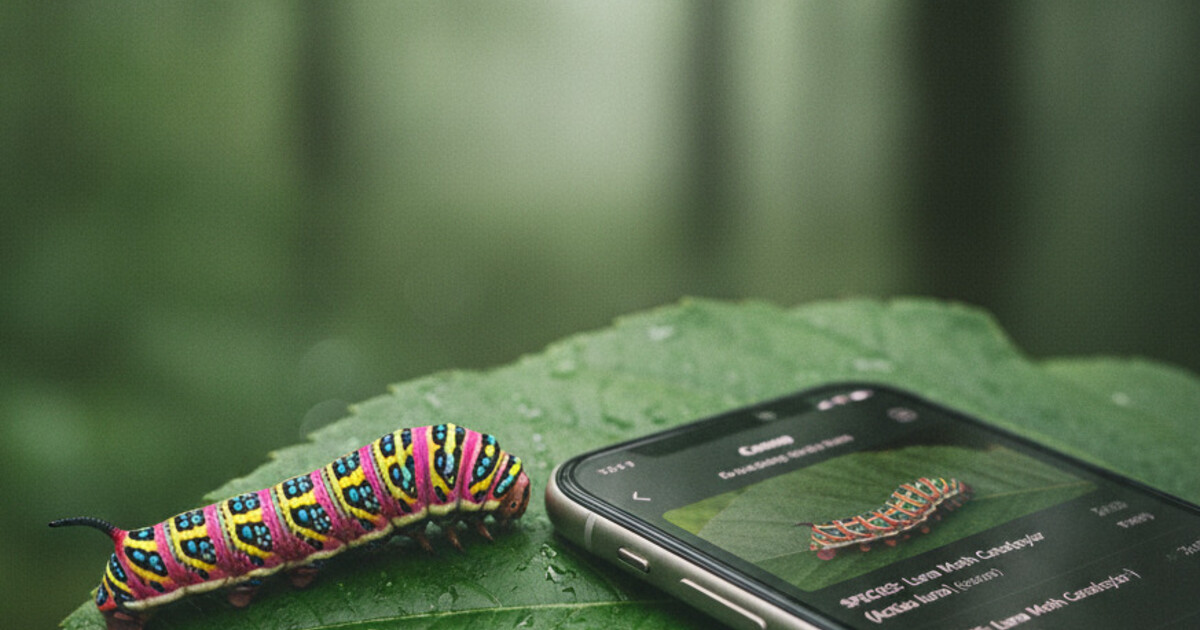
You’re out in the yard and there’s a caterpillar you’ve never seen before. Maybe it’s pale green with tiny white spines on your tomato plant. Maybe it’s crossing the driveway in September, fuzzy and rust-colored. Maybe something bright yellow with a red saddle is parked on your oak tree. Caterpillars show up constantly from late spring through early fall, and most are genuinely hard to name without help. North America has roughly 11,000 moth species and 725 butterfly species, and their larvae look nothing like the adults. Getting a caterpillar identification app on your phone is faster than any field guide and usually more accurate for the common species you’re likely to encounter.
The best caterpillar identification app for most people is Animal Identifier: take a photo, get the species in seconds, then use the built-in AI chat to ask follow-up questions about safety and host plants. For a completely free option with no daily limit, Seek by iNaturalist works well. Community verification on iNaturalist handles the species AI can’t confirm.
What Makes a Good Caterpillar ID App
Caterpillars are harder to identify from photos than most people expect. The same species can look completely different between its early and late instars. Most go through 4-5 stages, each with different coloring, markings, and body proportions. Yellow-and-black stripes appear on both the harmless Giant Swallowtail larva and the Spicebush Swallowtail, as well as several moth species. Lighting, angle, and photo blur all affect what an AI returns.
A good caterpillar ID app handles that ambiguity honestly. The best ones return the most likely species rather than forcing a single confident answer when the photo doesn’t support it. They give you enough context to narrow things down yourself: habitat, host plants, whether the species is commonly encountered in your region.
North America is home to roughly 11,000 moth species and 725 butterfly species, all of which pass through a larval caterpillar stage. Most go through 4-5 instars before pupating, and their appearance shifts significantly between each stage. The Monarch butterfly (Danaus plexippus) has distinctive yellow, black, and white banding that makes it one of the easier caterpillars to confirm from a photo. The Woollybear (Pyrrharctia isabella) is searched heavily each fall when it’s crossing roads ahead of winter. Harder cases include thousands of nondescript green geometrid moth larvae that often require a specimen and a specialist to separate. Photo-based AI apps typically return confident IDs for the 200-300 most commonly photographed species but drop off sharply for regional rarities. Submitting to iNaturalist’s community of 400,000+ active identifiers can resolve what AI can’t, though it takes hours to days rather than seconds.
Coverage breadth matters too. Some apps are trained primarily on adult beetles and common garden insects, with weaker data on larvae. Test an app with a few caterpillar photos before depending on it for the difficult ones.
The 5 Best Caterpillar Identification Apps in 2026
These five apps represent your best options right now, from free real-time ID to community-verified results. They’re ordered by what most readers will find most useful day to day.
1. Animal Identifier
Animal Identifier identifies caterpillars and other animals from a single photo using AI. Take a photo or upload one from your gallery and a species result comes back in seconds. Coverage is broad: mammals, birds, reptiles, and insects worldwide, including caterpillars and other larvae of all types.
The built-in AI chat is what separates it from simpler photo ID tools. After an identification, you can ask whether the caterpillar is safe to handle, what plant it feeds on, or what butterfly or moth it will become. The chat is scoped to animals so it stays focused on what you actually need to know. Past identifications save to your on-device history so you can look them up later without re-photographing.
Animal Identifier is available on iOS and Android, with 2 free identifications per day and no account required. Identifications run in the cloud, so you’ll need internet. It covers caterpillars as part of its broader insect coverage, which means the same app handles the moth that emerges from the cocoon a few weeks later. If you’re dealing with one of the most commonly searched caterpillar types, our black and yellow caterpillar guide covers the main species and the field marks that separate them.
Best for: Anyone who spots caterpillars regularly and wants to ask questions beyond the species name.
2. Seek by iNaturalist
Seek is the strongest free option with no daily limit. Built by the iNaturalist team, it uses their AI model and processes a live camera view. Point your phone at a caterpillar and it suggests a species as you frame the shot. No tapping required.
The trade-off is depth. You get a species name and a brief summary but no follow-up chat and no ID history. For a quick “what is this on my tomato plant” question, Seek is fast and completely free. For anything beyond the species name, you’ll need a different tool or a follow-up search on your own.
Seek is available on iOS and Android. It doesn’t require an account, and no observations are submitted without your permission.
Best for: Casual users who want free, instant ID with no daily limit.
3. iNaturalist
iNaturalist is the full platform behind Seek, with community verification on top. Upload a photo, submit it as an observation, and naturalists and entomologists in the community can confirm or correct the ID. With 400,000+ active identifiers and 170 million+ observations logged, difficult cases get resolved that AI alone can’t handle.
The trade-off is speed. A community response takes hours or days. For an unusual caterpillar that stumped the AI, a specialist confirming the ID is worth waiting for. iNaturalist is free, and your observation also contributes to biodiversity datasets that researchers actually use.
Best for: Unusual or regional species where AI confidence is low, or when you want a verified ID.
4. Picture Insect
Picture Insect is built specifically for insects, so its training data focuses on invertebrates rather than the full animal kingdom. It covers beetles, spiders, flies, caterpillars, and other insects. For common caterpillar species, that dedicated focus can sharpen results compared to broader wildlife apps.
The app is free with optional premium features. Results vary by species: common caterpillars return confident IDs while unusual or regional ones are less reliable. The interface is clean and walks you through species details including distribution and lifecycle.
Best for: Users who primarily identify insects and invertebrates and want a dedicated tool.
5. Google Lens
Google Lens is already on most Android devices and available inside the Google app on iOS. For caterpillar identification, it matches your photo against an image index that pulls from species databases and iNaturalist observations, often returning a workable result for the species people commonly search.
There’s no dedicated wildlife information built in. You’ll get a species match and links to sources but no habitat detail or safety notes without clicking through. For someone who doesn’t want to download another app, Lens handles common caterpillar questions reasonably well.
Best for: Quick reference when you don’t want to install a new app.
Free Caterpillar Identification Apps: What You Actually Get
“Free” means different things across these apps, and the difference matters once you’re standing in the garden with a caterpillar you’d rather not touch.
Seek by iNaturalist is free with no cap. There’s no account, no daily limit, and no paid tier pushing at you — the trade-off is that it wants a live camera feed and tends to go quiet on anything it can’t place, so you get silence rather than a best guess.
iNaturalist is also free, but it isn’t really an app that identifies your caterpillar. It’s a place to post the photo and wait for a person to identify it. Answers are often excellent and sometimes take days.
Animal Identifier gives you 2 free identifications a day with no signup, and every result comes with a follow-up chat — so you can ask “is this one safe to pick up?” or “how do I tell it from the lookalike?” without starting a new search. Needs an internet connection, since the identification runs in the cloud.
Picture Insect and Google Lens are free to try but hold the useful part back: Picture Insect pushes a subscription quickly, and Lens gives you visually similar images rather than a named species.
For a one-off caterpillar in the backyard, a free caterpillar identification app is genuinely enough. Where free stops being enough is volume — if you’re identifying a dozen larvae on a walk, a daily cap turns into the bottleneck.
How to Get a Better ID From Any App
The photo usually limits the result more than the app. A few adjustments improve accuracy across every tool on this list.
Fill the frame with the caterpillar. Get it as large as possible in the shot, and make sure the head capsule is sharp. Head shape, head color, and any facial spots or patterns are key ID features that disappear in wide or blurry shots. On a phone, tap the caterpillar on screen to lock focus before taking the photo.
Take multiple photos. A side view, a top-down view, and a close-up of the head give the AI much more to work with than a single image. If the caterpillar is moving, take several shots and use the sharpest one.
Note what plant it’s feeding on. Many caterpillars are host-plant specialists, so “large green caterpillar on a tulip poplar” is a much narrower ID problem than “large green caterpillar.” That context alone rules out dozens of possibilities. If an app returns low confidence, try a different angle before assuming the species isn’t in the database.
Seasonal timing helps too. Caterpillar season runs roughly July through September for most North American species, with some appearing in spring. Knowing the month and your region narrows the field considerably when you’re browsing results. For detailed help on identifying the species you’re most likely to find in the Midwest, our Michigan caterpillar guide walks through 9 common species with the field marks to check at each instar stage.
Some caterpillars are genuinely hard to separate from photos. Early-instar monarchs look almost nothing like late-instar ones. Many noctuid moth larvae are essentially identical in the field. An honest app tells you when the photo can’t support a confident ID. For those cases, iNaturalist’s community of identifiers is the right next step.
Frequently Asked Questions
What is the best free caterpillar identification app?
Seek by iNaturalist is the strongest free option with no daily limit. Point your camera at a caterpillar and it suggests a species in real time, no account needed. Animal Identifier gives 2 free IDs per day and adds a follow-up AI chat for questions beyond the species name, like whether it’s safe to handle or what it will eventually become.
Can you identify a caterpillar from a photo?
Yes, for most commonly photographed species. Photo-based AI apps return confident results for caterpillars like the Monarch, Woollybear, and Tomato Hornworm. Unusual regional species and early-instar larvae are harder to confirm. A clear, close-up photo of the head and body gives any caterpillar identification app its best chance of returning the right result.
Is it safe to touch a caterpillar you can’t identify?
Most caterpillars are harmless to handle, but some have urticating hairs that cause skin irritation or rash. The Io Moth larva, Saddleback Caterpillar, and Puss Caterpillar are among the ones to avoid in North America. Get the ID first, then decide whether to touch it. Our guides to spiky caterpillars and white fuzzy caterpillars cover which spines and hairs actually sting.
Do these apps work on larvae found indoors?
Usually, but indoor larvae are a different identification problem — they’re almost always pantry or clothes moths rather than garden species, and the useful question is what they’re eating rather than which butterfly they’ll become. Moth larvae identification walks through that case directly.
Why can’t my app identify this caterpillar?
The most common reasons: the photo is blurry or taken from too far away, the caterpillar is in an early instar stage that looks very different from later stages in the training data, or the species is regional and underrepresented in the app’s database. Try a closer photo from a different angle. If the app still can’t confirm, iNaturalist’s community of identifiers usually can.
Animal Identifier is free to download on iOS and Android. You get 2 identifications per day at no cost, no account needed. Open it the next time something unfamiliar crawls past you in the yard.