Moth Larvae Identification: What's Eating Your Clothes or Food
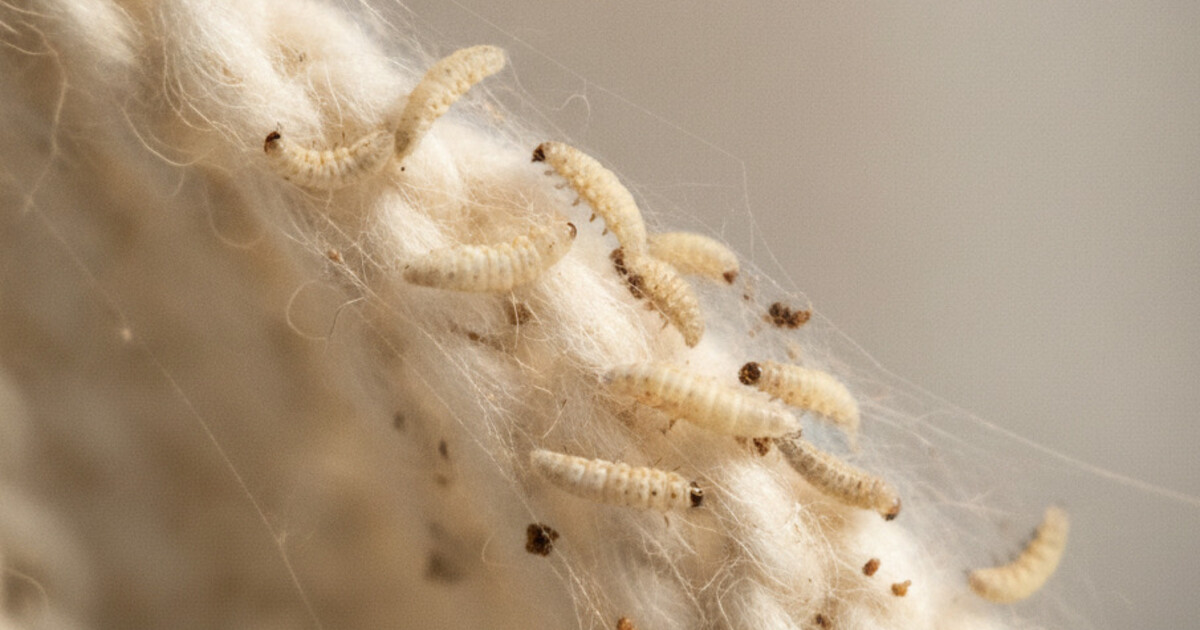
You pull a winter sweater from storage and find small holes surrounded by a silky, papery residue. Or you open a bag of oats and find the top layer matted in fine webbing. Both are moth larvae, but different species with different feeding habits and different fixes. The damage tells part of the story. The larvae themselves, if you can find them, tell the rest. Moth larvae identification comes down to four things: size, color, what they’re eating, and whether they spin a silk mat, a portable case, or loose webbing threaded through food. This guide covers the species most likely behind the damage in your home or garden, with enough detail to narrow down the culprit from what you’re seeing.
Moth larvae are soft-bodied caterpillars ranging from 4 to 20mm long. Clothes moth larvae are cream-white with a dark head and feed inside wool or silk fibers, spinning a silk tunnel over the damage. Pantry moth larvae, most commonly the Indian meal moth, are whitish to pinkish and leave silk webbing matted through grain, nuts, or dried fruit. Location and webbing pattern are the fastest ID clues.
What Moth Larvae Look Like
All moth larvae share the same basic body plan: a soft, segmented body with a darker head capsule, six jointed legs near the head, and fleshy prolegs further back. Indoor species tend toward pale, muted colors. Outdoor species, which feed on trees and garden plants, are usually larger and more boldly marked.
The two moth families responsible for most household damage belong to Tineidae (clothes moths) and Pyralidae (pantry moths). Tineidae larvae, including the webbing clothes moth (Tineola bisselliella) and case-bearing clothes moth (Tinea pellionella), are 4–10mm at full size, cream-white with a tan to honey-brown head capsule. They feed on keratin, the protein in wool, silk, feathers, and leather; they don’t touch plain cotton or synthetics. Pyralid pantry moths are larger: Indian meal moth larvae (Plodia interpunctella) reach 12–13mm, Mediterranean flour moth larvae (Ephestia kuehniella) reach 15–20mm. Both have a whitish body that shifts toward pink, green, or gray depending on the food consumed. The clearest distinguishing trait between families is silk production: clothes moth larvae spin concealed tunnels or portable cases pressed into fabric; pantry moth larvae leave loose, mat-like webbing threaded through infested food. Outdoor moth larvae, such as spongy moth (Lymantria dispar dispar), grow larger still, reaching 60mm, and typically have distinctive coloring or hair patterns absent from indoor species.
Color alone won’t always close the ID. A clothes moth larva and a flour moth larva are both pale and worm-like. What separates them is their location and what they’ve built around themselves. Find the silk structure and the food source, and the family becomes clear even before you measure the larva.
Clothes Moth Larvae Identification
Two species account for nearly all fabric damage in US homes.
Webbing clothes moth (Tineola bisselliella) is the more common of the two. Larvae are 4–8mm at full size, cream-white with a honey-yellow head. They don’t build a portable case; instead, they spin a flat silk mat or tunnel directly into the fabric surface and feed underneath it. The silk looks like a pale, gauzy crust pressed flat against the material, and small fecal pellets collect nearby. These larvae avoid light and prefer undisturbed spots: deep inside folded sweaters, along inner seams, and in storage boxes that haven’t been opened in months. If a garment you wear regularly has holes, webbing clothes moth is unlikely; they seek out the forgotten corner of a closet.
Case-bearing clothes moth (Tinea pellionella) larvae are slightly larger, up to 10mm, with a tan head and cream body. The giveaway is the portable silk case they carry, a small open-ended tube built from chewed fibers and fecal pellets that blends into the fabric color. As the larva grows, it extends the case from one end. You can sometimes spot them moving slowly across a dark fabric surface, dragging the case behind them.
Both species share the same food preferences: wool, cashmere, alpaca, silk, fur, feathers, and leather. They’ll also attack cotton or synthetic blends if those items are stained with sweat, body oils, or food residue; the organic matter draws them, not the fiber itself. For a look at the adult moths these larvae eventually become, see our house moth identification guide.
Pantry Moth Larvae Identification
Pantry moths belong to a separate family (Pyralidae), and their larvae share one clear trait: silk webbing in food. If you open a bag of birdseed, oats, or dried pasta and find the top layer matted together in a sticky web, you’re almost certainly looking at Indian meal moth larvae.
Indian meal moth (Plodia interpunctella) is the most common pantry moth in the US. Larvae are 12–13mm at full size, whitish to slightly pinkish or greenish depending on their diet. The head and thoracic shield are dark brown, which stands out clearly against the pale body. They spin silk as they move through food, leaving a dense mat on the surface layer that clumps grain, dried fruit, and nuts together. When ready to pupate, they crawl out of the food entirely, often ending up in a ceiling corner or along a wall joint away from the infested container. Finding the pupal cocoon there is another sign the infestation is Indian meal moth.
Two related species show up less often in US homes:
- Mediterranean flour moth (Ephestia kuehniella): pinkish-white, 15–20mm. Primarily a flour mill pest but turns up in home flour, especially whole-grain types stored for months.
- Tobacco moth (Ephestia elutella): brownish-gray to pinkish, 10–14mm. Targets a wide range of dry goods including chocolate, dried herbs, nuts, grain, and stored tobacco.
All three leave webbing. Pantry beetles, the other common stored-food pest, don’t produce silk at all. That single difference separates the two groups faster than any color comparison.
Outdoor Moth Larvae: Garden and Tree Species
Several moth species feed on trees and garden crops, and their larvae look nothing like the pale indoor types. If you’re finding caterpillars on foliage rather than in fabric or food, you’re likely dealing with one of these.
Spongy moth (Lymantria dispar dispar), renamed from “gypsy moth” in 2022, is the most ecologically significant moth pest in the northeastern US. Young larvae hatch at roughly 2mm; by their final instar they reach 50–60mm. The field mark is a double row of colored dots running down the back: 5 pairs of blue dots on the thoracic segments, followed by 6 pairs of red dots on the abdominal segments. No other common caterpillar in North America carries that exact pattern. They feed on more than 300 tree species but favor oaks. Older larvae are conspicuously hairy and can irritate sensitive skin on contact.
Fall webworm (Hyphantria cunea) larvae are 25–35mm, pale yellowish-green with a dark dorsal stripe and long white or grayish hairs. They build silk tents at the tips of branches, which separates them from eastern tent caterpillar, which builds tents at branch crotches. Active from late summer into fall, fall webworm looks alarming but rarely causes serious harm to a healthy tree.
Codling moth (Cydia pomonella) is what you find inside a wormy apple. Larvae are 12–18mm, creamy white with a pinkish flush and a brown head, tunneling directly toward the core. A related species does the same to walnuts. For caterpillars with spines or bristles of any color, see our guide to spiky caterpillars for a closer look at which species to handle with care.
How Animal Identifier Helps
A clear photo solves most moth larva questions faster than a field guide. Open Animal Identifier, place the larva on a plain white surface, and photograph it from directly overhead and from one side. The app returns the species with habitat notes and behavior details. The follow-up chat lets you ask “how do I tell it from X?” to compare against lookalikes when the first result doesn’t quite match.
The app covers the full range: indoor fabric pests, pantry species, and outdoor caterpillars including spongy moth and fall webworm. Two free identifications per day, no account needed. A sharp, well-lit image gets you to species; even a softer photo narrows things to family. White paper as a background gives the best contrast for pale larvae.
Animal Identifier identifies animals from photos. Photograph the larva itself, not just the surrounding damage, to get the most accurate result.
Frequently Asked Questions
Are moth larvae the same as caterpillars?
Yes. Every moth and butterfly larva is a caterpillar; Lepidoptera larvae are all caterpillars by definition. People tend to reserve “caterpillar” for colorful, hairy outdoor species and “moth larvae” for pale indoor ones, but both terms describe the same life stage. The visual differences come from different families and life histories, not a fundamentally different type of creature.
Can moth larvae sting or bite?
Indoor species like clothes moths and pantry moths can’t sting, bite, or cause skin reactions. Some large outdoor species, including spongy moth caterpillars in later instars, have tiny barbed hairs that irritate sensitive skin on contact. The pale, worm-like larvae found in fabric or food pose no physical risk to humans.
What’s the fastest way to tell clothes moths from pantry moths?
Where you found the damage. Clothes moth larvae feed inside fabric, including wool, cashmere, silk, and feathers, and leave silk tunnels pressed into the fiber. Pantry moth larvae feed inside stored dry goods and leave loose silk webbing matting the food surface together. Clothes moth larvae are also smaller (4–8mm versus 12–13mm for Indian meal moth) and have a lighter, more uniform head color.
How long do moth larvae live before they pupate?
Temperature controls the timeline. Indian meal moth larvae take 14 days to 2 months depending on temperature and food quality. Clothes moth larvae take 2 to 6 months in typical room conditions, and up to 2 years in cooler storage environments. Eggs are harder to spot than larvae, so an infestation often seems to appear suddenly after a long, quiet buildup.
Do moth larvae only eat wool and food?
Clothes moth larvae eat keratin-based materials: wool, silk, cashmere, fur, feathers, and leather. Pantry moth larvae eat dry, starchy or fatty plant material including grain, seeds, dried fruit, nuts, chocolate, and pet food. Neither type goes after plain cotton or synthetics. If you’re finding damage in polyester or acrylic, carpet beetle larvae are the more likely culprit; they don’t produce silk but chew fiber the same way.
If you spotted a moth larva and want a quick ID, Animal Identifier can help. Photograph it on a plain white surface and the app returns the species with behavior and habitat notes. Download free on iOS or Android.
Related reading: Moth Larva: What They Look Like and How to Identify Them