Caterpillars in Ohio: Identification and Poisonous Species
Ohio’s mix of Lake Erie lowlands, Appalachian foothills, and central farmland supports a wider caterpillar roster than most people realize. You’ll find monarchs working through garden milkweed in Cleveland suburbs, woolly bears crossing county roads near Chillicothe each October, and spicebush swallowtail caterpillars tucked in sassafras thickets along the Hocking River. Most are harmless. A handful will sting if you pick them up. This guide covers 9 caterpillars in Ohio you’re most likely to find, with the stinging species clearly marked so you know which ones to leave alone.
Common caterpillars in Ohio include the monarch on milkweed, the woolly bear crossing roads in fall, and the eastern tent caterpillar building silken webs in cherry and apple trees each spring. Two species sting on contact: the saddleback caterpillar and the IO moth caterpillar. Both carry venomous spines that cause burning, swelling, and hives.
Common Caterpillars in Ohio to Know
Ohio is home to more than 130 native butterfly species and roughly 2,000 moth species, placing it among the richer Lepidoptera states in the Midwest. Peak caterpillar activity comes in two windows: April through June when overwintered eggs hatch, and August through October when late-season broods fatten before winter. Ohio’s geography splits the species roster along roughly north-south and east-west lines. The Appalachian foothills of eastern Ohio, including Hocking Hills and Cuyahoga Valley, hold more woodland species like the spicebush swallowtail and forest tent caterpillar. Lake Erie’s thermal influence pushes first-emergence dates 7 to 10 days earlier along the northern shoreline than in Columbus or Dayton. The Woolly Bear Festival in Vermilion, Ohio, held each October since 1973, draws roughly 100,000 visitors and has made the woolly bear the state’s most recognizable caterpillar. In outbreak years, eastern tent caterpillar colonies appear in roadside cherry trees as early as the first week of April.
1. Monarch Caterpillar (Danaus plexippus)
Bold black, white, and yellow rings circling the whole body, with two black tentacles at each end. About 2 to 2.5 inches long at full size. Found only on milkweed plants (Asclepias species), which is the fastest way to confirm the ID. If the caterpillar is on milkweed, you’re almost certainly looking at a monarch.
Present statewide from May through September. Ohio sits on the eastern migration flyway, so milkweed corridors in the central and northern part of the state see the heaviest traffic. The chemicals in milkweed make monarchs toxic to most predators, which is why the bold coloring functions as a warning. Gardeners who plant common or swamp milkweed find them regularly.
2. Woolly Bear Caterpillar (Pyrrharctia isabella)
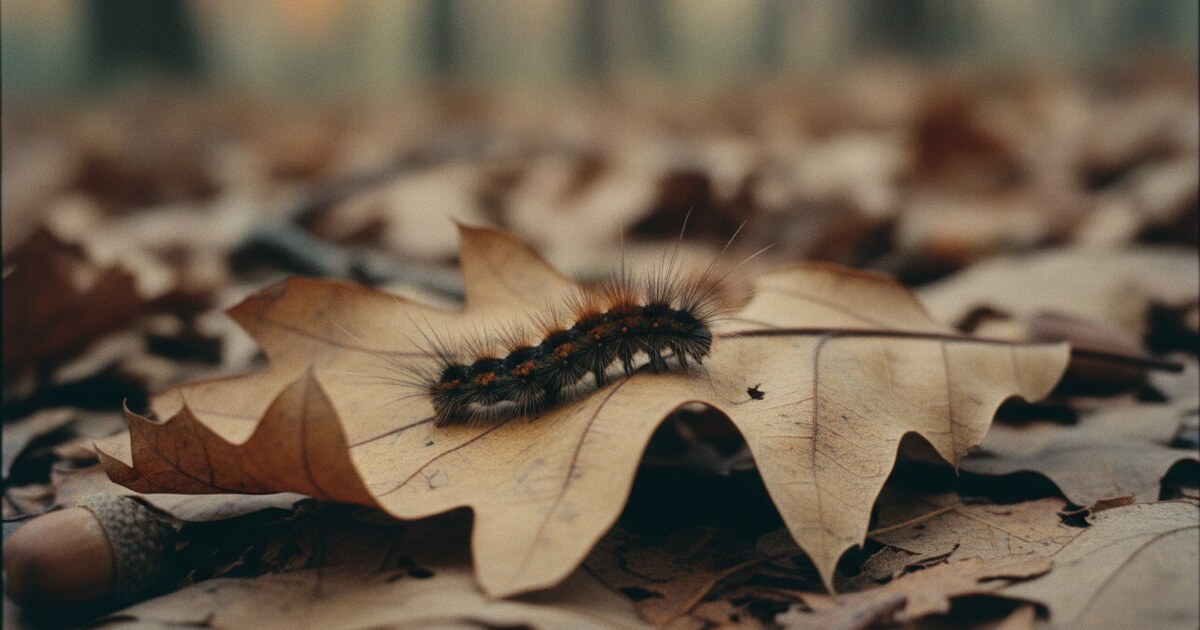
Fuzzy with a rusty-brown middle band and black at both ends. About 2 inches long. The hairs don’t sting, though they can irritate sensitive skin if you handle one. Best known for crossing roads and trails in September and October, searching for somewhere sheltered to overwinter under bark or leaf litter.
The folk tale linking the width of the brown band to winter severity has no scientific support. Band width varies by age and food availability, not by forecast. It turns into the Isabella tiger moth in spring. Found statewide, with peak road-crossing in October.
3. Eastern Tent Caterpillar (Malacosoma americanum)
Hairy and blackish with a white stripe down the back, blue spots along the sides, and a row of oval yellow marks. Young caterpillars build communal silken tents in the forks of wild cherry, apple, and crabapple tree branches, starting in early April. They feed during the day and return to the tent at night.
By late May most disperse as solitary wanderers, which is when you typically find them on sidewalks and fences. Heavy infestations can strip trees bare, but established trees push out new leaves within a few weeks. One of the most recognizable spring caterpillars in Ohio and common statewide.
4. Spicebush Swallowtail Caterpillar (Papilio troilus)
Plump and green with two large false eyespots on the thorax: yellow with a blue center and a dark pupil. The eyespots make it look like a small snake peering back at you, which is exactly the point. Early instars are dark brown with a white saddle mark, mimicking bird droppings.
The caterpillar rolls a leaf over itself and hides inside during the day, which means you find them by looking for curled leaves rather than exposed caterpillars. Found almost exclusively on spicebush and sassafras in woodland edges, creek-side thickets, and the Appalachian foothills of southeastern Ohio. Doesn’t sting.
5. Black Swallowtail Caterpillar (Papilio polyxenes)
Bright green with black bands, each band dotted with yellow spots. Disturb one and it extends an orange forked organ (the osmeterium) from behind the head and releases a sharp, pungent smell. Very effective at convincing you to back off.
Found on plants in the carrot family: parsley, fennel, dill, Queen Anne’s lace, and wild carrot. If you found it in your herb garden or along a weedy roadside with carrot-family plants nearby, this is almost certainly what you have. Common across Ohio from May through September. Doesn’t sting.
6. Forest Tent Caterpillar (Malacosoma disstria)
Often confused with the eastern tent caterpillar, but separated by one clear detail: the forest tent caterpillar doesn’t build a tent. Despite the name, it feeds in the open. Look for a chain of white keystone-shaped or footprint-shaped spots running down the center of a blue-gray, hairy body.
Feeds on oaks, aspens, and maples in Ohio’s eastern forests. In outbreak years, which cycle roughly every 10 to 15 years, colonies can defoliate large stretches of woodland. Individual outbreaks typically last 2 to 3 years before parasite and predator populations bring them down. Doesn’t sting.
7. Tomato Hornworm (Manduca quinquemaculata)
Large (up to 4 inches), bright green with diagonal white stripes along the sides and a stiff dark horn at the rear. The horn looks threatening but causes no harm. Very common in Ohio vegetable gardens from June through September on tomatoes, peppers, eggplants, and potatoes.
Sometimes you’ll find hornworms covered in small white cocoons attached to the outside of the body. Those are braconid wasp eggs. Leave those caterpillars alone: the wasps will kill the hornworm and parasitize more hornworms in the same garden next season.
Stinging Caterpillars in Ohio
Two caterpillars in Ohio deliver a venomous sting on contact. Neither is life-threatening to healthy adults, but both cause significant burning, swelling, and hives that can last several hours. The identifying rule: branching, tree-like spines on a caterpillar almost always mean it stings.
For a broader look at spiny species across North America, see Spiky Caterpillars: How to Identify and Avoid Stings.
8. Saddleback Caterpillar (Acharia stimulea)
One of the easiest caterpillars to recognize anywhere: dark brown at both ends with a bright green midsection, and a brown oval “saddle” outlined in white sitting squarely in the center. Four knob-like protrusions at the corners of the green section carry the stinging spines. The saddle marking works as a warning, and it works.
Touching the spines causes immediate burning, a raised welt, and a rash that can last several hours. Found on oaks, maples, cherries, elms, and many garden plants. Present throughout Ohio from July through September. The saddleback delivers one of the most painful stings of any caterpillar in the eastern US, comparable in intensity to a bee sting on heavy contact.
9. IO Moth Caterpillar (Automeris io)
Lime green with a white stripe outlined in reddish-brown along each side. The venomous spines are the same lime green as the body, which makes them easy to miss against foliage. Touching the spines causes immediate burning, swelling, and hives lasting several hours.
Young IO moth caterpillars are bright orange and cluster together in groups: those clusters are easier to spot. By the final instar they’ve shifted to the lime-green form that causes the sting. Found on oaks, maples, willows, and other hardwoods throughout Ohio. Active from July through September. A plump lime-green caterpillar with bristly tufts on hardwood leaves in summer deserves caution until you’ve confirmed the ID.
How to Identify Caterpillars in Ohio by Photo
For most caterpillars in Ohio, four clues narrow it down fast:
- Color and pattern: solid, striped, banded, or spotted
- Texture: smooth skin, hairy or fuzzy, or spiny
- Host plant: what plant was it on? Monarch on milkweed. Black swallowtail on parsley or fennel. Tomato hornworm on tomatoes. Host plant alone closes most IDs.
- Season: spring tent caterpillars (April through May), summer stingers and hornworms (July through September), fall woolly bears (September through October)
If those four clues leave you with multiple options, a photo does the rest. Animal Identifier lets you photograph the caterpillar and returns the species name in seconds. After the ID you can ask follow-up questions in the same session: “does it sting?” or “what does it turn into?” without leaving the app. It covers insects including caterpillars statewide, so it works whether you’re in the Hocking Hills, a Lake Erie-side garden, or a Columbus backyard.
For more on the state caterpillar series, see Caterpillar Identification in Michigan and white fuzzy caterpillar identification for the tussock and flannel moth species that also appear across Ohio. For the black-and-yellow species common in midwestern gardens, black and yellow caterpillars covers the full roster.
Frequently Asked Questions
Are there poisonous caterpillars in Ohio?
Two Ohio caterpillars sting on contact: the saddleback caterpillar (dark brown ends with a green midsection and venomous spine knobs) and the IO moth caterpillar (lime green with branching venomous spines the same color as its body). Neither is dangerous to healthy adults, but both cause burning, swelling, and hives lasting several hours. If stung, remove embedded spines with tape, wash the area with soap and water, and apply ice. See a doctor if you have a known allergy to insect venom.
What is the fuzzy caterpillar I keep seeing in fall in Ohio?
Almost certainly a woolly bear (Pyrrharctia isabella): fuzzy with a rusty-brown middle band and black at both ends. Woolly bears are most visible September through October when they cross roads searching for a winter shelter under bark or leaf litter. The hairs don’t sting, though they can irritate sensitive skin. The folk claim that the brown band’s width predicts winter severity has no scientific support.
What builds those white silken tents in Ohio trees each spring?
Eastern tent caterpillars (Malacosoma americanum) build communal silk tents in the branch forks of wild cherry, apple, and crabapple trees starting in early April. The caterpillars leave the tent to feed during the day and return at night. The forest tent caterpillar is a common Ohio species but doesn’t build a tent despite the name. It feeds in the open and has a chain of white keystone-shaped spots down its back instead.
When are caterpillars most active in Ohio?
Ohio has two peak windows. The first runs April through June, when spring-hatching broods feed on fresh foliage. The second runs August through October, when late-season broods fatten before winter. The northern Lake Erie shoreline sees activity start 7 to 10 days earlier than Columbus or Dayton. Stinging caterpillars (saddleback and IO moth) are most common July through September. Woolly bears peak in October.
What caterpillar is eating my tomatoes in Ohio?
The tomato hornworm (Manduca quinquemaculata): large (up to 4 inches), bright green with diagonal white stripes and a stiff dark horn at the rear. Common in Ohio vegetable gardens from June through September. It doesn’t sting. If you find one covered in small white cocoons on the outside of its body, leave it: those are braconid wasp eggs, and the wasps will kill far more hornworms than hand-picking would remove.
If you find a caterpillar in Ohio you can’t place, photograph it and open Animal Identifier. Point the camera, snap the picture, and you’ll have the species and details in seconds. You can ask follow-up questions in the same session, whether you want to know if it stings or what it’ll turn into. Download it free on iOS or Android and start with 2 identifications a day at no charge.