Poisonous Caterpillars in Florida: Which Ones Sting and How to Identify Them
Florida runs warm enough year-round that caterpillars stay active long after they’ve disappeared from most of the country. You’re as likely to spot one in October as in June. The state records more than 155 caterpillar species, from the familiar monarch larva feeding on milkweed along roadsides to the puss caterpillar lurking in live oak canopies. Most are harmless. A handful aren’t. Identifying caterpillars in Florida gets easier once you know a few quick field marks: body covering (fuzzy, smooth, or spiny), color pattern, and what plant it’s feeding on. This guide covers the species you’re most likely to encounter, starting with the ones that sting.
Florida has more than 155 caterpillar species. The most common include the monarch, gulf fritillary, and eastern tent caterpillar, all harmless to touch. The stinging ones, mainly the puss caterpillar and saddleback caterpillar, are rarer but present statewide. Body covering (fuzzy, spiny, or smooth), color pattern, and host plant are the fastest identification clues.
How to Identify Caterpillars in Florida
Florida’s mild climate and geographic range, from the Panhandle’s oak-hickory forests to the subtropical Everglades, give the state one of the broadest caterpillar rosters in the Southeast. Most species are active from July through September, but Florida’s warmth keeps many going well into November.
Four clues sort most identifications quickly. Body covering (smooth, fuzzy, or spiny) cuts the list in half. Color pattern, whether solid, striped, or spotted, narrows it further. Host plant rules out most remaining lookalike pairs. Time of year helps with the rest, though Florida’s long seasons blur that signal compared to northern states.
Florida records more than 155 documented caterpillar species across its 67 counties, from Panhandle counties sharing fauna with Georgia and Alabama down to Monroe County’s subtropical tip, which hosts species found nowhere else in the continental United States. The University of Florida Institute of Food and Agricultural Sciences (UF/IFAS) identifies four major stinging caterpillars present statewide: the puss caterpillar (Megalopyge opercularis), the saddleback caterpillar (Acharia stimulea), the Io moth caterpillar (Automeris io), and the hag moth caterpillar (Phobetron pithecium). Of these, UF/IFAS designates the puss caterpillar the most venomous caterpillar in the United States. Its spine-laced hairs connect to venom glands; contact breaks them off and drives them into skin, causing localized pain that can persist for hours. Florida’s year-round warmth extends the active season for most species well past what northern states see, with peak caterpillar activity running July through September statewide.
Poisonous Caterpillars in Florida: The Four That Sting
Four stinging caterpillar species show up regularly across Florida. Knowing what they look like before you reach for one is worth a few minutes.
Puss caterpillar (Megalopyge opercularis) is the one to memorize first. Its compact, oval body is covered in soft-looking grayish-tan or rust-colored fur that makes it resemble a small tuft of cat hair. That fur hides hollow venomous spines beneath the surface. Touching it drives those spines into skin, delivering a sting that hits fast: sharp burning pain that can spread up the arm within minutes, sometimes leaving a grid-pattern welt where the spines made contact. Severe reactions, including nausea and difficulty breathing, are uncommon but documented. Look for it on live oaks, elms, and citrus trees, mostly from late summer into fall. Nudge it off a surface with a stick; don’t pick it up.
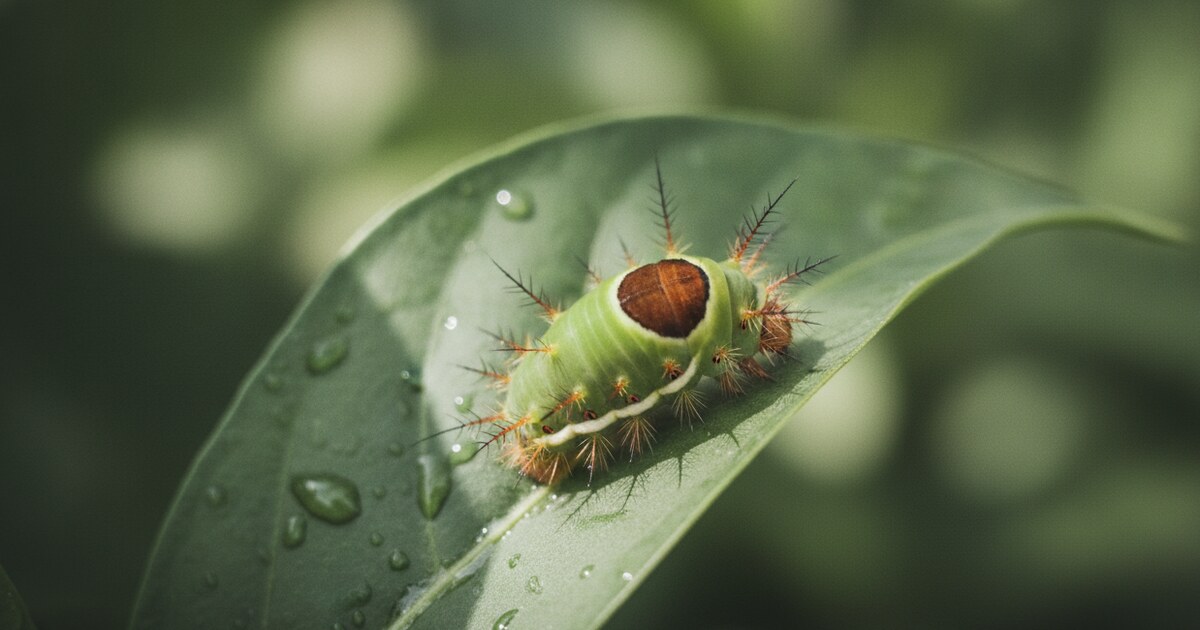
Saddleback caterpillar (Acharia stimulea) is unmistakable once you’ve seen it. Its back carries a bright green oval patch with a brown spot in the center, exactly like a saddle on a green blanket. Four clusters of fleshy spines protrude from its front, back, and sides. The caterpillar grows to about 1 inch long and feeds on a wide range of plants: corn, impatiens, palms, and ornamental hibiscus, so it turns up in gardens more often than you’d expect. UF/IFAS rates its venom second only to the puss caterpillar’s in severity, with pain lasting anywhere from one hour to several days.
Io moth caterpillar (Automeris io) is the one that fools people into reaching for it. Vivid lime green with a red-and-white stripe running along each side and clusters of pale green branching spines, it looks more decorative than dangerous. Contact causes immediate skin irritation similar to a bee sting, with localized redness and swelling lasting an hour or two. Young Io moth caterpillars feed in groups on the same branch before spreading out individually. They eat oak, corn, willow, and many ornamentals; mature caterpillars reach about 2.5 inches. For a broader look at spiny caterpillar species and how to tell them apart, see the spiky caterpillar identification guide.
Hag moth caterpillar (Phobetron pithecium), also called the monkey slug, has nine pairs of curved, hairy appendages that give it a genuinely scrambled appearance unlike anything else in Florida’s caterpillar roster. The hairs aren’t as venomous as the puss caterpillar’s but cause itching and mild burning on contact. You’ll find it on apple, dogwood, and various hardwoods across northern and central Florida. It’s less frequently encountered than the puss or saddleback but worth recognizing.
Non-Poisonous Florida Caterpillars You Can Safely Ignore
Most caterpillars you find in Florida are harmless. Several of the most striking-looking species won’t cause any skin reaction at all.
Monarch caterpillar (Danaus plexippus) is the benchmark for Florida identifications. Its plump, smooth body carries bold alternating bands of yellow, black, and white across every segment, and it feeds exclusively on milkweed. A banded yellow-black-white caterpillar on a milkweed plant is almost certainly this species. The coloring warns predators: monarchs absorb cardenolides from milkweed that make them unpalatable to birds. Mature caterpillars reach about 2 inches before forming a chrysalis. Florida’s warm winters support multiple monarch generations each year, so you can find them from spring through late fall.
Gulf fritillary caterpillar (Agraulis vanillae) is bright orange-red with rows of short, branching black spines along the body. Those spines look alarming but are completely soft and don’t sting. The species feeds exclusively on passionflower vines, both native and the ornamental varieties common in Florida gardens. Florida’s climate allows several generations per year. On a passionflower vine anywhere in the state, a spiny orange-red caterpillar is almost certainly a gulf fritillary. For comparisons with other yellow-and-black patterned species, see the yellow and black caterpillar guide.
Spicebush swallowtail caterpillar (Papilio troilus) goes through a dramatic change as it grows. Early instars are dark brown with cream markings, convincingly mimicking bird droppings. Final instars are vivid green with two large orange-and-black false eyespots near the head, designed to suggest a small snake when the caterpillar is tucked inside a rolled leaf. Completely harmless to touch. It feeds on spicebush, sassafras, and red bay wherever those plants grow across Florida.
Polyphemus moth caterpillar (Antheraea polyphemus) is the chunkier green caterpillar you’re likely to find on oak, maple, birch, and sweetgum across northern and central Florida. Ridged, bright green, and up to 3.5 inches long, it has small silver or red spots along each side. It’s often confused with the luna moth caterpillar, which is similar in color. The polyphemus has more pronounced ridges and silver spots; the luna is smoother with a pale lateral stripe and yellow spots at the base of each segment. Both are harmless.
Eastern tent caterpillar (Malacosoma americanum) shows up in spring in northern Florida, building silken tents in the crotches of wild cherry, apple, and crabapple branches. Colonies run 200 to 400 caterpillars and use the tent as a shared shelter, leaving to feed and returning at dawn and dusk. The caterpillars are dark with a white dorsal stripe and pale blue spots along the sides. Harmless to handle and gone by summer.
Identifying Florida Caterpillars by Color
Color is the fastest first filter, though host plant and body texture are needed to close most identifications.
Fuzzy or furry body: Puss caterpillar (grayish-tan or rust, dangerous), woolly bear (black ends with rusty mid-band, harmless; common in northern Florida in fall), and hickory tussock moth (white with black tufts and two long black hair pencils, mildly irritating). Handle any unfamiliar fuzzy caterpillar with gloves rather than bare hands.
Lime green with spines or stripes: Io moth caterpillar (branching green spines, red-white stripe, stings), saddleback (green saddle on brown body, stings), spicebush swallowtail (smooth green with false eyespots, harmless), polyphemus moth (ridged, silver spots, harmless). Spine presence and host plant separate the dangerous from the harmless.
Orange-red with spines: Gulf fritillary (soft black spines, on passionflower, harmless). On passionflower, this identification is almost certain.
Yellow, black, and white stripes on milkweed: Monarch caterpillar. The milkweed host plant makes this near-diagnostic.
Scrambled or alien appearance: Hag moth caterpillar (nine pairs of curved hairy appendages), found on hardwood foliage. Mildly irritating on contact.
How Animal Identifier Can Help
When you’ve got a caterpillar in front of you and the field marks aren’t adding up, a close-up photo is the fastest next step. Animal Identifier lets you photograph the caterpillar and returns a species identification in seconds, covering moths and butterflies across Florida and beyond.
After the ID, the app’s follow-up chat lets you ask specific questions: whether it stings, what butterfly or moth it becomes, or what plants it eats. The chat stays focused on animals and won’t go off-topic.
Animal Identifier is free to start, with 2 identifications per day and no account required. Available on iOS and Android. Photograph the caterpillar before you decide whether to touch it.
Frequently Asked Questions
What is the most dangerous caterpillar in Florida?
The puss caterpillar (Megalopyge opercularis) is the most venomous caterpillar in Florida and in the United States, according to UF/IFAS. Its soft, furry appearance is misleading: hidden spines beneath the fur connect to venom glands. Contact delivers sharp burning pain that can spread up the arm, sometimes leaving a grid-pattern welt. Severe reactions, including nausea and difficulty breathing, are rare but documented. Find it on live oaks, elms, and citrus trees.
What stinging caterpillars are found in Florida?
UF/IFAS identifies four stinging caterpillar species present statewide: the puss caterpillar (most venomous, furry tan appearance), the saddleback caterpillar (distinctive green saddle on a brown body), the Io moth caterpillar (lime green with branching spines and a red-white lateral stripe), and the hag moth caterpillar (scrambled hairy appendages, also called the monkey slug). All four cause skin reactions ranging from sharp burning pain to mild itching depending on species.
How do I identify a fuzzy caterpillar in Florida?
Color and tuft placement separate the main species. The puss caterpillar is uniformly covered in long grayish-tan or rust-colored hair with no visible structure underneath (dangerous). The woolly bear has a rusty brown mid-band between black fuzzy ends (harmless). The hickory tussock moth is white with black tufts and two long black hair pencils at each end (mildly irritating). For more fuzzy species with close-up field marks, see the white fuzzy caterpillar guide.
When are caterpillars most active in Florida?
Peak caterpillar activity in Florida runs July through September for most species, driven by the height of the growing season. Monarchs appear whenever milkweed is green, often through November in central and south Florida. Eastern tent caterpillars show up in spring, typically March through May in northern Florida. Gulf fritillaries are active nearly year-round in the southern half of the state, producing multiple generations from spring through late fall.
How does caterpillar identification in Florida compare to other states?
Florida has a longer active season and more species than most states, including subtropical species restricted to South Florida that aren’t found elsewhere in the continental US. The stinging caterpillar list overlaps with neighboring Georgia and Alabama but is broader than what you’d find in Michigan or Wisconsin, where the puss caterpillar is far less common. For a northern comparison, see the caterpillar identification Michigan guide.