Snake Poop: What Snake Droppings Look Like
Snake Poop: What Snake Droppings Look Like
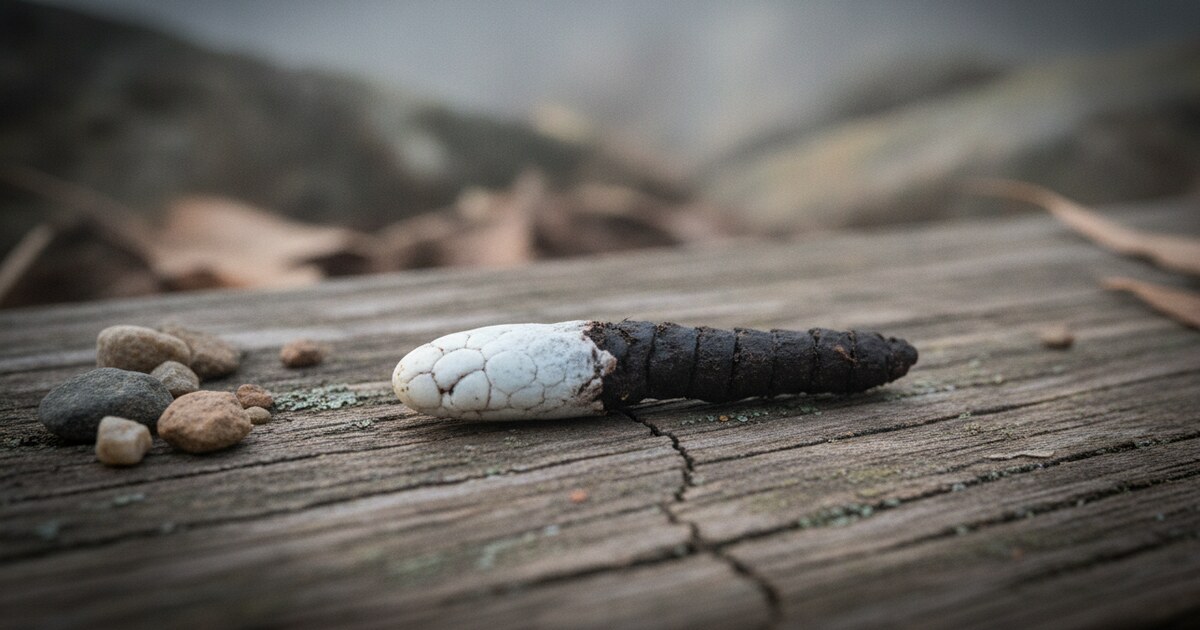
You found something in the garage, under the back deck, or along a crawl space wall. It’s dark, elongated, somewhat smeared, and has what looks like a white paste attached to one end. If a snake has been through, that white section is the giveaway. Snake poop looks different from every other animal’s waste in one specific way: it always comes with solid urine attached. People mistake it for rat droppings, lizard scat, or dried bird droppings constantly. Getting the ID right matters for understanding what’s sharing your space and for handling cleanup safely. This guide covers the exact field marks of snake droppings, how size varies by species, what that chalky white end actually is, and what to do after you find it.
Snake poop is a dark brown to black, elongated, cordlike mass with a chalky white urate cap. The white portion is the snake’s solid urine: snakes expel both waste types from a single opening called the cloaca. Fresh droppings may contain bones, fur, or scales from digested prey.
What Snake Poop Looks Like
The shape is the first thing that separates snake droppings from rodent droppings. Snake scat is twisted, cordlike, and often slightly smeared rather than a neat rounded pellet. It doesn’t hold a clean cylindrical form because the cloaca releases waste as a somewhat fluid mass rather than a compacted cylinder.
Color on the fecal portion is dark brown to nearly black. Fresh droppings have a slightly moist surface with a low sheen. Within a day they dry and dull, sometimes taking on a grayish cast. A dropping you find dried in an attic corner might look almost gray-brown overall, but the white cap remains visible.
Snake droppings are produced through the cloaca, a single posterior opening that handles all waste elimination in reptiles. The result is always two components in one deposit: a dark brown to black fecal mass and a white or yellow-white urate cap. Urates are the reptile equivalent of urine, but in solid or semi-solid form rather than liquid. A snake’s kidneys filter nitrogenous waste into uric acid instead of urea, which allows water to be reabsorbed before excretion. The urate portion appears as a chalky, paste-like or crystalline white section alongside or partially covering the dark fecal mass. This combined-deposit structure is found in all snakes and distinguishes their waste from every mammal, which passes urine and feces separately. Snake droppings also contain intact or semi-digested prey remains: bones, claws, scales, feathers, or fur depending on the diet. A snake that eats rodents leaves rodent hair and small bones pressed into the fecal portion.
Prey contents are a useful secondary clue. Rodent hair and tiny bones point to rat snakes, corn snakes, or kingsnakes. Visible feathers suggest a bird-eating species. Scales in the scat indicate a snake-eating species like a kingsnake or milk snake.
Snake Poop Size by Species
Size tracks the snake’s body size closely. A garter snake leaves thin droppings about 1/2 inch long and 1/4 inch wide. A corn snake deposits material closer to 1 to 2 inches long. A kingsnake runs 2 to 3 inches. A large constrictor like a boa produces droppings 4 to 8 inches long.
Most droppings found in US yards and structures come from garter snakes, rat snakes, corn snakes, or kingsnakes. That puts the typical range at 1 to 4 inches long and 1/4 to 1/2 inch in diameter.
Snakes don’t defecate as often as mammals. A wild snake eating once every one to two weeks might pass droppings once every week or two, depending on temperature and metabolism. You won’t find piles of snake scat the way you would with raccoon or squirrel activity. A single deposit, or at most a few spread out, is the typical find.
That infrequency is itself a clue. If you’re finding large quantities of droppings in a trail pattern, it’s almost certainly rodents.
Snake Poop vs. Rat Poop, Lizard Droppings, and Bird Droppings
Rat poop is the comparison that comes up first because both show up along walls and in enclosed spaces. Norway rat droppings are much smaller (3/4 inch maximum), pointed at one or both ends, and have no white urate cap at all. They’re also deposited in quantities of 40 to 50 per day, forming dense trails along baseboards and walls. A tight line of small, dark, pointed pellets means rats.
Lizard droppings are the closest look-alike. Lizards are reptiles too, so their scat also comes with a white urate section. The difference is size and form. Most house-visiting lizard species (geckos, skinks, anoles) leave droppings under 1/2 inch long — significantly smaller than even a garter snake’s. Lizard scat also tends to form a distinct small dark pellet with a clearly separated white tip, rather than an elongated smeared mass.
Bird droppings are white-dominated with a dark center, the reverse ratio of snake poop. They’re also liquid-heavy and splatter outward rather than holding a cordlike shape.
For a side-by-side look at raccoon, deer, rabbit, squirrel, and other common wildlife scat, the animal poop identification chart covers size, shape, and location cues for more than a dozen North American species.
| Animal | Typical length | White urate cap | Shape |
|---|---|---|---|
| Garter snake | 1/2–1 in | Always present | Thin, twisted |
| Rat snake | 1–3 in | Always present | Elongated, often smeared |
| Norway rat | 1/2–3/4 in | Never | Pellet, tapered ends |
| Gecko / skink | Under 1/2 in | Present, separate | Tiny pellet + white tip |
| Bird | Variable | White-dominant | Splattered, liquid |
When the droppings you found are small pellets with no white cap, the comparison shifts to squirrel and rodent territory. The squirrel poop guide covers the blunt-barrel vs. pointed-end difference that separates squirrel from rat droppings.
For larger scat with a twisted shape and visible fur or seeds inside, that’s likely coyote or fox rather than snake. The coyote poop identification guide covers the fur-and-bone contents and the 3-to-5-inch size range that distinguishes predator scat.
Where You’ll Find Snake Droppings
Snakes shelter under objects and in tight spaces. Droppings turn up along garage walls, under stored firewood, beneath flat rocks, in crawl spaces, and along foundation edges. The deposit is usually a single dropping near where the snake rested, not a trail or growing pile.
In gardens and yards, look under debris, in gaps in stone walls, around compost bins, and at the base of dense shrubs. Snakes follow rodent activity: if mice or rats are active in an area, snakes work through the same spaces feeding on them.
US species are most active from spring through fall. Droppings in late summer and early fall often mean snakes have been hunting rodents before cooling temperatures push them toward overwintering sites. A finding in November or December in the northern US usually means the dropping has been sitting there since the warmer months.
Health Risks and Safe Cleanup
Salmonella is the primary concern. Snakes naturally carry Salmonella bacteria in their gut, and it passes into their droppings. Exposure happens through hand-to-mouth contact after touching contaminated surfaces or soil. The risk is manageable with standard precautions.
Cleanup steps:
- Gloves on before touching anything.
- Dampen the dropping with diluted bleach (1 part bleach to 9 parts water) before disturbing it. This reduces airborne particles and kills surface bacteria.
- Pick up with a paper towel or disposable cloth. Seal in a plastic bag and double-bag it.
- Wipe the surface again with bleach solution and let it air dry.
- Remove gloves carefully, then wash hands with soap and water for at least 20 seconds.
In crawl spaces or enclosed areas where droppings have dried out, use an N95 mask. Dried material produces dust when disturbed, and inhaling contaminated particles is a real, if less common, exposure route.
How Animal Identifier Can Help
Snake droppings confirm a snake has been in the area, but they can’t tell you the species. That matters when a venomous species is possible in your region. A cottonmouth and a harmless water snake leave similar scat. So do a rattlesnake and a nonvenomous rat snake.
When you spot the snake itself, photograph it. Animal Identifier returns the species from a single still photo in seconds, along with the range, habitat, and behavior details for that species. It covers reptiles worldwide, including the venomous and nonvenomous snakes of North America. You get 2 free identifications per day with no account required, on iOS and Android.
Frequently Asked Questions
What does snake poop look like?
Snake poop is a dark brown to black, twisted or cordlike mass with a chalky white urate cap attached to one end. Fresh droppings are slightly moist; they dry and dull within 24 hours. The white portion is the snake’s solid urine and is present in all snake species. Droppings often contain visible prey remains: hair, small bones, scales, or feathers depending on the snake’s diet.
What does snake-like stool look like?
The phrase usually refers to human or animal stool that is thin, elongated, and smooth, named for the resemblance to a snake’s body. Actual snake droppings are dark, twisted, and attached to a white urate section; they don’t look like neat smooth cylinders. The descriptor “snake-like” in a medical or dietary context is unrelated to actual snake scat.
How do you know if a snake is around?
Droppings near a wall or under stored items are one sign. Shed skin, left behind as a single intact piece near a shelter spot, is another. You might also find displaced mulch, a moved rock, or a gap in a foundation where the snake has been entering. Rodent activity in the same area often draws snakes. Fresh, moist droppings mean recent activity; dried and dull ones may have been sitting for weeks.
How do you identify snake poop vs. rat droppings?
Check for the white cap first: rat droppings have none. Rat droppings are also smaller (3/4 inch maximum for a Norway rat), tapered at the ends rather than smeared, and deposited in high-density trails along walls rather than as isolated single drops. Finding 20 or more small pointed pellets in a line along a baseboard means rats. A single elongated dark dropping with a white end is snake.
Is snake poop dangerous?
Snake droppings carry Salmonella, which snakes harbor naturally in their gut. The main exposure route is hand-to-mouth contact after touching contaminated soil or surfaces. Standard precautions handle the risk: gloves during cleanup, dampening before disturbing dried material, and thorough handwashing afterward. The concern is higher in crawl spaces and enclosed areas where children play or food is stored nearby.
When you spot the snake itself, Animal Identifier returns the species from a single photo in seconds. It covers reptiles, mammals, birds, and insects worldwide and gives you 2 free identifications a day with no account needed. Available on iOS and Android.