Small Black Birds: 10 Species You're Most Likely Seeing
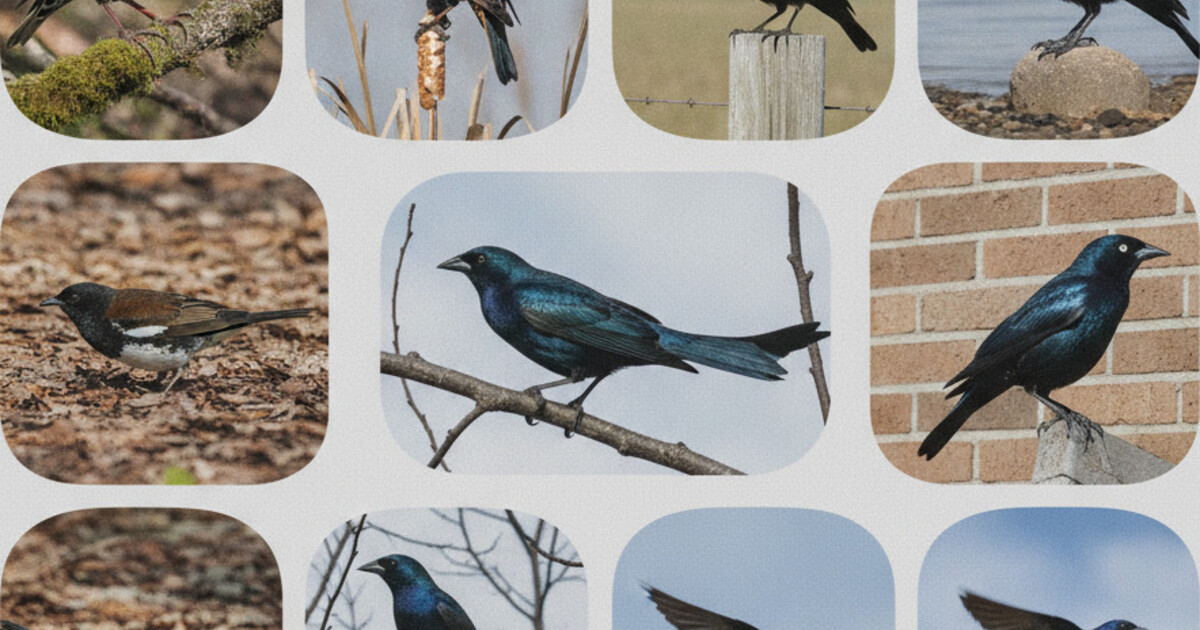
A small black bird lands at your feeder, then it’s gone before you get a good look. Black is one of the most common plumage colors in North American birds, and a half-dozen species show up in the same yard looking nearly identical at a glance. The differences come down to shoulder patches, tail shape, bill size, and eye color. Here are 10 small black birds you’re most likely to encounter, with the field marks that separate them.
Most small black birds in North America are European Starlings, Red-winged Blackbirds, or Common Grackles. To tell them apart, check the shoulder: Red-winged Blackbirds carry bright red-and-yellow epaulets, Starlings show a short tail and a yellow bill in summer, and Grackles have a long keel-shaped tail with a glossy blue-green head.
Small Black Birds at the Feeder
The five species below are the ones most people are naming when they search “small black bird.” All are common feeder visitors across much of North America.
The Red-winged Blackbird (Agelaius phoeniceus) is the most abundant landbird in North America, with an estimated 130 million individuals counted in Partners in Flight population surveys. It nests from Alaska to Central America, taking over wetland edges, roadside ditches, and cattail marshes in huge numbers. The European Starling (Sturnus vulgaris) arrived in New York’s Central Park in 1890, when the American Acclimatization Society released roughly 60 birds imported from Europe; that founding population expanded to about 200 million birds across the continent in a little over a century. Common Grackles are declining sharply: the North American Breeding Bird Survey records about a 50% population drop since 1970, and the IUCN now lists the species as Vulnerable. All three overlap broadly across eastern North America and travel in mixed flocks from late summer through winter, which is why “a small black bird at the feeder” so often turns out to be more than one species.
European Starling
The European Starling is usually the culprit behind “what’s that stocky black bird at my feeder?” In summer it’s glossy black with a yellow bill and faint purple-green iridescence. In fall and winter the whole bird gets covered in white spots, which throws a lot of people off because they assume they’re seeing a completely different species.
At 8.5 inches, Starlings are compact with a short triangular tail and a stout straight bill. Bill color alone gets you most of the way there: yellow in breeding season, dark gray in winter.
Red-winged Blackbird
The male Red-winged Blackbird is one of the easiest black birds to name once you get a clear view: jet-black body with bright red shoulder patches (epaulets) that flash a yellow border at the trailing edge. Females look completely different, streaky brown all over, and are often mistaken for a large sparrow.
Red-winged Blackbirds are marsh birds at heart, but they show up at feeders regularly, especially in mixed flocks with Starlings and Cowbirds. The red shoulder settles the ID in seconds.
Brown-headed Cowbird
The male Brown-headed Cowbird is the one small black bird with a brown head. It’s about 7.5 inches with a short, finch-like bill and a glossy black body. Cowbirds are brood parasites: they lay their eggs in other birds’ nests and let the host raise their chicks, a strategy recorded in more than 220 host species across North America.
At feeders, Cowbirds tend to walk along the ground under the seed rather than perching on the feeder itself. Brown head plus black body is all you need.
Brewer’s Blackbird
Brewer’s Blackbird looks similar to a Cowbird but is fully black with a pale yellow eye. The male shows purple iridescence on the head and green iridescence on the body in good light. It’s a western species, common in parking lots, lawns, and open parks from the Rockies to the Pacific coast.
The pale eye is the fastest way to split it from every other small black bird on this list. If you’re west of the Rockies and a small black bird is walking along the sidewalk beside you, Brewer’s Blackbird is the first guess.
Eastern Towhee
Male Eastern Towhees look solidly black from a distance, but they’re tri-colored up close: black hood and back, rufous-orange flanks, and a white belly. They spend most of their time scratching through leaf litter under feeders rather than perching on them, so you often hear the rustling before you see the bird.
The rufous sides rule out the all-black species once you’re close enough. From a distance the dark back reads as “another small black bird,” which is why Towhees are routinely undercounted in casual yard lists.
Small Black Birds in Fields and Wetlands
These three species prefer open landscapes and wetland edges rather than feeders, but they’re common enough that most people encounter them regularly.
Common Grackle
At 11-13 inches, Common Grackles are larger than most birds on this list, but people consistently describe them as small when they’re comparing to crows and ravens. The keel-shaped tail is diagnostic: in flight it fans into a distinctive ridge shape. The head shows blue-violet iridescence separate from the bronzy-green body.
Grackles travel in noisy mixed blackbird flocks and raid feeders in groups, scattering smaller birds. If a flock of long-tailed black birds lands and takes over your yard, you’ve got grackles. The tail shape is also explored in our guide to birds with long tails, which covers more species where tail length is the fastest field mark.
Rusty Blackbird
Rusty Blackbirds breed across boreal Canada and winter in the eastern US, where they favor flooded forests and swampy woodland edges rather than open feeders. In fall and winter they develop rusty-orange edging on the feathers, giving them a mottled look that fades to fairly uniform black by spring.
They’re not common at feeders, but they’re distinctive in the right habitat. A small black bird standing in a few inches of water in a flooded woodland in January is almost certainly a Rusty Blackbird.
Bobolink
The male Bobolink in breeding plumage is unlike any other North American bird: black below, with a creamy-yellow nape and white patches on the wings and back. That upside-down color pattern (pale on top, dark below) is an easy identifier in spring and early summer. Outside the breeding season, males look buffy and streaked, nearly unrecognizable as the same species.
Bobolinks show up in open meadows and hayfields during spring and fall migration, almost never at feeders. A small black bird in a grassy field with a pale cap is a breeding male Bobolink.
Small Black Birds Overhead
These two species don’t perch at feeders. You see them in the air, and their flight shape is the field mark.
Chimney Swift
Chimney Swifts fly constantly on narrow, swept-back wings with a rapid fluttering wingbeat. They’re sooty dark all over, about 5.25 inches, with a tiny rounded tail and almost no visible neck. The “cigar with wings” description has been used so often because it’s accurate.
Their numbers have dropped about 72% since 1970 according to the North American Breeding Bird Survey, mostly because old chimneys used for nesting are being capped and hollow trees removed. If swifts are spiraling down into a chimney at dusk, you’ve found a roost worth watching.
Purple Martin
The male Purple Martin is North America’s largest swallow, about 7.9 inches, with a blue-black body that reads as all-dark from below. Purple Martins are colony nesters: in the eastern US they depend entirely on nest boxes put up by people, eating insects caught in flight, usually high overhead.
If a group of large dark swallows is circling a martin house in your neighborhood, that’s Purple Martin. Females and immatures are gray-brown below, but the colony nesting habit and larger size compared to other swallows identify them regardless.
How to Tell Small Black Birds Apart
The fastest field marks to check, in order:
- Shoulder patch: Red-and-yellow epaulets mean Red-winged Blackbird, nothing else
- Head color: Brown head on a black body = Brown-headed Cowbird
- Eye color: Pale yellow eye = Brewer’s Blackbird
- Tail shape: Long keel-ridge = Grackle; short triangle = Starling; almost none = Chimney Swift
- Bill shape: Short and finch-like = Cowbird; straight and yellow in summer = Starling; long and slightly decurved = Grackle
- Body color at close range: Rufous flanks plus white belly = Eastern Towhee; white patches on back, black below = Bobolink
- Where you see it: In shallow flooded woods in winter = Rusty Blackbird; overhead in fast circles = Chimney Swift; around a colony nest box = Purple Martin
Once these patterns are sorted, most small black bird IDs take about five seconds in the field. The tricky situations come when a species is in non-breeding plumage: winter Starlings in white spots and fall Bobolinks both look nothing like their breeding selves.
For more on using color and markings to sort common look-alike situations, see our guides to birds with red heads and small brown birds.
How Animal Identifier Can Help
If you’ve got a photo and the field marks still aren’t clicking, Animal Identifier can close the gap. Point your camera, take a shot, and the app returns the species with information on habitat, diet, and range. After the ID you can ask a follow-up in the chat (“how do I tell it from a Brewer’s Blackbird?”) and get a direct answer without leaving the app.
Animal Identifier covers all 10 species on this list and a wide range of rarer visitors. It’s free to start: 2 identifications a day, no account required, available on iOS and Android.
Frequently Asked Questions
What is the most common small black bird in North America?
The Red-winged Blackbird holds that title with roughly 130 million individuals, per Partners in Flight population estimates. European Starlings are close behind at around 200 million, though they’re not native to the continent. At backyard feeders you’ll often see more Starlings than Red-winged Blackbirds, because Starlings have adapted thoroughly to suburban and urban yards.
What small black bird has a red spot on its wing?
That’s the male Red-winged Blackbird. The bright red shoulder patches, called epaulets, are visible when the bird is perched and flash dramatically in flight. The trailing edge often shows a yellow border. Females of the same species look completely different: streaky brown all over, often mistaken for a large sparrow.
Why do small black birds travel in huge flocks?
Most blackbird species flock together outside the breeding season, often mixing species in the same flock: Red-winged Blackbirds, Common Grackles, Brown-headed Cowbirds, and Rusty Blackbirds regularly travel together. Flocking gives individual birds protection from predators and helps the group find food across a wider area. Flocks can number in the thousands, which is part of why “small black bird” is such a common identification search.
Can tail shape help identify small black birds?
Yes, tail shape is one of the fastest field marks for black birds. Common Grackles have a long keel-shaped tail that fans into a ridge in flight. European Starlings have a short triangular tail. Red-winged Blackbirds have a rounded, medium-length tail. Chimney Swifts have almost no visible tail, which gives them their distinctive cigar shape overhead.