Birds With Long Tails: How to Tell Them Apart
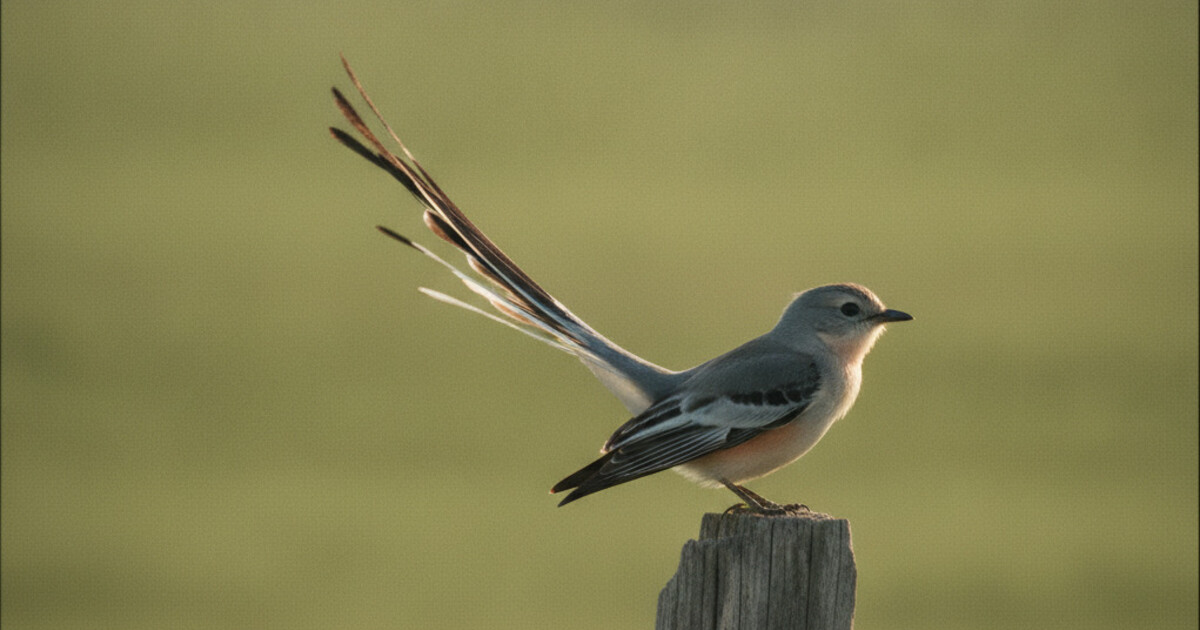
You spotted a bird with a tail that seemed almost too long for its body, and now you want a name. The tail is the main clue, but the type of long tail matters. A forked tail with ribbon-like streamers points you toward a different group than a long graduated tail held flat, or a keel-shaped tail that rises in a V when the bird displays.
North America has a solid collection of long-tailed birds spread across several families. Some show up in suburban backyards and along highway medians; others take a trip west or south to find. Tail shape, body size, and location do most of the separating work.
This guide covers 9 long-tailed species you’re most likely to encounter across the continental US.
Birds with long tails in North America include the Scissor-tailed Flycatcher, Black-billed Magpie, Ring-necked Pheasant, Great-tailed and Common Grackle, Barn Swallow, Northern Mockingbird, and Greater Roadrunner. Tail shape (forked, graduated, or keeled) plus body size and region narrow the ID quickly. In the eastern US, most sightings come down to grackles or the mockingbird.
Birds With Long Tails in North America
Several North American birds have tails that account for more than 40% of their total body length. The Scissor-tailed Flycatcher, Oklahoma’s state bird since 1951, measures 8.7 to 14.9 inches overall; male tail streamers reach 6 to 9 inches and grow longer with each successive molt. Black-billed Magpies average 17.7 to 23.6 inches in length, with the iridescent green-black tail making up roughly half. Male Ring-necked Pheasants, introduced from Asia to North America in the 1880s, carry tails averaging 20 to 35 inches, the longest of any common upland game bird on the continent. Great-tailed Grackles have pushed their range from central Texas north into Kansas and Iowa since the early 1900s; males reach 18 inches total, with the keel-shaped tail accounting for around 9 of those inches. Barn Swallows carry tail streamers of 0.8 to 2.6 inches, short in absolute terms but producing a forked silhouette found on no other North American swallow.
For identification purposes, it helps to sort birds with long tails into three tail types. Forked or streamer tails have a clear split at the tip, like a Barn Swallow’s or Scissor-tailed Flycatcher’s. Graduated tails taper to a point or are simply long relative to the body, as with the mockingbird and roadrunner. Keel-shaped tails are distinctive to grackles: the edges curl upward in a boat-hull shape during display.
Knowing which type you saw cuts the candidate list in half.
The Scissor-tailed Flycatcher
If the bird looked like it was trailing two ribbons behind it, and you’re in Texas, Oklahoma, Kansas, or anywhere along the central flyway in spring or fall, it’s almost certainly a Scissor-tailed Flycatcher.
Males carry elongated outer tail feathers that make up more than half the bird’s total length. In flight the tail splits open into a deep scissors shape; while perched, the feathers cross slightly over each other. Females have the same basic look but shorter streamers.
The body is pale gray-white above, washed salmon-pink on the belly and flanks. The wings carry a salmon-pink shoulder patch that becomes vivid when the bird raises them during display. It hunts insects from exposed perches: fence posts, utility wires, dead branch tips. Preferred habitat is open grassland and shrub-scrub, which describes most of the southern Great Plains.
Scissor-tailed Flycatchers arrive on their Texas breeding grounds by late March and push north through Oklahoma and Kansas through May. They’re one of the most reliably spotted long-tailed birds in the US for anyone driving through the central states in spring.
Black-billed Magpie
The Black-billed Magpie is the most visually striking corvid in North America. Its tail is iridescent green and blue-green, roughly as long as the black-and-white body above it.
Range is the first filter: magpies stay mostly west of the 100th meridian. If you spotted this bird east of Kansas City or south of the Texas Panhandle, check the Yellow-billed Magpie (central California only) or reconsider the ID.
Body pattern is unmistakable: white belly and wing patches, black head, back, and bill, and a long iridescent tail that shifts between green and bronze in changing light. Average total length runs about 20 inches, with roughly half of that accounted for by the tail.
Magpies are opportunists. They turn up along roadsides, ranches, suburban areas near open country, and streamside willows. Outside the breeding season they’re usually in loose flocks. A lone magpie is possible but uncommon.
For more on other black-and-white birds you might encounter at the same location, see the black and white birds guide.
Ring-necked Pheasant
Male Ring-necked Pheasants carry the longest tail of any common upland bird in North America: 20 to 35 inches, depending on age and condition. The tail is copper-bronze with dark barring, long and pointed, draped behind the bird in a slight arc when walking.
The body is a mosaic of rust, gold, and iridescent green, with a white neck ring (present on most but not all birds) and a bare red facial patch around the eye. Males are hard to misidentify. Females are mottled brown throughout but still show a noticeably long tail, around 10 to 14 inches.
Pheasants were introduced from Asia in the 1880s and now breed widely across the northern and central states. Kansas and South Dakota hold the largest populations. They spend most of their time on the ground in agricultural fields, brushy ditches, and tall grass edges. The loud, two-note crowing call of a male carries half a mile.
Grackles: Three Species With Keel-Shaped Tails
Three grackle species in North America carry noticeably long tails, all with the same keel shape during display. The tail curves up at the edges like the hull of a boat, most dramatically in larger males.
Great-tailed Grackle. The largest. Males reach 18 inches total, with the tail taking up around 9 of those inches. Found across the Southwest and increasingly in the Midwest, often in large noisy flocks around parking lots, suburbs, and farm fields. Females are brown and noticeably smaller.
Boat-tailed Grackle. Nearly as large as Great-tailed, but restricted to coastal areas from New England south through the Gulf Coast. Eye color helps: males east of the Mississippi usually have dark eyes; Gulf Coast birds often have yellow eyes.
Common Grackle. Smaller, at 11 to 13 inches, with a less dramatic tail. The most widespread of the three, found east of the Rockies from Canada to the Gulf. The keel shape is visible in males but less exaggerated, especially in females.
All three give a similar impression in flight: a large blackbird with a tail that fans out and curves upward at the edges. The Common Grackle is by far the most likely grackle at an eastern feeder.
Barn Swallow, Northern Mockingbird, and Greater Roadrunner
Three more species turn up regularly in “bird with a long tail” searches, each from a different family.
Barn Swallow. Total length 5.9 to 7.5 inches, but the forked tail with its long outer streamers is immediately recognizable. Males carry the deeper fork (streamers 0.8 to 2.6 inches). The rust-orange throat and steel-blue back separate it from all other swallows. Common in open country, farmland, and anywhere it can nest under a structure with a horizontal beam.
Northern Mockingbird. At 8.3 to 10 inches, the mockingbird’s tail makes up roughly 40 to 45% of its total length. It’s a plain gray bird, and the long white-edged tail is the most visible field mark, especially in flight when the white outer feathers flash. Common across the South, expanding north. Its mimicry covers 200 or more songs.
Greater Roadrunner. The only member of the cuckoo family most North Americans ever see: 20 to 24 inches total, with a tail close to 10 inches. It’s terrestrial. If the bird was running along the ground and had a long flat tail held horizontally, this is it. Range is the desert Southwest through Texas.
For more on small streaked songbirds in the mockingbird’s size range, see the small brown birds guide.
Identifying a Bird With a Long Tail in the Field
When you come across a bird with a long tail and want to narrow it down, start with these four checks:
Tail type. Forked (swallow, flycatcher), graduated or pointed (pheasant, mockingbird, roadrunner), or keeled (grackle, magpie)? Tail type alone rules out most options.
Body size. A pheasant is chicken-sized. A grackle is crow-sized but slimmer. A mockingbird is robin-sized. A barn swallow fits in your fist. Rough size cuts the field fast.
Color and pattern. Solid black body with a keeled tail: grackle. Black-and-white body with an iridescent long tail: magpie. Pale gray body with ribbon streamers: Scissor-tailed Flycatcher. Mottled copper-bronze body: pheasant.
Region and habitat. Magpies stay west of the Great Plains. Great-tailed Grackle concentrates in the Southwest and South. Scissor-tailed Flycatcher breeds on the Great Plains. Roadrunner stays in the desert Southwest and Texas.
A blurry photo still carries enough of these signals to make a confident ID in most cases.
How Animal Identifier Can Help
A photo of a bird with a long tail doesn’t always come out sharp. Birds move fast, lighting is often tricky, and many long-tailed species are backlit against open sky when you spot them.
Animal Identifier works from a single still photo: take a picture or upload one from your gallery, and it returns the species name along with habitat notes, behavior, and diet. It covers birds, mammals, reptiles, and insects, so you don’t need a separate app for each group you might spot on the same walk.
The follow-up chat is useful when the ID isn’t clear. If you get Great-tailed Grackle but aren’t sure whether it might be Boat-tailed, ask “how do I tell these two apart?” and it walks through the specific field marks, including range and eye color. Two identifications are free every day, no account required.
Try Animal Identifier on iOS or Android next time you spot a bird with a long tail you can’t name.
Frequently Asked Questions
What is the bird with the longest tail in North America?
The male Ring-necked Pheasant carries the longest tail of any common North American bird, averaging 20 to 35 inches. In pure spectacle, male Scissor-tailed Flycatchers get more attention because their ribbon-like streamers make up most of a 14-inch bird, but in absolute inches the pheasant wins easily.
What small bird has a very long tail?
The Barn Swallow is the most common small bird with a striking forked tail. The outer streamers in males run 0.8 to 2.6 inches, which sounds modest but creates the deep forked silhouette that makes swallows easy to identify in flight. The Northern Mockingbird is a small-to-medium bird with a proportionally long tail that flashes white outer feathers when it flies.
I saw a large black bird with a long tail. What is it?
In most of North America, a large black bird with a long tail is a grackle: Common Grackle (widespread east of the Rockies), Great-tailed Grackle (Southwest and South), or Boat-tailed Grackle (Atlantic and Gulf Coast). All three hold their tails in a keel shape when displaying. If the bird was in the West and had an iridescent green tail, it’s a Black-billed Magpie.
Do female birds with long tails look the same as males?
Mostly no. Male Ring-necked Pheasants have dramatic copper-and-gold plumage and tails up to 35 inches; females are mottled brown with tails around 12 inches. Male Scissor-tailed Flycatchers have much longer streamers than females. Male grackles are noticeably larger than females. The mockingbird and roadrunner are exceptions: both sexes look nearly identical.
What bird has a long tail and white wing flashes in flight?
The Northern Mockingbird flashes white outer tail feathers and white wing patches when it flies, which is often the most visible thing about the bird. The Scissor-tailed Flycatcher shows salmon-pink shoulder patches in flight. The Long-tailed Duck, a sea duck found on coastal waters and large inland lakes in winter, shows mostly white body feathers and a pointed tail.