Rabbit vs Hare: How to Tell Them Apart
You just watched something bolt across a field. Big ears, powerful back legs, serious speed. The rabbit vs hare question comes up constantly, but most people use the terms interchangeably without realizing they’re genuinely separate animals with different bodies, different habits, and very different young.
In North America, the mix-up has an extra layer: the jackrabbit sprinting across open desert or prairie belongs to the hare side of the family tree. Learning to tell them apart takes only a few field marks, and once you know them, the ID clicks instantly.
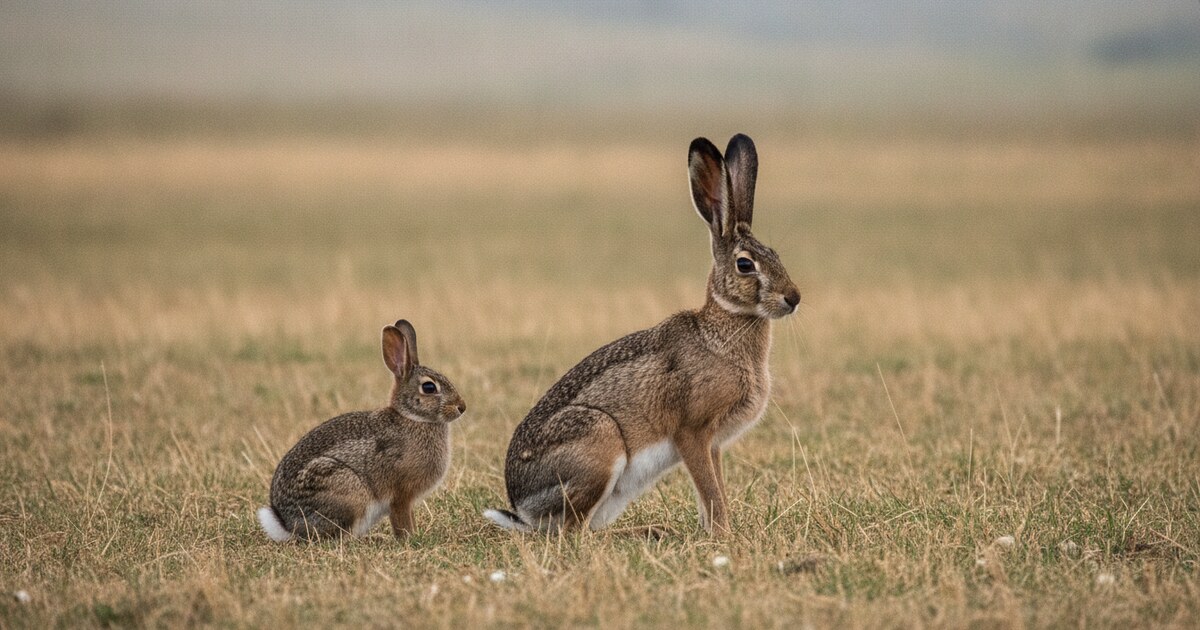
Hares are larger, with longer ears often tipped in black, longer legs that give them a noticeably high hindquarter profile, and no cotton-ball tail. Rabbits are smaller, with shorter rounded ears, and they flash a bright white tail when they run. In North America, cottontail rabbits are the most common backyard species; jackrabbits, despite the name, are hares.
Rabbit vs Hare: What to Look For at a Glance
The ears are your first clue. A jackrabbit’s ears can run 5 to 6 inches long, often with a black stripe along the outer edge. Cottontail rabbit ears top out around 2 to 3 inches, with no black markings at all.
Body size is the second check. An eastern cottontail weighs 2 to 4 pounds and runs about 15 to 19 inches from nose to rump. A black-tailed jackrabbit weighs 4 to 8 pounds and can stretch to 24 inches. When sitting still, hares have a crouched-forward posture because their hindquarters sit noticeably higher than their shoulders.
Rabbits and hares split into two distinct groups within the family Leporidae, though they look similar at a distance. The simplest field ID comes from four features: ear length, body size, leg proportion, and tail. Hares are larger, with longer ears (up to 6 inches in jackrabbits) often tipped in black.
Rabbits are smaller, with shorter rounded ears and a distinctive white cotton-ball tail that flashes when they bolt. In body size, cottontail rabbits run 2 to 4 pounds; jackrabbits (which are hares, despite the name) run 4 to 8 pounds. In speed, jackrabbits can hit 45 mph compared to a cottontail’s top speed of about 35 mph.
The hind legs are proportionally longer in hares: when a jackrabbit sits, its hindquarters sit visibly higher than its shoulders. The same leg proportion gives hares longer, bounding strides while rabbits make short, quick hops toward cover. Count on combining all four features for a confident ID, since young hares and adult rabbits can overlap in size.
The tail seals it. If a fleeing animal shows a bright white cotton-ball flash from behind, that’s a cottontail rabbit. Hares don’t carry that high-contrast flag.
Rabbits and Hares You’ll Actually See in North America
The eastern cottontail is the rabbit most US residents know. It lives in brush piles, overgrown edges, suburban yards, and forest margins across most of the eastern half of the country. Its brown-gray coloring, short ears, and white rump are the classic image most people picture when they hear the word “rabbit.”
The two main hares in the US are the black-tailed jackrabbit and the snowshoe hare. The jackrabbit occupies open deserts and grasslands from the Pacific Coast to the Great Plains: big, lanky, and built for flat ground. The snowshoe hare lives in northern forests, with oversized hind feet that keep it from sinking into deep snow and a coat that turns white in winter.
A third species trips up a lot of people: the white-tailed jackrabbit, found across the central and western US, is also a hare. Any animal with “jackrabbit” in the name belongs to the hare genus. The European hare was introduced to parts of North America (particularly Ontario and the Northeast) and is occasionally spotted, though it’s far less common than the native species.
Just as a coyote and a fox look similar at a distance but differ in ways that become obvious once you know the cues (see our guide to telling coyotes from foxes), rabbits and hares share a silhouette that rewards a closer look.
How Rabbits and Hares Raise Their Young
This is where the two animals differ most sharply, and it’s the most reliable way to confirm which you’re dealing with if you find young ones.
Rabbits dig or use existing burrows and build a lined nest inside. Females give birth after a 28 to 31 day gestation, and the babies, called kittens (or kits), arrive blind, hairless, and completely helpless. They depend on the mother for about three weeks before leaving the nest.
Hares don’t burrow. A female hare scrapes out a shallow depression in the grass called a form, which offers almost no shelter. After a 42 to 47 day gestation, the leverets arrive fully furred, eyes open, and able to hop within minutes.
Within a day, they scatter to separate spots and each one hides on its own. The mother returns only briefly to nurse them. The whole arrangement means leverets are essentially independent from day one.
If you’ve found a nest of hairless baby animals, they’re rabbits. If you’ve found a fully furred, open-eyed young animal sitting alone in the grass, it’s almost certainly a leveret. Picking either one up is usually a mistake: cottontail nests in a yard are intentional, and leverets on their own aren’t abandoned.
Gophers and groundhogs, like rabbits, are accomplished burrowers. If you’re trying to sort out another backyard excavation mystery, our guide to telling gophers from groundhogs covers the same ground.
Rabbit vs Hare: Speed, Defense, and Daily Habits
Hares are built for open ground where there’s nowhere to hide. A jackrabbit’s primary defense is speed: up to 45 mph in a straight sprint, with sharp direction changes that can outmaneuver a coyote. They’re mostly solitary and rely on staying still and blending in until the last possible second, then bursting away.
Rabbits use a different strategy. They live close to cover (brush, burrows, dense grass) and their first move when threatened is to get underground or under cover fast. They’re more social than hares; cottontails share territories and will thump the ground to warn others nearby.
Both are most active at dawn and dusk, feeding on grasses, forbs, bark, and buds. In winter, snowshoe hares take on the white coloration of their surroundings in one of the more dramatic seasonal changes of any North American mammal. Their population also cycles dramatically, roughly every 10 years, in a predator-prey relationship with the Canada lynx.
The chipmunk and squirrel are another pair of small mammals that constantly get confused (see our guide to telling chipmunks from squirrels). The rabbit and hare confusion follows the same pattern: related animals with an obvious shared silhouette, with the differences becoming clear once you know where to look.
How Animal Identifier Can Help
If you’ve spotted one of these animals and you’re not sure what species you’re looking at, a photo is the fastest way to get an answer. Animal Identifier uses AI to identify mammals, birds, reptiles, and insects from a single photo. Take a clear shot showing the animal’s ears, body, and face, and you’ll get the species along with details on its habitat, behavior, and diet.
The app covers cottontail rabbits, jackrabbits, snowshoe hares, and the European hare. After the identification, you can ask follow-up questions in the built-in chat: “Is this species common in my state?” or “What does a snowshoe hare eat in winter?”
You get 2 free identifications a day with no account required. Download Animal Identifier on the App Store or Google Play and next time something fast with long ears bolts across your path, you’ll know exactly what you’re looking at.
Frequently Asked Questions
Is a jackrabbit a rabbit or a hare?
Jackrabbits are hares. Despite the name, they belong to the genus Lepus (hares) rather than Sylvilagus (cottontail rabbits). They share all the hare characteristics: longer ears, longer legs, precocial young (leverets born furred and open-eyed), and no use of burrows. The same applies to white-tailed jackrabbits and antelope jackrabbits.
Is Bugs Bunny a rabbit or a hare?
Based on his long ears, long legs, and fast-running lifestyle, Bugs most closely resembles a hare. The original character design was loosely based on a jackrabbit. The “Bunny” in his name is just marketing; anatomically, he looks like a hare.
What is the lifespan of a hare compared to a rabbit?
Wild cottontail rabbits live about 1 to 3 years; most are taken by predators in their first year. Wild jackrabbits live about 1 to 4 years. Domestic rabbits (a fully domesticated species) regularly reach 8 to 12 years with proper care.
Can rabbits and hares mate?
No. Rabbits and hares have different chromosome counts (44 for European rabbits, 48 for European hares) and are genetically incompatible. They’ve been separate enough to diverge substantially over millions of years, and cross-breeding doesn’t happen.
What is a baby hare called?
A baby hare is called a leveret. Baby rabbits are called kittens (or kits). The practical difference: leverets are born fully furred with eyes open, so a furred young animal found sitting alone in the open is almost certainly a leveret rather than an abandoned rabbit kit.