Coyote vs Fox: How to Tell Them Apart at a Glance
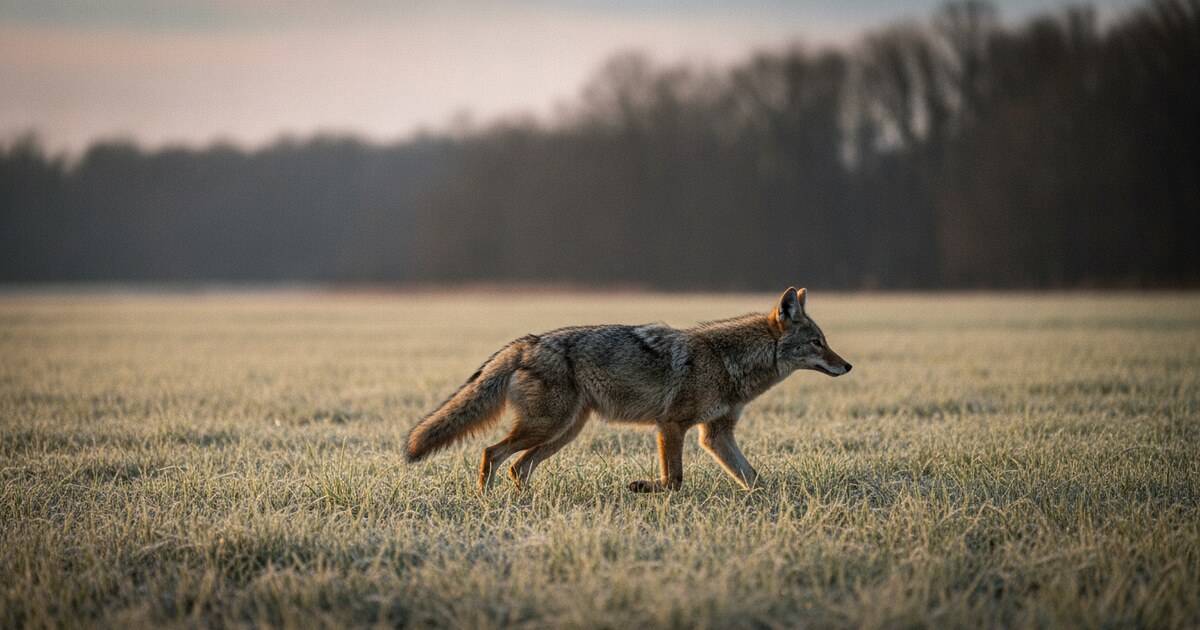
You spot a canid trotting across your backyard at dusk. Too big for a house cat, wrong shape for a dog, but is it a coyote or a fox? Both species live across much of North America, including suburban neighborhoods, parks, and farmland, and they look similar enough at a quick glance that people mix them up all the time.
A handful of field marks separate them reliably. Once you know what to look for, most sightings become easy to call.
The fastest way to separate a coyote from a fox is the tail. Coyotes carry their tails hanging low when they trot; foxes hold their bushy tail (called a brush) level or slightly raised. Coyotes are also much larger, typically three to four times heavier than a red fox, standing noticeably taller on longer, leaner legs.
If you got a photo of the animal, Animal Identifier can tell you which species it is in seconds. It covers coyotes and foxes, plus hundreds of other mammals. Two free scans a day, no sign-up needed.
Coyote vs Fox Size and Build
A coyote is a mid-sized canid, typically 20–50 pounds and 32–37 inches from shoulder to rump, with the tail adding another 11–16 inches. Shoulder height runs about 23–26 inches (knee-height on most adults). Red foxes weigh 7–15 pounds and stand 14–16 inches at the shoulder, closer to ankle-height. Gray foxes fall in a similar range, usually 7–13 pounds. When a coyote and a red fox stand side by side, the coyote can outweigh the fox by three to four times. That size gap usually settles things in good light at close range, but at a distance or in dim conditions the shapes blur enough that you need a second field mark. Both animals are slender and long-legged for their size, but the coyote has the build of a medium-sized running dog, rangy and loping. A fox looks lower to the ground, more compact, and almost delicate by comparison. The coyote’s legs are longer in proportion to its body, which gives its trot a distinctive, ground-eating quality.
That size difference alone rules out confusion in many sightings. When light is poor or the animal is moving fast, though, the tail and face become essential.
The Tail: One Look and You Know
A coyote’s tail hangs straight down or trails slightly back when the animal trots. It has a black tip, and the tail is thinner than you’d expect for an animal that size.
A fox carries its tail differently. The red fox holds its brush roughly level with its spine or slightly raised, and the tail has a distinctive white tip. The gray fox also holds its tail level or raised, but its tail tip is black, which can cause a brief moment of confusion if you catch only a rear view.
Watch a coyote for a few seconds and the low-hanging tail becomes unmistakable. Foxes look “plumed.” Coyotes look “tucked.” This one difference alone will correctly ID the animal most of the time.
Face, Ears, and Eyes
Both animals have large, pointed ears, but the face shape separates them quickly.
A coyote has an elongated, narrow muzzle that gives it a lean, alert expression. Its ears are large but proportional to its head, and they tend to angle slightly outward.
A fox has a shorter, sharper muzzle and ears that look enormous relative to its smaller skull. The fox face has a compact, almost triangular quality when you view it straight on.
There’s one more difference worth knowing: foxes have vertical slit pupils, the same cat-eye shape you see in domestic cats. Coyotes have round pupils. Up close or in a decent photograph, that pupil shape is a solid confirm.
Color and Markings
This is where a lot of people get tripped up, because the common species are quite different from each other.
Red fox: Bright orange-red body, black legs, white chest and belly, white tail tip. The coloring is vivid and distinctive. Some individuals show color variants (silver phase, cross fox), but the black legs and white tail tip usually stay constant.
Gray fox: Pepper-and-salt gray on the back and head, rusty-orange sides and neck, black tail tip. This one genuinely resembles a coyote from a distance, especially in fall and winter when both animals look grayer.
Coyote: Tan to grayish-brown on the back and sides, paler belly, often a darker stripe along the spine. No bright orange patches, no black legs.
If you see a vivid orange-red canid in your yard, it’s almost certainly a red fox. If it’s gray-brown with no orange, lean toward coyote. If there’s rust on the sides but gray on the back, that’s the gray fox.
Coyote and Fox Tracks
Both species move in what trackers call a direct-register trot: the back foot lands where the front foot was, leaving a nearly straight line of prints. That similarity can make track ID tricky, but size and texture help.
Coyote tracks are oval, about 2.25–2.5 inches long, with four toes and visible claw marks. The stride is long and loping, prints spaced farther apart than you’d expect.
Fox tracks are smaller, about 1.75–2 inches for a red fox. Red fox prints often have a “fuzzy” edge because the fox has dense hair between its foot pads, which fills in the negative space of the print. The stride is shorter and tighter. Gray fox tracks are even smaller, similar in size to a large house cat’s.
If the prints are roughly quarter-sized and clean with crisp outlines, that’s a coyote. Smaller, fuzzier prints in a tight, almost perfectly straight line point to a red fox. If you’re following a coyote’s trail, also check the coyote droppings you might find along the route. For fox sign, the fox scat guide has the full ID breakdown.
Where You’re Most Likely to See Each
Both species have adapted to suburban and semi-urban environments, but they tend to use the habitat slightly differently.
Coyotes prefer open ground: golf courses, agricultural edges, highway corridors, and park meadows. They’re usually out at dawn and dusk and tend to move in a straight-line trot across open areas. They’ve habituated to people in many urban areas and may hold their ground longer than you’d expect.
Red foxes favor woodland edges, overgrown lots, and areas with dense brush for cover and denning. They move with a quick, bouncy trot and tend to stick to cover.
Gray foxes live in denser wooded habitat and are the only North American canid that can climb trees. If you spot a canid resting on a low branch or scrambling up a trunk, that settles it immediately.
How Animal Identifier Helps With a Quick Sighting
When the animal moves fast or the light isn’t great, all these field marks go out the window. That’s when a photo is worth more than any guide.
Animal Identifier uses AI to identify mammals, birds, reptiles, and insects from a single photo. Take a clear shot of the animal and you’ll get the species in seconds, along with details on its habitat, diet, and behavior. You can follow up in chat with questions like “how do I tell it from a gray fox?” or “is this species active during the day?” The app answers animal-related questions and keeps a history of everything you’ve identified.
It covers coyotes, red foxes, gray foxes, and hundreds of other mammal species worldwide. Two free identifications a day, no account required.
A quick note on what it doesn’t do: the app works from still photos and needs a data connection. It identifies the animal from a photo, not from tracks or droppings. If you’re chasing a blurry backyard glimpse, the field marks above are still your best starting point.
Download Animal Identifier on iOS or Android to identify what you’re seeing in real time.
Frequently Asked Questions
Is that a coyote or fox in my yard?
Look at the tail first. A coyote holds it low, almost trailing behind when it trots. A fox holds its bushy tail level or raised. If the animal is roughly knee-height, gray-brown, and moving with a long loping stride, it’s likely a coyote. If it’s smaller, more orange or gray with rust-orange sides, and moving with a quick dainty trot, it’s a fox. When in doubt, a photo and Animal Identifier will settle it.
Do coyotes and foxes live in the same areas?
Yes. Their ranges overlap across most of North America, including suburbs and cities. They tend to use slightly different microhabitats: coyotes favor open ground and red foxes favor woodland edges. Seeing both species in the same general area is common. Coyotes occasionally chase foxes away from prime territory, so where you see a lot of coyotes, fox activity sometimes drops.
What’s the difference between coyote and fox tracks?
Coyote tracks are oval, about 2.25–2.5 inches long, with clean outlines and visible claw marks. Fox tracks (red fox) are smaller, about 1.75–2 inches, and often look fuzzy at the edges because dense inter-pad hair fills in the print. Both species trot in a nearly straight line, landing the back foot where the front foot was. Coyote prints are farther apart due to its longer stride. If you want a broader look at similar-sized mammal pairs, the chipmunk vs squirrel guide uses the same field-mark approach.
Can foxes and coyotes interbreed?
No. Foxes and coyotes belong to different genera. Coyotes (Canis latrans) are more closely related to wolves and domestic dogs than to foxes (genus Vulpes for red fox, Urocyon for gray fox). They share habitat but can’t produce offspring together. The similar appearance comes from convergent evolution: both are fast, medium-sized canids that benefit from the same general body plan.
If you’re trying to ID an animal from a photo, Animal Identifier confirms the species in seconds: coyotes, foxes, and hundreds of other mammals worldwide. Try it on iOS or Android. Two free scans a day, no sign-up required.