Chipmunk vs Squirrel: How to Tell Them Apart
Chipmunk vs Squirrel: How to Tell Them Apart
You’re watching something dart along the base of your fence. Striped, small, quick, gone before you got a proper look. Chipmunk or squirrel? From a distance, the two look surprisingly similar, especially when either one is moving fast. Both are small, brownish rodents. Both show up at bird feeders and in backyard gardens. The confusion makes sense.
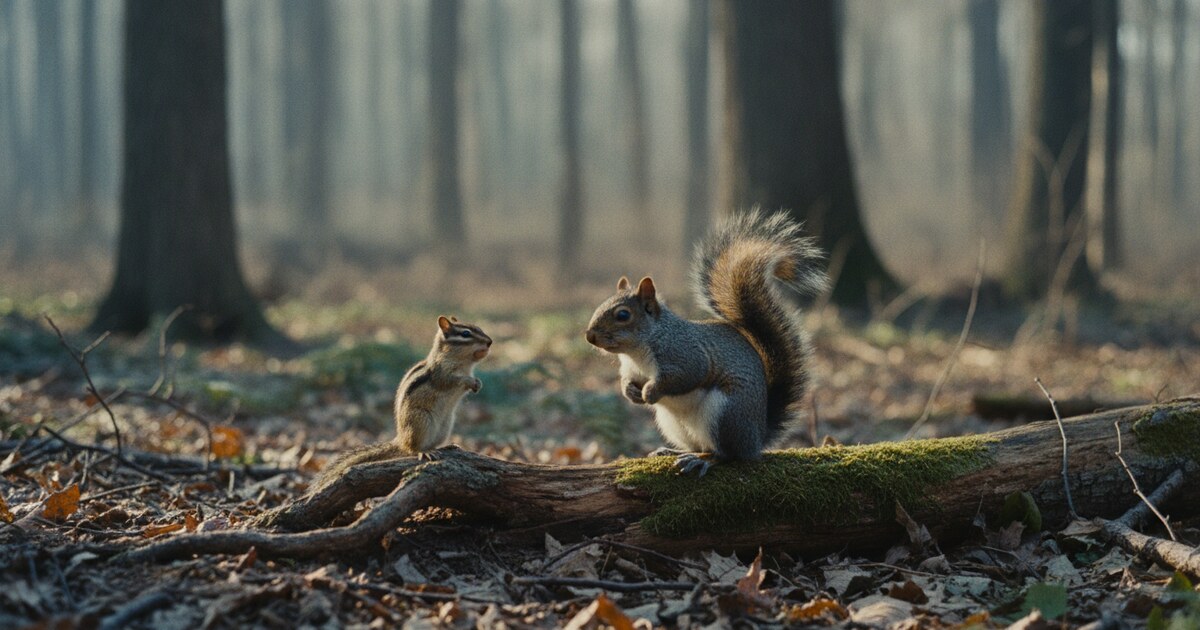
The good news: one look at the right spot settles it almost every time. Chipmunks and squirrels differ in size, face markings, tail shape, and behavior in ways you can read from 20 feet away once you know what to look for. This guide covers the clearest field marks for the most common species across North America, so next time you’ll know in seconds.
The fastest chipmunk vs squirrel identification shortcut: look at the face. Chipmunks have 2 dark stripes running through their eyes. Squirrels don’t have facial stripes. If the face is striped, it’s a chipmunk.
The clearest way to tell a chipmunk from a squirrel is the face. Chipmunks have 2 dark stripes running through each eye, from nose to ear. No North American squirrel has this pattern. Chipmunks are also noticeably smaller, with thinner tails held upright when running, and they spend most of their time at ground level.
The Fastest Way to Tell a Chipmunk from a Squirrel
Face first. A chipmunk has 2 dark stripes running through its eyes, one through each eye from nose to ear. This gives the whole face a striped look from any angle. No North American squirrel has this.
Chipmunks also carry 5 dark stripes down their backs, alternating with lighter cream stripes. Some squirrels have body markings (red squirrels have a faint side stripe), but none of them carry the facial stripe that every chipmunk species shares. If you see striped face plus striped back, the ID is done.
The same face-first approach simplifies other tricky identification pairs too. With hawks and falcons, wing shape and tail silhouette do most of the work. See the hawk vs falcon identification guide for a similar breakdown.
The eastern chipmunk (Tamias striatus) is the most common species across the eastern US. Its body measures 5-6 inches, with the tail adding another 3-4 inches, and it weighs 2-5 oz. The eastern gray squirrel (Sciurus carolinensis) measures 9-12 inches in body length with a 7-10 inch tail and weighs 14-21 oz. The chipmunk’s most reliable field mark is 2 dark stripes running through each eye, plus 5 dark stripes down the back. No North American squirrel has facial stripes. Chipmunks use expandable cheek pouches to carry seeds; one chipmunk can stuff roughly 35 sunflower seeds into its cheeks at once. Eastern chipmunks enter torpor in October or November and re-emerge in March or April. Gray squirrels stay active year-round, caching food in shallow soil and tree cavities. A single gray squirrel creates roughly 3,000 food caches per season and recovers about 75% of them using spatial memory and scent.
Chipmunk vs Squirrel: Body Size
After the face, size is the quickest separator. An eastern chipmunk’s body is 5-6 inches long and weighs 2-5 oz. Small, compact, low to the ground.
An eastern gray squirrel’s body runs 9-12 inches, with a 7-10 inch tail on top of that. Weight runs 14-21 oz, roughly one to one and a half pounds. That’s four to six times the mass of a chipmunk.
The red squirrel (Tamiasciurus hudsonicus) is the one that causes real confusion. At 7-8 inches and 5-9 oz, it’s much closer to chipmunk size than to a gray squirrel. But the face is still clean with no eye stripes, and red squirrels are solidly tree animals. If it’s small AND running through the canopy, it’s almost certainly a red squirrel.
Stripes and Markings: The Full Picture
Chipmunks have a layered pattern:
- 2 dark eye stripes, one running through each eye
- 5 dark stripes down the back (3 dark brown, 2 cream)
- The pattern runs from the head to the base of the tail
The stripes are crisp and bold, visible clearly at a distance.
Gray squirrels have no stripes. Their coat is gray-brown on top with a paler belly and no pattern at all. Fox squirrels can be orange-brown or nearly black depending on the region, but still plain-coated.
Red squirrels have a white belly sharply cut from a reddish-brown back, sometimes with a faint dark line along the flank. That’s a single side stripe on the body only, running horizontally. No facial markings.
The thirteen-lined ground squirrel, found in open Midwestern grasslands, has stripes and spots on the body. Its habitat is open prairie rather than wooded backyards, and it still has no facial stripes. In eastern US suburbs, you’re almost certainly not dealing with one.
Tail Shape and How They Carry It
Chipmunks have thin, flat tails. When running, they often carry the tail straight up like a flag. The tail doesn’t have the thick, spreading fur of a squirrel tail.
Squirrels are built around their tails. A gray squirrel’s tail is about as long as its body and twice as thick, with dense fur that spreads outward. Squirrels wave it during social communication, use it as a parasol in summer heat, and wrap it around themselves when sleeping.
A squirrel flicking its tail rapidly is stressed or alarmed. A chipmunk with its tail bolt upright is just running.
Tail shape alone can often settle the ID from a distance. Thin and held up: chipmunk. Thick and bushy: squirrel.
Behavior and Habits
Cheek pouches. Chipmunks can puff their cheeks dramatically to carry seeds and nuts back to their burrows. A chipmunk with full pouches looks round-faced, noticeably puffy. Squirrels carry food in their mouths too, but they don’t have the same expandable pouch structure, so you won’t see a squirrel with a visibly swollen face.
Ground vs trees. Chipmunks are ground animals. They forage on the forest floor, run along walls and fallen logs, and disappear into burrow entrances at the base of trees, rocks, or shrubs. Squirrels are climbers. Gray squirrels move between ground and tree canopy constantly and build leaf nests called dreys in tree forks 20-50 feet up.
Winter. Eastern chipmunks enter torpor in late October or November. They seal their burrow, sleep in a food-lined underground chamber, and don’t re-emerge until March or April. Squirrels don’t hibernate and stay active all winter, digging through snow for cached acorns. Any small rodent tracks you find in deep winter belong to squirrels: chipmunks are underground. The animal tracks in snow identification guide covers the full breakdown of common winter tracks.
Sound. Chipmunks produce a rapid chip-chip-chip alarm call, which is where the name comes from. Gray squirrels give a kuk-kuk-kuk warning when alarmed. Red squirrels are notably loud, scolding anything that enters their territory with prolonged chattering.
Where You’ll Find Each One
Chipmunks favor forest edges, rocky slopes, dense shrubs, and wooded suburban backyards with plenty of ground-level cover. The eastern chipmunk covers most of eastern North America from southern Canada through Florida. In the West, the least chipmunk (Neotamias minimus) ranges from Michigan to British Columbia, mainly in mountain and sagebrush terrain.
Gray squirrels thrive in deciduous and mixed forests, city parks, and suburban yards across the eastern and central US. Red squirrels dominate boreal and conifer forests across Canada and the northern and western US.
If the animal is in a suburban backyard with trees, you’re most likely looking at an eastern chipmunk at ground level or an eastern gray squirrel anywhere from the ground up into the canopy.
Common North American Species at a Glance
| Species | Body | Weight | Stripes | Habitat | Winter |
|---|---|---|---|---|---|
| Eastern chipmunk | 5-6 in | 2-5 oz | Facial + back | Forest floors, suburbs | Torpor Oct-Apr |
| Least chipmunk | 3.5-4.5 in | 1-2 oz | Facial + back | Western mountains | Torpor |
| Eastern gray squirrel | 9-12 in | 14-21 oz | None | Deciduous forest, parks | Active |
| Red squirrel | 7-8 in | 5-9 oz | Side stripe only | Conifer/mixed forest | Active |
| Fox squirrel | 10-15 in | 17-37 oz | None | Open woodland, savanna | Active |
The eastern chipmunk and eastern gray squirrel account for the vast majority of backyard sightings in the eastern US.
Frequently Asked Questions
Are chipmunks a type of squirrel?
Technically yes. Chipmunks belong to the family Sciuridae, the same family as squirrels, making them distant relatives. In everyday use, though, “squirrel” refers to the larger, tree-climbing species like the eastern gray squirrel. The distinction between chipmunks and squirrels is well understood in common usage.
Which one is digging up my yard?
Chipmunks create shallow tunnels with consistent entrances near the base of trees, shrubs, or walls. Gray squirrels dig many small, shallow holes spread across a wider area for food caches, typically 2-3 inches wide and 1-2 inches deep. Deeper, clearly defined tunnels with regular entrances are usually chipmunks.
Do chipmunks and squirrels ever fight?
Rarely. They mostly occupy different vertical zones: chipmunks on the ground, squirrels in the trees. At a feeder, a squirrel will usually displace a chipmunk simply by being much larger. Actual fighting is uncommon because the size difference makes it one-sided.
Can chipmunks and squirrels interbreed?
No. They’re in different genera with incompatible genetics. Chipmunks (Tamias species) and squirrels (Sciurus, Tamiasciurus, etc.) are too distantly related to hybridize, despite being in the same family.
Why do chipmunks disappear in fall?
Eastern chipmunks enter torpor in October or November, sealing their burrow and sleeping in a food-lined underground chamber until March or April. Gray squirrels don’t hibernate and stay active through winter, relying on cached food they buried in fall.
If you’ve got a good photo and still aren’t certain, Animal Identifier can settle it. Take a clear shot with decent lighting, and the app returns the species with habitat range, diet, and behavior notes. The follow-up chat lets you ask things like “how do I tell this from a red squirrel?” and get an answer based on the species already identified. It covers chipmunks, all common squirrel species, and hundreds of other North American mammals. Free to start: 2 identifications per day, no account needed.