Gopher vs Groundhog: Which One Is Digging Up Your Yard?
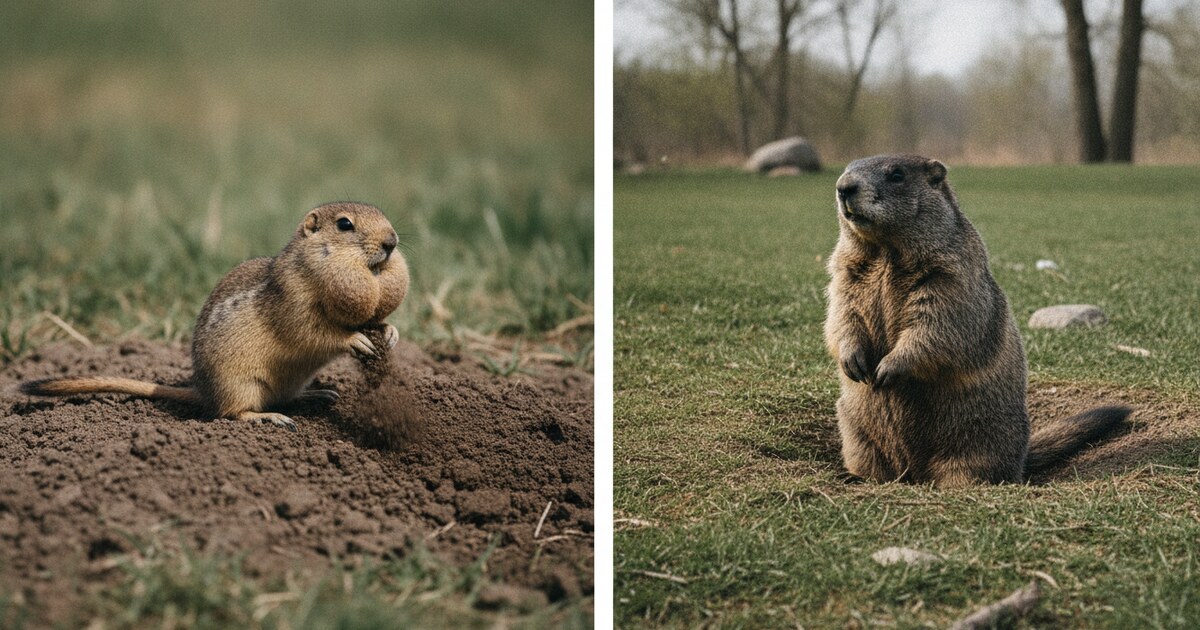
You found a pile of dirt in your yard overnight. Or maybe you spotted a stocky brown animal waddling away from your garden. Either way, you’re trying to figure out what made the mess: is it a gopher or a groundhog?
They’re both burrowing mammals, they both tear up yards, and people confuse them constantly. But they’re not even close relatives. A groundhog is basically a large ground squirrel. A pocket gopher is a small, pouched digger from a completely different family. Once you know what to look for, they’re easy to separate.
Gophers and groundhogs are two distinct animals with different sizes, behaviors, and burrowing styles. Groundhogs (Marmota monax) are large marmots, 5-14 lbs, that forage above ground and leave round open burrow entrances. Pocket gophers are small rodents under 2 lbs with fur-lined cheek pouches that live almost entirely underground and leave crescent-shaped mounds with plugged holes.
The Size Difference: Gopher vs Groundhog at a Glance
This is the fastest field mark if you actually see the animal.
A groundhog (Marmota monax) is a sturdy, cat-sized mammal: 16 to 26 inches from nose to tail tip, weighing anywhere from 5 to 14 lbs. Adults in late summer can hit the top of that range as they fatten up for hibernation. They look vaguely like a small beaver without the flat tail, with rounded ears, a wide gray-brown face, and a short, bushy tail 4-6 inches long.
A pocket gopher is considerably smaller. The most widespread US species are the plains pocket gopher (Geomys bursarius) and Botta’s pocket gopher (Thomomys bottae). Most weigh under half a pound; larger adults top out around 2 lbs. Body length is 6 to 10 inches, with a short, nearly hairless tail 2-3 inches long. The ears are tiny and almost hidden in the fur. The eyes are small. The defining feature you won’t see on any other backyard animal: fur-lined cheek pouches that extend from the mouth back to the shoulders, used to carry food underground. That’s where the name “pocket” gopher comes from.
The 35 species in family Geomyidae are found only in North and Central America. Groundhogs belong to Sciuridae, the squirrel family; they’re the largest member of the marmot group, sharing lineage with chipmunks and squirrels and prairie dogs. A groundhog’s skeleton is built for climbing (they do occasionally climb trees) and running short distances. A gopher’s skeleton is built for tunneling: massive foreclaws, a broad flat skull that fits neatly in a burrow, and reinforced incisors used to bite through roots and loosen soil.
Groundhogs range east of the Great Plains from northern Georgia up through Canada and into Alaska. Most gopher species live in the Great Plains, the Southwest, and the West Coast. If you’re in New England or the Carolinas’ coastal plain, the burrower you’re dealing with is almost certainly a groundhog. If you’re in Kansas, Oklahoma, or California’s Central Valley, it’s probably a gopher.
Gopher Hole vs Groundhog Hole: Reading the Mounds
You don’t need to see the animal. The dirt it pushes up tells you everything.
Gopher mound: A pocket gopher tunnels laterally from its main burrow, pushing excavated soil up and to the side. What you find is a crescent- or horseshoe-shaped pile of loose, fine soil, typically 12 to 24 inches across. The plug that blocked the lateral tunnel is offset to one side; it’s sealed, not open. There’s no hole to look into. If you dig into the flat side of the crescent, you’ll find the plugged tunnel entrance. Plants in the area may be pulled underground or simply collapse as roots get severed. A single productive gopher can build 200 or more mounds per season; in an active infestation you’ll find fresh crescent mounds appearing overnight.
Groundhog burrow: The main entrance is obvious. It’s a round hole 6 to 10 inches across with a conspicuous fan of excavated dirt piled in front, sometimes extending 2 feet out. Groundhogs also dig hidden “pop holes” at other points around their territory; these have no soil mound, so they’re easy to miss and can be a tripping hazard. The main burrow runs 25 to 50 feet, dipping 2 to 5 feet underground, with separate chambers for sleeping, rearing young, and waste. Groundhog burrows can undermine concrete slabs, foundations, decks, and retaining walls. If you’ve found dark brown torpedo-shaped droppings nearby, see our groundhog poop identification guide to confirm the culprit.
The yard context helps too. Gophers eat plant roots, bulbs, and underground stems, pulling plants down rather than chewing them off at the surface. If your garden plants are disappearing root-first, that’s a gopher. If they’re being chewed off at ground level or above, that’s a groundhog. Groundhogs love clover, alfalfa, garden vegetables, and young garden plants. They typically emerge in early morning and late afternoon to feed, then retreat below.
Physical Differences Side by Side
| Feature | Pocket Gopher | Groundhog |
|---|---|---|
| Weight | Under 2 lbs | 5-14 lbs |
| Body length | 6-10 in | 16-26 in |
| Tail | Short, hairless | Short, bushy |
| Cheek pouches | Yes (fur-lined, external) | No |
| Teeth visible | Yes (large yellow-orange incisors protrude) | No (white, only visible if mouth open) |
| Ears | Tiny, nearly hidden | Small, rounded, visible |
| Color | Brown to tan | Gray-brown with frosted tips |
| Seen above ground | Rarely | Regularly, often in daylight |
The protruding teeth are worth calling out. A pocket gopher’s incisors are large, yellow-orange, and stick out in front even when the mouth is closed. That’s not a defect; the lips close behind the teeth, letting the gopher use them to cut roots without swallowing soil. A groundhog has white incisors you’d only see if the animal opened its mouth or yawned.
Year-Round vs Seasonal: When They’re Active
Groundhogs are true hibernators. By mid-October they’ve disappeared underground, heart rate and body temperature both plummeting, and they won’t emerge until late February or March (hence the Groundhog Day tradition). If you’re seeing fresh burrow activity in January in the eastern US, it’s something else.
Pocket gophers don’t hibernate. They stay active 365 days a year, tunneling below the frost line in winter. Fresh crescent mounds in January in the Great Plains mean gopher, not groundhog.
Range Overlap and Where They Live
The two species barely share territory. Groundhogs live east of the Great Plains, with their western boundary running roughly through the Dakotas, Nebraska, Kansas, and Oklahoma. They’re absent from most of the Southwest, Pacific Coast, and deep South Gulf Coast. They do occur in Alaska and across Canada.
Gophers dominate the central and western US. The plains pocket gopher blankets the Great Plains from Texas to Manitoba. Botta’s pocket gopher covers California and much of the Southwest. The southeastern pocket gopher (Geomys pinetis) occupies the coastal plain of Georgia, Florida, and Alabama, meaning gophers and groundhogs do share some territory in the Southeast. But the mound shape still tells you which is which.
A few Midwestern states (Illinois, Indiana, Ohio) could have both. The quick read: groundhog burrows are obvious and open; gopher mounds are closed and crescent-shaped.
Which One Is in Your Yard?
Three questions narrow it down fast.
1. Where do you live? West of the Great Plains: probably a gopher. East of the Mississippi: almost certainly a groundhog. Southern Atlantic coastal plain (Georgia, Florida panhandle, Alabama): could be either.
2. What does the mound look like? Crescent-shaped with a plugged hole and no visible entrance: gopher. Round open hole 6-10 inches across with a soil fan: groundhog.
3. Are plants pulling underground or getting chewed off? Roots disappearing, plants collapsing: gopher. Leaves and stems chewed, garden plants stripped at or above ground level: groundhog.
If you spot the animal itself, snap a photo. The cheek pouches are the surest gopher tell: they look like stuffed pockets on either side of the face. A groundhog looks like a gray-brown beaver-marmot hybrid and runs with a distinctive waddling gait.
How Animal Identifier Can Help
If you catch a glimpse of the animal and get a photo (however brief), Animal Identifier can tell you what it is in seconds. Take the photo or upload it, and the app returns the species along with habitat details, diet, and range information. It covers both pocket gophers and groundhogs, as well as the other burrowing mammals you might encounter: moles, voles, prairie dogs, ground squirrels, and badgers.
The app works on 2 free identifications per day with no signup required. If you’re not sure whether you’re dealing with a gopher or a groundhog, a quick photo is usually faster than trying to dig up the burrow entrance. Animal Identifier is available on iOS and Android.
Frequently Asked Questions
Are gophers and groundhogs the same animal?
No. Gophers (family Geomyidae) are small burrowing rodents weighing under 2 lbs with fur-lined cheek pouches. Groundhogs (Marmota monax) are large marmots in the squirrel family, weighing 5-14 lbs. They’re not closely related. A groundhog is essentially a giant ground squirrel; a gopher is a pocket-pouch digger.
How do I know if I have a gopher or groundhog?
Look at the mound. A gopher leaves a crescent- or horseshoe-shaped pile of soil with a plugged lateral hole offset to one side, with no open entrance visible. A groundhog leaves a large circular entrance hole 6-10 inches wide with a fan of loose soil in front. If you see the animal itself: groundhogs are cat-sized and regularly forage in daylight; gophers are rarely seen above ground.
What does a gopher hole look like compared to a groundhog hole?
Gopher holes are almost never open. The animal plugs the tunnel entrance and pushes soil to the side, leaving a crescent or fan-shaped mound of loose dirt with no visible opening. Groundhog holes are obvious: a round opening 6-10 inches across with a pile of excavated soil nearby. Groundhogs also dig hidden pop holes away from the main entrance with no soil mound.
Do gophers and groundhogs live in the same areas?
Mostly no. Groundhogs range across the eastern half of North America, from Georgia to Alaska, staying east of the Great Plains. Most gopher species live in the Great Plains, the West, and parts of the Southeast. There’s some overlap in the Midwest, but if you’re in New England or the Deep South’s coastal plain, the burrower in your yard is almost certainly a groundhog.
Which causes more yard damage, a gopher or a groundhog?
They damage different things. A gopher destroys plant root systems from underground: a single gopher can produce up to 200 mounds per year and sever irrigation lines. A groundhog eats crops and garden plants from above and digs burrows 25-50 feet long that can undermine foundations, decks, and retaining walls. Gophers are harder to notice; groundhog burrow damage is structural and serious.