Rabbit Poop vs Deer Poop: How to Tell Them Apart
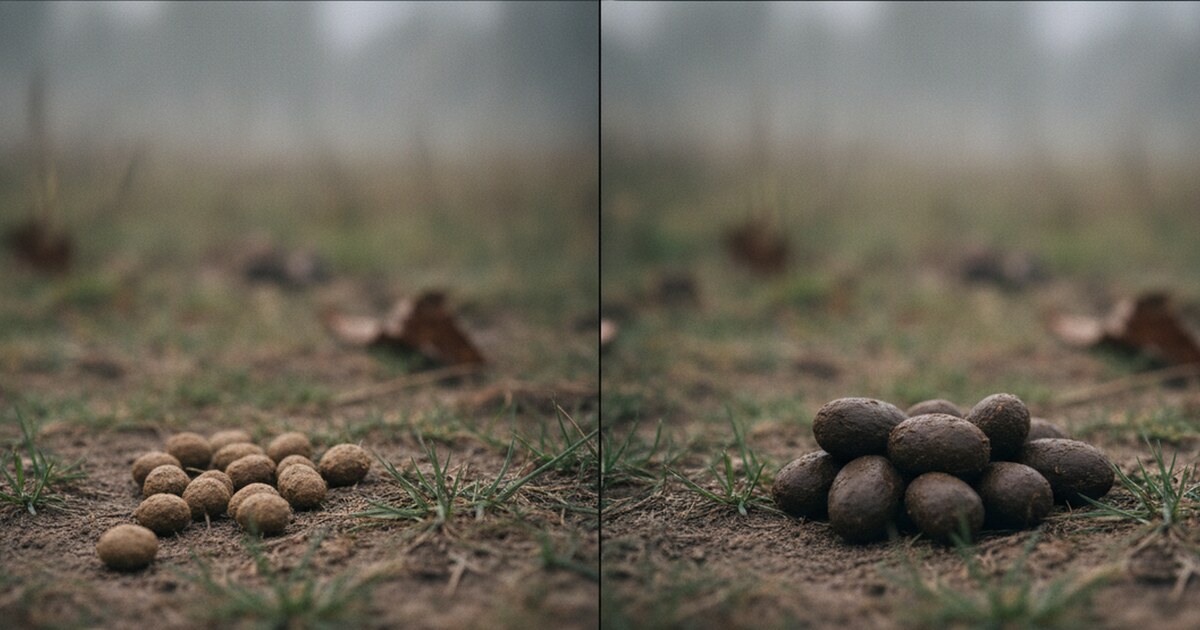
You found small brown pellets near the garden beds, along a trail, or at the edge of the lawn, and you’re not sure which animal left them. Rabbit poop and deer poop look similar at first glance. Both are dark brown, roughly pellet-shaped, and show up wherever these animals move. But the differences are consistent and easy to read once you know what to look for.
This guide walks through rabbit poop vs deer poop using features you can check in the field without touching anything: size, shape, surface texture, color changes, and how the pellets are arranged on the ground.
Rabbit droppings are round and pea-sized, with a rough, fibrous surface and a loosely scattered pattern. Deer droppings are oval and 2 to 3 times longer, smooth when fresh, and deposited in tight clusters of 50 to 80 pellets. Those three differences alone let you separate them in the field with confidence.
Rabbit Poop vs Deer Poop: The Key Differences
The fastest check is size. Hold your thumb and forefinger about ¼ inch apart and you’ve got the width of a rabbit pellet. Now double that length and elongate the shape into an oval — that’s a deer pellet.
Rabbit droppings from cottontails and jackrabbits measure 6 to 8 mm across (roughly ¼ inch). They’re spherical, with a rough, fibrous exterior that reflects the grasses, clover, and leafy plants the rabbit was eating. Color starts out dark brown and fades to tan or pale yellow-brown within hours in dry air. They scatter as the animal moves, turning up loosely across a wide patch rather than collecting in one spot.
Deer pellets are oval and elongated, 12 to 20 mm long (½ to ¾ inch), making them two to three times the size of rabbit droppings. The exterior is smooth when fresh, and the color shifts from moist dark brown to near-black as the pellets age and dry. A whitetail doe deposits a tight pile of 50 to 60 pellets per elimination; a buck leaves 70 to 80 in one spot. Deer defecate 10 to 15 times per day during the fall rut and 20 to 30 times daily during the calmer spring and summer months. That means fresh piles appear frequently along any active travel route. When you’re looking at a tidy cluster of dark oval pellets all piled together, that’s deer. When the pellets are round, pale-ish, and scattered across 2 or 3 feet of ground, that’s rabbit.
The surface texture seals the ID. Run your finger across a dry rabbit pellet (using a stick or glove) and you’ll feel the fibrous, slightly rough exterior — plant material compressed into a ball. Deer pellets, when fresh, are smooth and slightly waxy on the outside. That tactile difference comes from diet: deer eat a wider range of food including woody browse and mast, which produces a denser, smoother pellet.
What Rabbit Droppings Look Like
Wild rabbit poop looks like a loose scattering of small round balls. Eastern cottontail droppings, the most common type across North America, run 6 to 8 mm in diameter. Jackrabbit pellets are slightly larger, up to 10 mm, but still rounder and smaller than deer.
The color is dark brown when fresh and dries to tan or pale brown quickly. In a sunny yard they can go from dark to light in a matter of hours. Smell is minimal; dry plant fiber doesn’t give off much odor, which is one reason many people don’t notice a rabbit has been in the garden until they spot the droppings (or the missing lettuce).
Rabbit scat turns up along the same paths every day. Rabbits use consistent feeding routes, so if you find pellets near a fence gap or garden edge one morning, you’ll find fresh ones in the same area the next. They’re found near low cover: brush piles, dense groundcover, the base of shrubs, the perimeter of a fence row. The scattered pattern is the giveaway; rabbits defecate continuously while they move and graze, rather than stopping to deposit a pile.
Wild rabbits also produce cecotropes, soft dark-greenish clustered pellets that the animal eats directly as part of digestion. You rarely see these because they’re consumed on the spot. If you do encounter soft, clustered, greenish matter in the yard, that’s what it is — it looks very different from the firm, dry, round droppings described here.
What Deer Droppings Look Like
Deer droppings are oval pellets with one end blunt and the other slightly tapered. They’re noticeably larger than rabbit poop and arrive in a tight cluster rather than scattered. A single pile from a whitetail can hold 50 to 80 pellets, all within a 4 to 6 inch circle.
Fresh pellets are moist and dark brown with a smooth exterior. As they age they dry out and darken to near-black. Moist, dark brown pellets mean the deer passed through recently, probably within the last few hours. Dry, black, crumbling pellets mean the deer came through days or weeks ago. That color progression is one of the most useful things trackers look at when checking a trail camera site or scouting a food plot.
Deer droppings turn up wherever deer travel and feed: along wood-line edges, in garden beds, on hiking trails, in lawn areas near wooded cover. You’ll often find them next to browse sign — stripped bark at the base of a sapling, nipped branch tips on ornamental shrubs, eaten flower buds. Deer stop to defecate frequently along their routes.
A concentrated area with multiple overlapping piles, more pellets than a single pass would explain, usually means a bedding area nearby. Deer often defecate before lying down and again when they rise. Locating that kind of concentration tells you more about where the deer is spending its time than a single trail-crossing pile does.
Rabbit Poop vs Deer Poop: Side-by-Side Comparison
| Feature | Rabbit | Deer |
|---|---|---|
| Size | 6–8 mm (~¼ inch) | 12–20 mm (½–¾ inch) |
| Shape | Round/spherical | Oval, slightly tapered |
| Surface | Rough, fibrous, dull | Smooth when fresh, dull when dry |
| Fresh color | Dark brown | Dark brown |
| Old/dry color | Tan, pale brown | Near-black |
| Pile pattern | Scattered loosely | Tight cluster, 50–80 pellets |
| Odor | Near odorless | Mild musk when fresh |
| Typical location | Near brush, garden edges, fence lines | Wood-line edges, trails, garden beds |
What Finding Each One Means for Your Yard
Rabbit droppings near the garden mean rabbits are actively foraging on your property. The next step is checking the garden perimeter for access points: small gaps under a fence, spots where wire has lifted off the ground, or openings at a gate base. Cottontails only need about 3 inches of clearance to get through. The droppings won’t tell you exactly what they ate, but check for bite marks at the base of young plants (clean diagonal cuts) or missing seedlings.
Deer droppings in the yard mean deer are using your property regularly, probably at dawn and dusk. Check shrubs and young trees for browse damage: angled cuts at a consistent height of 2 to 4 feet, shredded bark on saplings from antler rubbing in fall. Deer are creatures of habit and will return to a food source once they find it. Knowing they’re present lets you act on garden protection before the damage gets worse.
Both animals are mostly harmless to people. Deer droppings can carry E. coli and other pathogens, so avoid direct contact and wash your hands after working soil near a droppings site. Rabbit droppings pose a low health risk and are sometimes used as garden amendment after composting — the high fiber content breaks down well.
For a full picture of what other animals are moving through your property, the animal poop identification chart on this site covers common North American wildlife across a wide range of sizes and species.
Using the Sign to Find the Animal
Droppings confirm an animal is present, but they don’t show you what it looked like. If you want to identify the actual animal — to confirm whether it’s a cottontail or a jackrabbit, a whitetail or a mule deer — a photo is the fastest route.
Animal Identifier lets you take or upload a photo and returns the species in seconds, along with habitat, behavior, and diet details. It covers mammals, birds, reptiles, and insects worldwide, and gives you 2 free identifications per day with no sign-up required. So the next time you spot the animal that left those droppings, you’ve got a tool ready.
Deer leave other sign worth reading alongside the droppings. The deer tracks guide on this site explains how to read hoof prints and what they tell you about the deer’s size, direction, and gait.
Frequently Asked Questions
What do deer droppings look like?
Deer droppings are small oval pellets, 12 to 20 mm long, dark brown when fresh and nearly black when dry. They’re deposited in tight clusters of 50 to 80 pellets with a smooth exterior. Fresh piles indicate a deer passed through within the last few hours. Dry, crumbling pellets are days old.
What does wild rabbit poo look like?
Wild rabbit poop is round and roughly pea-sized, about 6 to 8 mm across, with a rough fibrous surface. Color ranges from dark brown when fresh to tan as it dries. Rabbit pellets are scattered loosely across a wide area rather than piled up, because rabbits defecate continuously while moving.
Can you tell if a pile was left by a buck or a doe?
Possibly. Does typically leave piles of 50 to 60 pellets; bucks leave 70 to 80 in one spot. The shape and size of individual pellets is identical regardless of sex, so the count is the only field indicator. Tracks, rubs, and scrapes are more reliable for confirming a buck is in the area.
What other animal droppings look similar to rabbit or deer?
Groundhog droppings are oval like deer’s but shorter (around 10 to 12 mm) and usually found near burrow entrances. Squirrel droppings are close in size to rabbit pellets but tend to be more cylindrical than round. Mouse droppings are much smaller (3 to 6 mm) and tapered at both ends. For a broader comparison, the animal poop identification chart covers these and others side by side.
Are rabbit or deer droppings dangerous to touch?
Deer droppings can carry E. coli and other pathogens; avoid direct contact and wash hands after handling soil near them. Wild rabbit droppings pose a low but nonzero risk (tularemia, in rare cases). The risk is low with normal precautions, but avoid handling with bare hands and wash up afterward.