Deer Tracks: How to Identify and Read Them
Deer Tracks: How to Identify and Read Them
You’re walking a muddy trail, a fresh stretch of snow, or the soft bank of a creek, and you notice a series of cloven prints pressed into the ground. Deer tracks turn up everywhere across North America: backyard gardens, forest paths, cornfield edges, and suburban greenbelts. The trick is knowing what you’re looking at once you spot them.
This guide covers how to recognize deer tracks by shape and size, how to read the direction of travel, what the difference between buck and doe prints looks like in practice, and what other deer sign to look for beyond the tracks themselves.
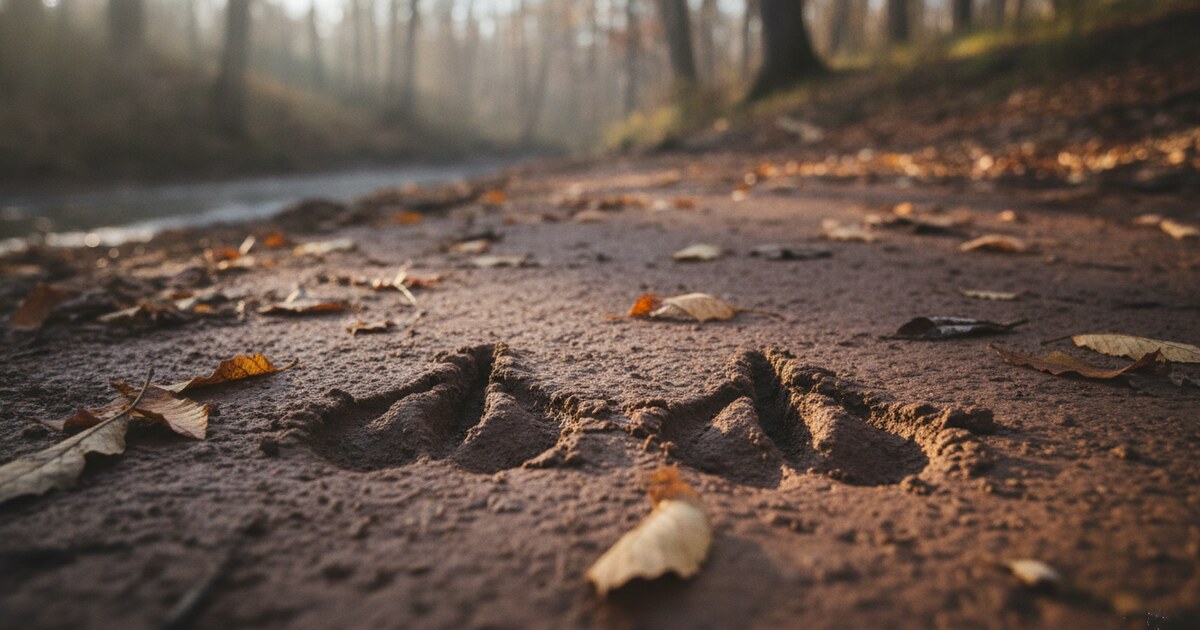
Deer tracks are heart-shaped, two-toed (cloven) prints, typically 2–3 inches long. The pointed end of the two toes faces the direction of travel. Front hooves are slightly larger and rounder than the hind. In soft mud or snow, two small dew claw marks appear 1–2 inches behind the main print.
What Deer Tracks Look Like: Size and Shape
The hoof print is made by two separate toes, the third and fourth digits, which form the cloven (split) hoof. Together they produce that heart shape: wide and rounded at the back, tapering to a pointed split at the front.
Adult white-tailed deer (the most common deer species across most of North America) produce tracks in these size ranges:
- Adult doe or yearling: 2–2.5 inches long, about 1.5 inches wide
- Adult buck: 2.5–3 inches long, about 2 inches wide
- Large mature buck: up to 3.5 inches (less common)
The front hooves are broader and more rounded than the hind. A front print in mud looks nearly circular at the heel. The hind print is slightly narrower and more pointed from back to front.
White-tailed deer tracks average 2–3 inches long in adults, with large mature bucks occasionally reaching 3.5 inches. The print is formed by the third and fourth digits of the foot, a split-hoof (cloven) structure that carries the deer’s weight. Front hooves run roughly 0.25–0.5 inches wider than the hind. In wet mud or fresh snow, two small dew claw impressions appear 1–2 inches behind the main print. Dew claws are vestigial side digits that contact the ground when the animal moves fast, slips, or sinks into soft substrate. A deer walking calmly on packed soil usually won’t leave dew claw marks. The heart shape with the pointed end forward is the most reliable field mark: that tip always faces the direction of travel. Size, substrate type, and gait pattern together let you estimate how recently the deer passed and at what speed it was moving.
Reading Deer Tracks: Direction and Gait
The split between the two toes tapers to a point, and that point always faces the direction of travel. Confirm it with the stride pattern.
At a relaxed walk, white-tailed deer use a gait called “direct register”: the hind foot lands on or just slightly ahead of the front print. A walking trail often looks like a single line of prints rather than two parallel rows.
- Stride (print to print, same side): 18–30 inches at a walk
- Straddle (track width, left to right): 4–8 inches
At a trot, the hind foot overshoots the front, spreading the trail outward. At a full run, all four feet land in grouped sets with long gaps between them. Running tracks are deeper, splayed outward, and almost always show dew claw marks even in firmer soil.
Fresh tracks have sharp, clean edges. Older prints show crumbling or rounded edges where the soil or snow has settled. In snow especially, tracks expand as freeze-thaw cycles erode the impression. A day-old track can look noticeably larger than the actual hoof.
Buck vs. Doe Tracks: The Honest Differences
Print size overlaps heavily between a large doe and a small buck, so a single track is hard to sex with confidence. What does help:
Size: A print over 3 inches long almost certainly came from a buck. Under 2.25 inches points to a doe or yearling.
Shape: Buck hooves tend to be slightly rounder and more splayed at the tips. Doe hooves are narrower, with more evenly tapered toes.
Stride: Heavy bucks have a wider straddle (6 inches or more) and a longer stride at a walk. Doe trails tend to be narrower and neater.
Drag marks: During the rut (October through December across most of the US), bucks shuffle their feet, leaving scrape marks in leaves between prints. A doe walking through leaf litter usually doesn’t do this.
Dewclaw spacing: On a heavy buck, the dew claws print farther behind and wider from the main hooves, because more body weight splays the foot outward.
Use all five together. A track over 3 inches, splayed, with dew claws showing in November mud, is a much stronger buck indicator than any one measurement alone.
Deer Sign Beyond the Tracks
Tracks are the entry point. A deer’s home range leaves a whole vocabulary of other sign worth knowing:
Scat: Deer droppings are small oval pellets, roughly the size of a marble to a small olive. Fresh pellets are dark, shiny brown; they gray out as they dry. You’ll find them in loose scatter-piles, often below browsed shrubs where the deer paused to feed.
Browse marks: Deer have no upper front incisors, so they grip a twig and rip rather than cut cleanly. The break is ragged and fibrous, angled in multiple directions. A clean 45-degree cut on a stem means a rabbit or rodent was there instead.
Antler rubs: In early fall, bucks strip velvet from their antlers by rubbing saplings 1–4 inches in diameter. The rub scar has pale, exposed wood at roughly shoulder height (2.5–4 feet). Fresh rubs smell strongly of sap and sometimes show loose bark shredded downward.
Beds: A deer bed is an oval depression about 2 feet wide by 3 feet long, with vegetation matted flat or leaf litter swept to the sides. Beds often appear in clusters if a doe is with fawns. Look for them along thick brushy edges and inside forest openings.
Where to Find the Clearest Deer Tracks
Substrate matters. Here’s where to look and what each one shows:
Wet mud along creek banks, pond edges, and farm field margins gives the sharpest impressions. Dew claw marks are visible even at a walk. The crispness of the print edges tells you how old it is. Sharp, clean edges mean hours; rounded, crumbling edges mean a day or more.
Fresh snow reveals the complete stride sequence. It’s the easiest substrate to read a gait pattern from, because the whole trail is visible at once. Keep in mind that snow tracks expand as they age: a print left at dawn can look much bigger by afternoon as sunlight melts the edges inward.
Soft trail dirt after rain works well at stream and trail crossings. Dry, loose soil holds poor detail.
Forest leaf litter is the hardest substrate to read. Look for depressions with individual leaves turned upside-down in the rough outline of a hoof, and a general flattening of the mat where the foot pressed down.
If you’re following deer sign through thick woods, you’ll often share the same trails with other wildlife. Our guides to apps that identify snakes and apps for bug identification can help if you encounter something unexpected on the trail.
When You Spot the Actual Deer
Tracks tell you an animal passed through. When you see the deer itself, Animal Identifier can tell you exactly what species you’re looking at.
In most of the US that’s a white-tailed deer. But mule deer, black-tailed deer, and elk all overlap in western and mountain regions, and telling them apart at a distance isn’t always obvious. Open the app, snap a photo, and you’ll get the species name and a summary of its range and behavior in seconds. Animal Identifier covers mammals, birds, reptiles, and insects worldwide, all from a still photograph. It works on 2 free identifications a day with no account required.
Download Animal Identifier for iOS or Android to identify the animal itself once you find it.
Frequently Asked Questions
How do you identify deer tracks?
Look for a heart-shaped, two-toed (cloven) print 2–3 inches long. The pointed end of the two toes faces the direction of travel. Front hooves are slightly larger and rounder than the hind. In soft ground, two small dew claw marks appear 1–2 inches behind the main print. White-tailed deer are the most common species across the eastern and central US.
Are buck and doe deer tracks different?
Yes, but the differences are subtle and overlap significantly. Buck tracks are generally larger (over 3 inches suggests a buck), slightly rounder and more splayed, and may show drag marks in leaves during the rut in fall. Doe tracks tend to be smaller, narrower, and more closely spaced. A single track is rarely enough to sex the deer definitively.
Which direction do deer tracks point?
The pointed end of the hoof, the narrow split between the two toes, always faces the direction the deer was traveling. Confirm this with the stride: a walking deer’s hind foot lands on or near the front print, creating a single-line trail. At a run, prints splay outward and the trail widens.
What is a deer footprint called?
Hunters and trackers call a deer footprint a “slot.” The two halves of the cloven hoof are called “cleaves.” You’ll see both terms in tracking guides and hunting literature. Deer slots are distinct from sheep or goat slots by their size and the relatively narrow split between the two cleaves.
What other deer sign should I look for beyond tracks?
Look for scat (small oval pellets, marble-sized, scattered in loose piles), ragged browse marks on twigs and shrubs at shoulder height, antler rubs on small saplings (pale scarred wood at 2.5–4 feet), and oval bed depressions in brushy or grassy cover, roughly 2 feet wide by 3 feet long.