Possum Poop: How to Identify Opossum Droppings
Possum Poop: How to Identify Opossum Droppings
You found what looks like possum poop in the yard, under the deck, or along the crawl space wall. The size puts them somewhere between a rat and a cat, but neither quite fits. Virginia opossums are one of the most common nocturnal backyard visitors across the eastern and western US, and their scat turns up in gardens, attics, and garages without warning. Knowing what you’re looking at matters before you start cleaning up. Opossum droppings carry several real health risks, and one of them is specific to horses. This guide covers the field marks, the key comparisons with other animals, where droppings show up, and how to handle cleanup safely.
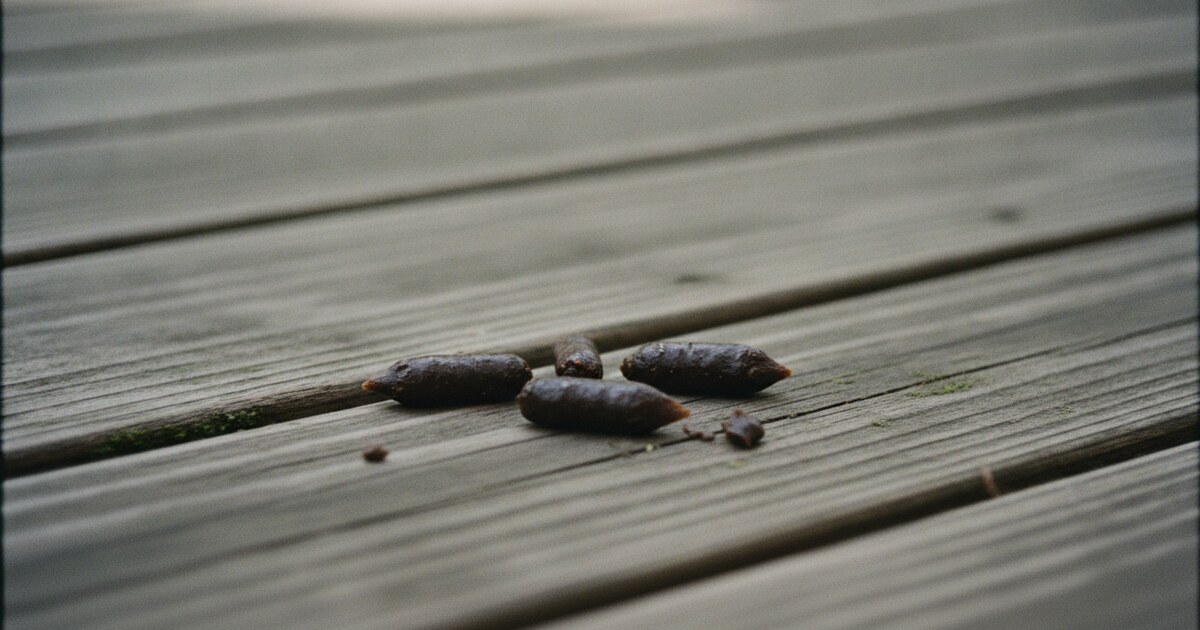
Possum poop is cylindrical, 1 to 2 inches long and about 1/4 to 3/4 inch wide, with tapered ends. Fresh droppings are dark brown to black with a slightly shiny surface. Unlike raccoons, opossums don’t use fixed latrines. They scatter droppings along their nightly travel routes, so you’ll find them spread across a wider area rather than piled in one spot.
What Possum Poop Looks Like
The shape is the primary field mark. Opossum droppings are cylindrical with one or both ends tapering to a soft point. Squirrel droppings, by comparison, have both ends bluntly rounded like a small barrel. That taper-vs-blunt difference is the single fastest way to separate the two, especially when you’re working in an attic or crawl space with mixed droppings.
The surface is smooth and slightly glossy when fresh. That sheen disappears within 24 to 48 hours as the dropping dries and the surface turns matte gray-brown. Color shifts with diet. Fresh scat from an opossum eating mostly meat, insects, or carrion is dark brown to nearly black. Scat from a berry- or fruit-heavy meal runs lighter, sometimes reddish or pale tan. Visible contents are common: berry seeds, fruit skin, and insect exoskeleton fragments all show up, which makes sense for an animal that eats almost everything.
The Virginia opossum (Didelphis virginiana), North America’s only marsupial, produces cylindrical droppings 1 to 2 inches long and 1/4 to 3/4 inch in diameter, with soft tapers at one or both ends. Fresh droppings are dark brown to black with a smooth, slightly moist surface; they dry to gray-brown within 24 to 48 hours. Diet shows directly in the scat: berry seeds, insect exoskeletons, and fruit skin fragments are regular inclusions. Adults deposit 30 to 50 droppings per night along their foraging routes. Unlike raccoons, opossums don’t return to fixed latrine sites; they scatter droppings across an area as they move, producing a wide, thin distribution rather than a single growing pile. Virginia opossums now occupy all 48 contiguous states, with the heaviest density in the eastern US and Pacific Coast. An opossum’s resting body temperature (94 to 97°F) is low for a mammal, which makes them resistant to rabies and inhospitable to many common parasites, a difference that shifts the health risk picture significantly compared to raccoons.
Possum Poop vs. Rat, Cat and Raccoon Droppings
Size is the fastest separator between opossum and rat. Norway rat droppings run 1/2 to 3/4 inch long, roughly half the length of typical opossum scat, with one end blunt and one tapering to a point. Roof rat droppings are similar but slightly curved, still much smaller. If the dropping you’re looking at is more than an inch long, rats are off the list.
For a detailed comparison of squirrel and rat droppings — two species often confused with opossum in yards and attics — the squirrel poop guide covers the blunt-barrel vs. pointed-tip difference and the location cues that separate them.
Cat scat is close in size to opossum: 1.5 to 2 inches long and about 1/2 inch across. The key differences are burial behavior and smell. Cats usually scratch to cover their waste, so you’ll often find disturbed soil or litter around it. Cat scat is also more segmented and has a noticeably stronger, ammonia-forward odor. Opossum droppings are left fully exposed with a more earthy smell.
Raccoon droppings are larger (2 to 3 inches, up to 3/4 inch in diameter), contain obvious berry seeds, and always indicate a latrine. Raccoons return to the same spot over and over. A growing pile at the base of a tree, on a fence rail, or in an attic corner is raccoon. Scattered droppings across a wider area with no fixed concentration point to opossum.
| Animal | Length | Width | Shape | Latrine behavior |
|---|---|---|---|---|
| Opossum | 1–2 in | 1/4–3/4 in | Cylindrical, tapered ends | Scattered, no fixed site |
| Norway rat | 1/2–3/4 in | 1/4 in | Pellet, one pointed end | Trails along walls |
| Roof rat | ~1/2 in | 1/4 in | Slightly curved | Trails |
| Cat | 1.5–2 in | 1/2 in | Segmented, sometimes buried | Variable |
| Raccoon | 2–3 in | 3/4 in | Cylindrical, blunt ends | Fixed latrine sites |
Coyote scat is larger still (3 to 5 inches, twisted, with visible fur or bone). For that comparison, see the coyote poop identification guide.
For a broader look at deer, skunk, rabbit, bear, and a dozen other species side by side, the animal poop identification chart breaks down size and shape across the most common North American wildlife.
Where Opossums Leave Their Droppings
Opossums follow food. Trash cans with loose lids, compost piles, fallen fruit, pet food left outside overnight, and bird feeders with seed spillage on the ground all draw them in. The droppings follow whatever path the animal took to reach that food and back to cover.
Common outdoor spots: under decks and porches, along fence lines, at the base of fruit trees, and in vegetable gardens. Inside structures, expect them in attics, crawl spaces, and garages, usually along a wall or beam. You’ll rarely find one dense pile. The scattered pattern across a path or area is what distinguishes opossum from raccoon.
Opossums are active year-round. Activity drops when temperatures stay below about 20°F — they don’t hibernate, but they hunker down. Most fresh droppings in suburban yards turn up from late summer through early winter, when natural food sources thin out and opossums range more widely at night.
How to Tell Fresh from Old Droppings
Fresh opossum scat is dark, smooth, and slightly glossy. It holds its shape well and doesn’t crumble. After 24 to 48 hours, the surface dries, the color lightens from brown-black to gray-brown, and the dropping becomes brittle. Older deposits crumble when disturbed.
In an attic or crawl space with a recurring visitor, you’ll typically see a mix: a few dark fresh pellets scattered among paler, older, crumblier ones. That mix tells you the animal has been coming through regularly, not just once.
Freshness matters for cleanup. Dried droppings in enclosed spaces create dust when disturbed, and that dust can carry pathogens. Old accumulations in attics call for an N95 respirator, not just a paper mask.
Health Risks from Opossum Droppings
The health risks are real but narrower than with raccoon droppings. Opossums don’t carry rabies in practice (their low body temperature makes infection essentially impossible) and they’re not a hantavirus source (that’s deer mice). The actual concerns are:
Leptospirosis. Opossums can carry Leptospira bacteria in their urine. Urine contaminates surrounding soil and nearby surfaces, which includes areas where droppings land. Transmission to humans happens through broken skin or mucous membrane contact with contaminated material.
Salmonella. Opossums carry Salmonella in their gut. The risk is highest when droppings contaminate garden soil, food-prep surfaces, or water sources, especially relevant if children play in affected areas.
Equine protozoal myeloencephalitis (EPM). Opossums are the definitive host for Sarcocystis neurona, the protozoan that causes EPM in horses. Opossum droppings that contaminate hay, grain, water troughs, or pasture soil can infect horses; once the horse ingests the sporocysts, the parasite invades the nervous system and causes progressive neurological damage. If you find opossum activity near horse feed storage or water sources, treat it as urgent. Clean and disinfect the area promptly and consult your vet.
Standard precautions for any wildlife scat: gloves before handling anything, a mask in enclosed spaces, hands washed thoroughly afterward.
How to Clean Up Opossum Droppings Safely
- Put on disposable gloves and an N95 mask before touching anything, especially in attics or crawl spaces.
- Dampen the droppings with a bleach solution (1 part bleach to 9 parts water) or an EPA-registered disinfectant. This reduces dust and kills surface pathogens.
- Scoop or wipe up the material with paper towels or a disposable cloth.
- Seal everything in a plastic bag, double-bag it, and dispose of it in an outdoor bin.
- Disinfect the surface again and let it dry fully.
- Remove gloves carefully, then wash your hands with soap and water.
For large accumulations in attics or crawl spaces (anything from a recurring visitor over several weeks), professional wildlife cleanup is worth the cost. The area may also need exclusion work to block re-entry, and a pro can identify the entry points more reliably than a visual scan from below.
How Animal Identifier Can Help
Opossum scat narrows things down, but the animal itself usually turns up when you’re investigating where the droppings are coming from. Opossums in crawl spaces, under decks, or moving through the yard at night can look like cats, raccoons, or large rats in bad lighting.
If you spot the animal and want a confirmed ID, Animal Identifier works from a single still photo. Point your camera, take the shot, and the app returns the species along with habitat, range, and behavior details in seconds. It covers the full animal kingdom, mammals included. You get 2 free identifications a day with no account required, on iOS and Android.
Frequently Asked Questions
What does possum poop look like?
Opossum droppings are dark brown to black, cylindrical, 1 to 2 inches long and about 1/4 to 3/4 inch wide, with tapered ends. Fresh scat is slightly shiny and holds its shape; dried scat turns gray-brown and crumbles easily. The droppings often contain seeds, berry skins, or insect fragments, reflecting the opossum’s omnivorous diet.
How do you tell possum poop from rat poop?
Size is the clearest check. Rat droppings (Norway or roof rat) are 1/2 to 3/4 inch long, roughly half the length of opossum scat, with a sharp taper at one or both ends. Opossum droppings are larger, heavier, and frequently contain visible seeds or insect material. Rat droppings typically form dense trails along walls; opossum droppings are scattered.
Is opossum poop dangerous?
It can be. Opossum droppings and contaminated soil can carry Leptospira bacteria and Salmonella. For horse owners, the primary concern is Sarcocystis neurona, the protozoan that causes equine protozoal myeloencephalitis; opossums shed the parasite in their scat. Handle droppings with gloves and an N95 mask, especially in enclosed spaces where dried material can become airborne.
Do opossums poop in the same spot every time?
No. Opossums don’t establish latrines the way raccoons do. They scatter droppings along their nightly foraging routes, producing a wide, thin distribution rather than a growing pile in one place. Finding a dense, repeated pile in a single location points to raccoon rather than opossum.
Can I get hantavirus from opossum droppings?
No. Hantavirus is carried by deer mice and certain other rodents, not opossums. Opossum droppings do carry other health concerns (Leptospira, Salmonella, and Sarcocystis neurona for horses), but hantavirus isn’t among them. General enclosed-space caution still applies: mask up and dampen droppings before disturbing them regardless of species.
Once you’ve read the scat and confirmed opossum, seeing the animal itself gives you the full picture. If the opossum shows up in the yard, under the porch, or in the crawl space and you want a confirmed ID, Animal Identifier returns the species from a single photo in seconds, along with habitat range and behavior. It covers mammals, birds, reptiles, and insects worldwide and gives you 2 free identifications a day with no account needed. Available on iOS and Android.