House Moth Identification: Which Moth Is in Your Home
A small, pale moth drifts across your kitchen ceiling at night, or you pull a wool sweater out of storage and find tiny holes in it. Either scenario prompts the same question: which moth is this, and does it matter which? It does matter, because the two main groups of house moths, clothes moths and pantry moths, damage completely different things and call for different responses. Knowing the species takes less than a minute once you know what to look for. Body size, wing color, wing pattern, and where in your home you’re finding them tell you almost everything.
The two house moths most often found indoors are clothes moths (small, plain buff or golden, found in closets and fabric storage, avoid light) and pantry moths, usually the Indian meal moth (slightly larger, two-toned wings, found near kitchens, fly toward lights). Both leave larvae and webbing behind, but in different locations.
Clothes Moths vs. Pantry Moths: The First Split in House Moth Identification
Before identifying a specific species, the most important divide is functional: a clothes moth and a pantry moth have completely different diets, behaviors, and hiding spots. Two questions settle it before you even look at wing markings: where did you find the moth, and did it move toward the light or away from it?
Clothes moths are photophobic. They flee from light and spend their lives in dark, undisturbed corners: inside folded sweaters, under furniture cushions, in sealed boxes of stored wool. If you flip on a light and a small moth immediately darts toward the darkest corner, you’re almost certainly looking at a clothes moth.
Pantry moths do the opposite. They fly toward lights, appear around kitchen windows, and turn up near ceiling fixtures at night.
Their larvae eat stored dry goods: grains, flour, dried fruit, spices, pet food, birdseed. If the moth came from the direction of your kitchen cabinet and flew toward the light, the pantry is where you need to look.
The two groups belong to entirely different moth families. Clothes moths are Tineidae, the fungus moths, a family of roughly 3,000 species worldwide, most of them small, pale, and nocturnal. The 2 species responsible for nearly all fabric damage in North American homes are Tineola bisselliella (webbing clothes moth) and Tinea pellionella (casemaking clothes moth). Pantry moths fall mainly under Pyralidae and Phycitinae. The dominant pantry pest in North America is Plodia interpunctella, the Indian meal moth, accounting for the vast majority of household pantry moth complaints. The Mediterranean flour moth (Ephestia kuehniella) and almond moth (Cadra cautella) account for most of the rest, though Indian meal moths outnumber them in surveys of household pest calls by a wide margin. Adult moths in both families have wingspans in the 12-24mm range in most pest species, with clothes moths sitting at the small end. Larvae, not adults, cause the damage in both groups.
How to Identify Common House Moth Species
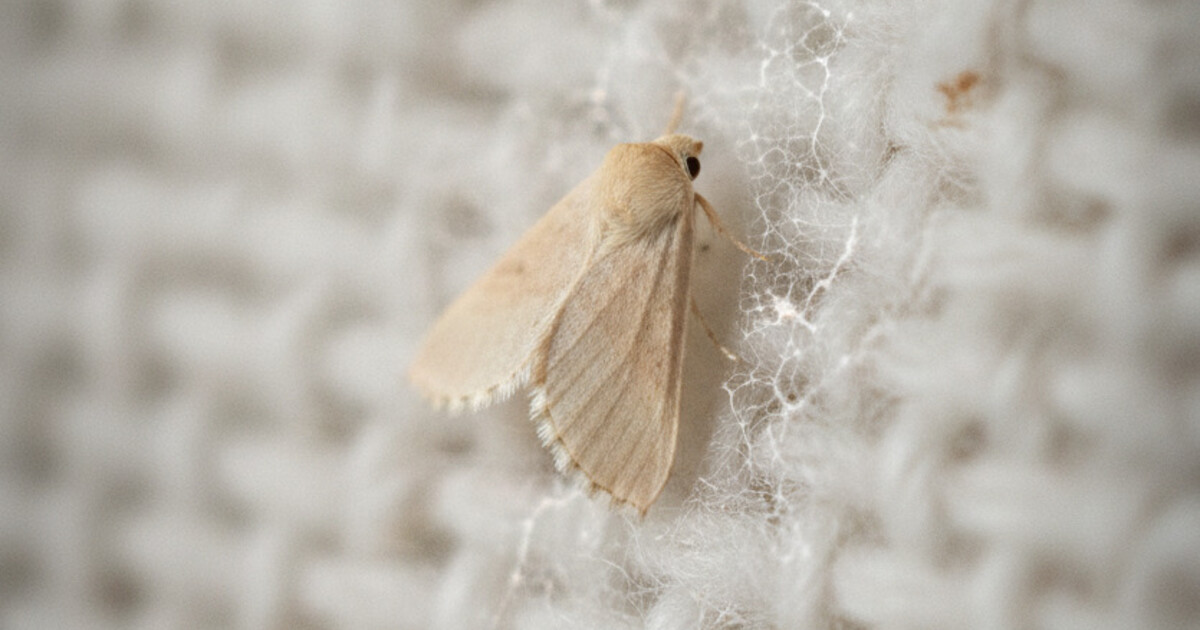
Webbing clothes moth (Tineola bisselliella) is the most widespread fabric pest in North America. It’s small: 12-17mm wingspan, body about 6-8mm. The wings are entirely plain, a uniform buff or golden-tan with no markings at all, and the head carries a distinctive reddish-gold tuft of hair-scales. When resting, the wings fold flat over the body like a tent, giving a narrow, triangular silhouette from above. You rarely see them flying. They’d rather run along a baseboard or disappear into a fold of fabric when disturbed. The larvae spin silken webbing on the surface of whatever they’re eating, which is how the species got its name. Pull out a wool blanket and find irregular patches covered by a thin, silky film with tiny grayish-white caterpillars inside, and you’ve found a webbing clothes moth infestation.
Casemaking clothes moth (Tinea pellionella) is similar in size (12-17mm wingspan) but slightly easier to identify. The wings are a darker, more muted buff-brown, and 3 faint dark spots are usually visible on each forewing. The larvae are more distinctive: each one builds a portable silken tube, or “case,” that it drags along as it feeds. You might find these cases stuck to the surface of damaged fabric, inside a shoe, or caught on carpet fibers. If the damage pattern is scattered individual spots rather than a single large area of webbing, Tinea pellionella is the more likely culprit.
Indian meal moth (Plodia interpunctella) is the one you’ll find flying in your kitchen. At 16-20mm wingspan, it’s noticeably larger than either clothes moth. The diagnostic feature is bicolored wings: the inner third (near the body) is pale gray or whitish, and the outer two-thirds shade through bronze, copper, and dark gray, sometimes with a clear band at the transition. No other common house moth has this two-tone pattern.
The larvae eat almost any dry stored food: cornmeal, oats, dried beans, raisins, paprika, dog biscuits, birdseed. A typical discovery: you open a bag of flour and find silky webbing matted into the contents along with small cream-colored caterpillars.
Brown house moth (Hofmannophila pseudospretella) is larger than the others: wingspan 15-26mm, occasionally reaching 30mm. The wings are bronze-brown with a scatter of darker brown spots, giving a more textured look than the plain clothes moths. It’s a generalist feeder whose larvae eat natural fibers, dried plant material, dead insects, and stored food. It’s less common as a household pest in the US than in Europe, but it does turn up. Its size sets it apart: if the moth in your closet is noticeably larger than a fingernail, brown house moth is worth checking.
White-shouldered house moth (Endrosis sarcitrella) is the easiest to separate from the rest. The head and thorax are bright white, contrasting with mottled gray-brown wings. Wingspan is 15-23mm. It’s a cosmopolitan species found worldwide and feeds on dry plant material, seeds, and dead insects. The white “shoulders” (the thorax and head in profile) are a reliable field mark no other common house moth shares.
What House Moths Leave Behind
The adult moth is often the first thing you notice, but the larvae are responsible for all the damage. Knowing what to look for tells you which moth you have and how far the infestation has run.
Clothes moth damage appears as irregular holes in natural-fiber items: wool, cashmere, silk, felt, fur. Synthetic fibers aren’t eaten, though blended fabrics can be damaged if the larvae are going after the natural fiber component. Webbing clothes moth larvae leave a silky, matted surface film on whatever they’re feeding on.
Casemaking clothes moth larvae leave small silken tubes attached to fabric or carpet. Either way, damage concentrates in dark, undisturbed storage: the back of a closet, a sealed box in a basement, the underside of an upholstered chair. Items stained with sweat, food, or oils are favorite targets, since those residues add nutrition.
Pantry moth damage looks different. You’ll find silky webbing inside food containers, matted into flour or cereals, sometimes causing dry goods to clump together. The larvae are cream-colored with a brownish head, about 12-14mm at full size.
You might find them crawling out of a food bag or up a cabinet wall, or spot a cocoon spun in the corner where the cabinet wall meets the ceiling. Powdery residue or sticky webbing inside food packaging is the main sign.
Frass (larval droppings) is common to both groups, visible as tiny dark grains in the damaged area. In clothes moths it appears mixed with fabric fibers; in pantry moths it’s mixed into food residue.
Putting together a clear photo of the adult moth, the damage site, and any larvae you can find gives you everything needed for a reliable identification. This is the same method that works when you’re trying to separate black and yellow caterpillars from similar species: a few visual features from a photo settle what memory can’t.
When the Field Marks Aren’t Enough: How Animal Identifier Helps
Separating webbing from casemaking clothes moths, or telling an Indian meal moth from a brown house moth, is difficult without a good photo. Both comparisons require seeing wing pattern details that are easy to miss when the moth is moving. If you can get the moth into a glass or photograph it on a flat surface, a clear image often resolves the species in seconds.
Animal Identifier identifies insects and other animals from photos. Take a clear shot of the moth, ideally from above with wings visible, and the app returns the species along with habitat, behavior, and diet information. After the identification you can ask follow-up questions in the chat, such as “what does this moth eat?” or “how do I find the larvae?” without leaving the app. It’s free to start with 2 identifications a day, no account needed, on iOS and Android.
Getting the species right matters before you treat. Clothes moth treatment focuses on natural fibers and dark storage areas. Pantry moth treatment focuses entirely on your dry food supply. Treating for the wrong moth wastes time and leaves the actual infestation running.
The approach is consistent whether you’re identifying a house moth or a bug that looks like a roach: contain it briefly if you can, light it well, shoot from above and from the side, and you’ll have a usable image. A photo tells you what species you’re dealing with and what to do about it.
Frequently Asked Questions
What kind of moth is in my house?
The two most common are clothes moths (small, plain buff-gold, found in closets and drawers, flee from light) and pantry moths, usually Indian meal moths (slightly larger, two-toned wings with pale inner and bronze-copper outer sections, found near kitchens, fly toward lights). Location and behavior separate them before you even look at wing markings.
How do I tell a clothes moth from a pantry moth?
Check where you found it and how it behaved. Clothes moths flee from light and stay in dark fabric storage areas. Indian meal moths fly toward lights and live near dry food storage in kitchens. Wing color also helps: clothes moths are uniform buff-gold with no pattern. Indian meal moths have a clear two-tone pattern, pale near the body and darker bronze-brown toward the wing tips.
What does a webbing clothes moth look like?
A webbing clothes moth (Tineola bisselliella) has a 12-17mm wingspan, entirely plain buff or golden-tan wings with no markings, and a small reddish-gold hair tuft on the head. It folds its wings flat when resting. It’s the most common clothes moth in North America and leaves silky webbing on the surface of damaged wool, cashmere, and other natural fibers.
Why do I keep seeing moths but can’t find any damage?
Some moths that enter homes from outside are harmless: many Pyralid moth species, outdoor grain moths, and other species are attracted to lights but don’t breed indoors. If the moth appeared near an open door or window at night and you can’t find damage in closets or food storage, it likely came in from outside. Check both closets and the pantry to rule out an actual infestation before assuming the worst.
Can clothes moths eat synthetic fabric?
Clothes moths can’t digest synthetic fibers like polyester, nylon, or acrylic. They eat keratin, the protein in natural fibers. A blended fabric with wool content can be damaged if the larvae are eating that component, but a 100% polyester garment won’t be touched. Silk and cotton are less preferred than wool but can be damaged, especially if stained with food or body oils.
If you’re not sure what’s flying around your closet or kitchen, snap a photo and run it through Animal Identifier. You’ll have a species name and enough context to know whether to check the pantry, the storage closet, or just leave the window open.
Related reading: Moth Larva: What They Look Like and How to Identify Them