Moth Larva: What They Look Like and How to Identify Them
Moth Larva: What They Look Like and How to Identify Them
You pull a cashmere sweater out of storage and find small ragged holes near the shoulder. Or you lift a container of oats and see the top layer matted together in sticky webbing. Both are moth larva damage, but different species are responsible. The adults flying around your lamp don’t eat solid food. The larvae do all the feeding, and they’re the part of the moth lifecycle that causes problems in your home. This guide covers what moth larvae look like, the two main household types, why they show up indoors, and whether they pose any real risk to you.
A moth larva is the caterpillar stage of a moth’s lifecycle. Household pest species are soft-bodied, pale, and range from 4 to 20mm long. Two types enter homes: clothes moth larvae, which feed on natural fibers like wool and cashmere, and pantry moth larvae, which infest stored dry foods like grain, seeds, and dried fruit.
What Is a Moth Larva?
“Larva” refers to the feeding stage in a moth’s four-part lifecycle: egg, larva, pupa, adult. The larva does all the eating. Most adult moths don’t consume solid material at all; some drink nectar, and many eat nothing after emerging from the cocoon. Everything the moth needs to survive as an adult was stored up during the larval stage.
Every moth larva is technically a caterpillar. The terms are interchangeable. People tend to use “caterpillar” for the colorful, hairy outdoor species on trees and garden plants, and “moth larva” for the pale pest types found in closets and pantries. Scientifically there’s no difference between them.
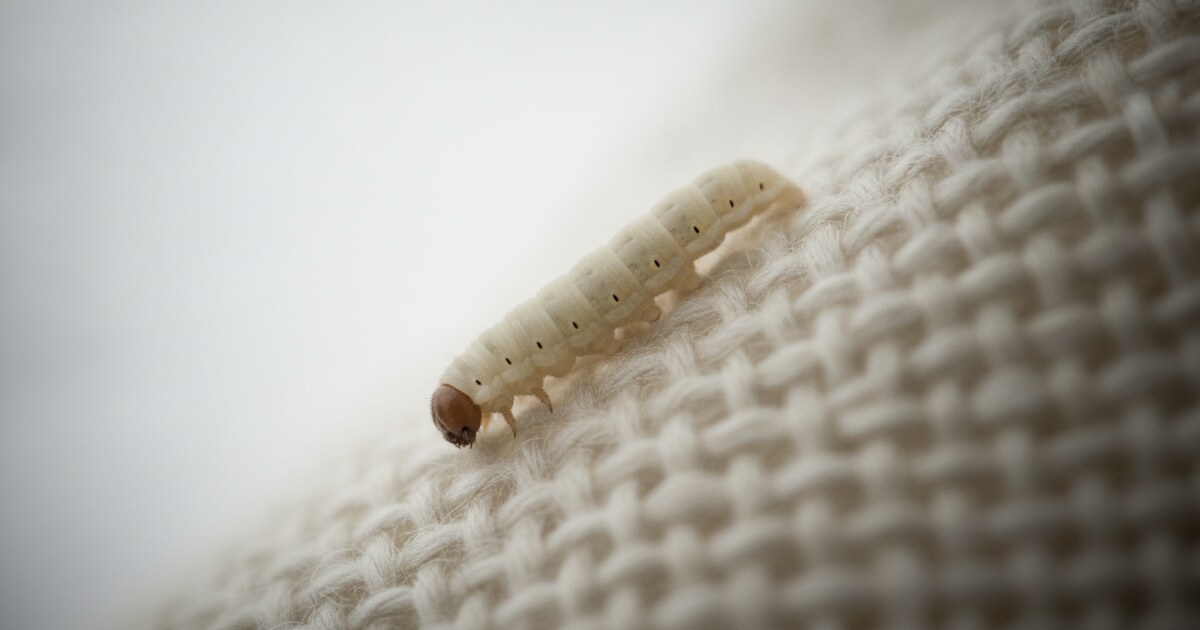
All moth larvae share the same body plan: a segmented cylindrical body, a distinct darker head capsule, three pairs of jointed true legs near the head, and fleshy prolegs along the abdomen for gripping surfaces. Outdoor species are usually larger and more vividly marked. Indoor pest species stay pale and smooth, which helps them blend into the fabric or food they’re feeding on.
Moth larvae pass through multiple instars (growth stages), each ending in a molt. The larva you find in fabric is usually mid-instar and still actively feeding before it’s ready to pupate. For a species-by-species breakdown with exact measurements and field marks, the moth larvae identification guide covers each type from clothes moths to outdoor caterpillars.
What Does a Moth Larva Look Like?
The two families behind most household moth larva problems are Tineidae (clothes moths) and Pyralidae (pantry moths). Clothes moth larvae are 4 to 10mm at full size, cream-white with a tan to honey-brown head capsule. They’re smooth-bodied with no hairs or spines. The Indian meal moth (Plodia interpunctella), the most common pantry moth in North America, reaches 12 to 13mm, with a whitish to pinkish body and a distinctly darker brown head and thoracic shield. Both families share the same segmented structure: a defined head capsule, three true legs near the front, and fleshy prolegs along the abdomen. The clearest separator between them is silk. Clothes moth larvae spin flat tunnels or portable cases pressed into fabric. Pantry moth larvae leave loose webbing matted through stored food. Indoor moth larvae rarely exceed 13mm. Outdoor pest species like spongy moth and fall webworm run 25 to 60mm and never infest homes. Size and location together narrow the ID to family before you even look at color.
The webbing clothes moth larva (Tineola bisselliella) is the most commonly found clothes moth in US homes. At 4 to 8mm, it’s small enough to hide inside folded fabric. It spins a flat silk mat over the surface of the fiber and feeds from beneath it. Look for the pale gauzy crust flattened against the material, with small pellets of frass nearby.
The case-bearing clothes moth larva (Tinea pellionella) is slightly larger, up to 10mm, and carries a portable silk case made from chewed fibers. It moves more freely across fabric than its webbing cousin, dragging the case behind it. You can sometimes spot the case on a dark sweater before you spot the larva inside.
The Indian meal moth larva (Plodia interpunctella) is the one most people find in the kitchen. At 12 to 13mm it’s noticeably bigger than clothes moth larvae, pinkish or greenish depending on what it’s been eating, with a clearly darker brown head. It spins loose webbing through grain, nuts, dried fruit, and birdseed, then climbs out of the container to pupate in a ceiling corner or wall joint.
The Two Types of Household Moth Larvae
Clothes Moth Larvae
Clothes moth larvae (family Tineidae) feed on keratin, the protein that makes up wool, silk, cashmere, alpaca, feathers, and leather. They don’t touch plain cotton or synthetic fibers. If you’re finding damage in a polyester blend or acrylic sweater, clothes moths didn’t do it.
Both species prefer dark, undisturbed spots. The back corner of a storage box, the inside of folded sweaters, under furniture along baseboards where animal hair collects. Garments you wear regularly are rarely targeted; it’s the forgotten storage pieces that get chewed through over months.
One note worth knowing: clothes moth larvae will attack cotton or synthetic blends if those items are stained with sweat, body oil, or food residue. The organic matter draws them to the fiber, not the fiber itself. Clean your items before storage and you remove their food source.
Pantry Moth Larvae
Pantry moth larvae (family Pyralidae) eat dry, starchy, or fatty plant material: grain, flour, cereals, dried fruit, nuts, chocolate, pet food, and birdseed. The Indian meal moth is the most common species in the US, but the Mediterranean flour moth (Ephestia kuehniella) and tobacco moth (Ephestia elutella) show up occasionally in home kitchens.
The webbing these larvae produce is the fastest identification clue. If your oats or birdseed has clumped together in a sticky mat, pantry moth larvae are behind it. Pantry beetles, the other common stored-food pest, don’t produce silk. That single difference separates the two groups faster than any color comparison.
Unlike clothes moth larvae, pantry moth larvae are restless before pupating. Finding a small cocoon in a cabinet corner, on the ceiling, or stuck to a baseboard far from any food container is a sign the infestation is well established.
Why Am I Finding Moth Larvae in My House?
Moth larvae don’t fly in. Adults do the flying, and they’re looking for places to lay eggs, not food for themselves. The larvae that hatch from those eggs are what you find weeks later.
Clothes moth adults enter homes through open windows, gaps around doors, or on secondhand clothing and vintage textiles purchased elsewhere. They’re drawn to natural fiber storage areas. Once inside, a female lays 40 to 50 eggs on or near suitable material. The eggs are tiny and white, nearly invisible to the naked eye. By the time you find larval damage, the adult that started the infestation has probably been gone for weeks.
Pantry moth infestations most often start with contaminated goods brought into the home. Grain, birdseed, nuts, and dried fruit can carry eggs or early-instar larvae from a warehouse or retail store. You bring the bag home, store it, and six weeks later you open the pantry and find webbing. The larvae were already there before the bag left the shelf.
Seasonal timing matters for clothes moths. In North America, adult clothes moths are most active from late spring through fall, roughly April through October. A sweater stored in May with a few undetected eggs on it may show damage by the time you retrieve it in October.
Are Moth Larvae Harmful?
Clothes moth larvae and pantry moth larvae don’t bite, sting, or cause skin reactions in most people. They’re fabric and food pests, not threats to human health.
Clothes moth larvae can’t pierce skin. Their mouthparts are designed for chewing natural fiber, not for defense. Some people with sensitive skin report mild irritation from the silk webbing or larval hairs if they handle infested fabric directly, but this is uncommon and minor.
Pantry moth larvae contaminate food but don’t cause illness in most cases. If you accidentally consume infested grain, the FDA notes this is generally not dangerous; the bigger concern is discovering it. The larvae, webbing, and frass (excrement) don’t produce toxins.
One outdoor exception: spongy moth caterpillars (formerly called gypsy moth caterpillars) have tiny barbed hairs in later instars that can cause skin irritation on contact. These are large outdoor species that defoliate trees; they’re not household pests and you won’t find them inside your home.
The actual harm from moth larvae is economic: damage to expensive woolens and cashmere garments, loss of stored food, and the time spent locating and eliminating an infestation. A single female clothes moth can lay 40 to 50 eggs in one laying. Left unchecked, an indoor infestation can run for months before the damage becomes visible.
How Animal Identifier Helps
If you find an unfamiliar larva and want a quick species ID, photographing it and using Animal Identifier can narrow things down fast. Place the larva on a plain white surface for the best contrast, and photograph it from directly above and from one side to capture the head shape, body color, and any silk structure around it.
The app covers the full range of moth larvae: indoor pest species (clothes moths and pantry moths), outdoor caterpillars including spongy moth and fall webworm, and the broader Lepidoptera spectrum. After the initial ID, the follow-up chat lets you ask “how do I tell it from a carpet beetle larva?” or “is this the webbing clothes moth or the case-bearing type?” to work through lookalikes. Two free identifications per day, no account required, on iOS and Android.
If you want to understand the adult moths behind the damage you’re finding, our guide to house moth identification covers the adults with size, color, and behavioral differences between the major pest species.
Frequently Asked Questions
Why am I finding moth larvae in my house?
Clothes moth larvae enter homes on adult moths that fly in through open windows or on secondhand wool and vintage textiles. Pantry moth infestations usually start with contaminated food purchased at a store. Eggs and early-instar larvae in grain, nuts, and birdseed are invisible without magnification. The larvae you find developed from eggs laid weeks or months before you noticed any damage.
What is a moth larva called?
A moth larva is a caterpillar. All Lepidoptera larvae, whether from moths or butterflies, are caterpillars by scientific definition. The terms “moth larva” and “caterpillar” refer to the same life stage. In everyday use, people tend to reserve “caterpillar” for colorful outdoor species and “moth larva” for the pale pest species found indoors, but the distinction is informal rather than scientific.
Are moth larvae harmful?
Clothes moth larvae and pantry moth larvae aren’t harmful to humans. They don’t bite, sting, or produce toxins. Clothes moth larvae cause economic damage by chewing through wool, cashmere, silk, and other natural fiber garments. Pantry moth larvae contaminate stored food but don’t cause illness. The main exception is spongy moth caterpillars outdoors, which have irritating hairs in later instars, but these are tree-feeding species that won’t be found in your home.
What does a moth larva look like?
Indoor pest moth larvae are pale and worm-like, ranging from 4 to 20mm long. Clothes moth larvae are cream-white with a tan to honey-brown head, 4 to 10mm at full size. Indian meal moth larvae (pantry moths) are slightly larger at 12 to 13mm, whitish to pinkish with a distinctly darker brown head capsule. Both types are smooth-bodied without hairs or spines. Outdoor species like woolly bears, spongy moth caterpillars, and swallowtail larvae are much larger and more colorfully marked.
Found moth larvae somewhere and want to know exactly which species you’re dealing with? Animal Identifier can ID them from a photo in seconds. Take the photo on a white surface, upload it, and you’ll get the species with habitat and behavior notes. Download free on iOS or Android.