Caterpillar Identification Chart: By Color and Markings
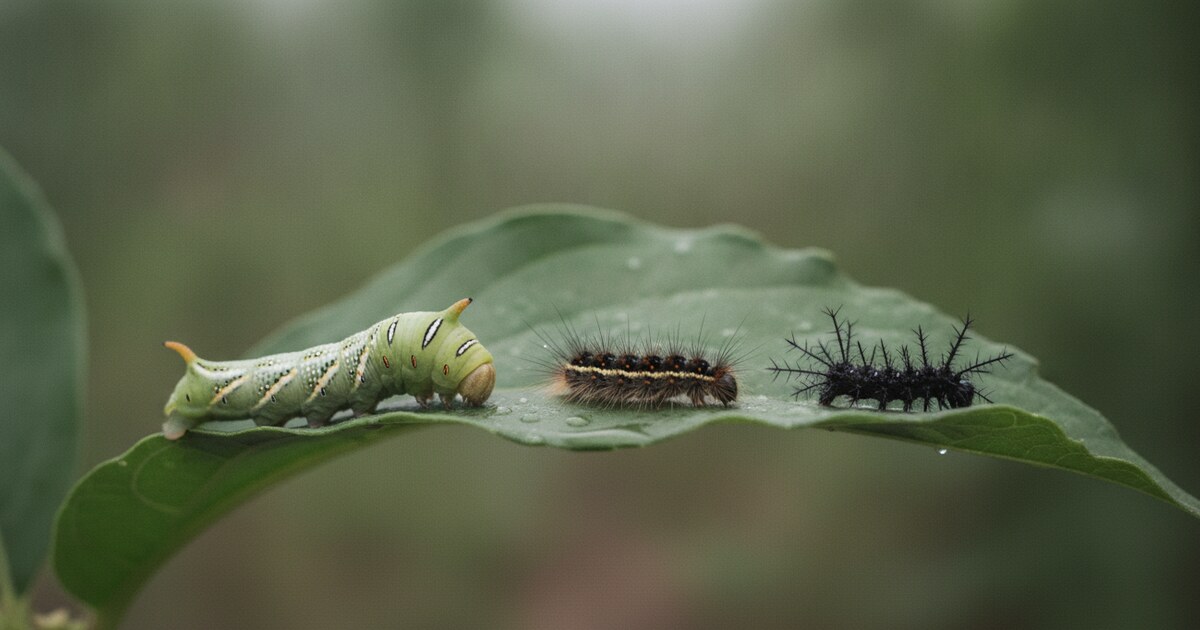
Caterpillar Identification Chart: By Color and Markings
You spotted a caterpillar and want to know what it is. The fastest way in is color. Before checking the host plant or the season, look at the dominant body color, then note the markings, texture, and size. That combination gets you to a species, or at least a short list. This caterpillar identification chart organizes the most common North American caterpillars by color group, flags the ones that sting, and links to deeper guides for species that come up most often by region. If you know where you are, the state guides narrow it further still — the caterpillars in Texas guide, for example, covers a stinging set that looks nothing like the northern one.
To identify a caterpillar, start with body color, then note markings (stripes, spots, or horns), texture (smooth, hairy, or spiny), and size. Most common North American caterpillars fall into five color groups: green, yellow-and-black, brown, white or pale, and stinging-and-spiny. Matching the host plant where you found it narrows the list fast.
How to Use This Caterpillar Identification Chart
Four traits get you the farthest with the least effort.
Color is the first filter. Caterpillars change appearance across their 4-6 growth stages (instars). If a species looks vaguely familiar but not quite right, you may be seeing a younger instar. Note the dominant body color and move on.
Markings narrow the field. Stripes can run lengthwise (a dorsal stripe down the back or a lateral stripe along the side) or wrap across the body. Eyespots are false-eye patterns near the head, used to startle predators. Bands are repeating color patterns down the body.
Texture (smooth and waxy, densely hairy, or visibly spiny) tells you a lot about the family. Spiny caterpillars always warrant extra caution before handling.
Host plant is a shortcut. If you can identify the plant, the species list collapses fast. Monarch larvae eat milkweed almost exclusively. Black swallowtail larvae live on carrot-family plants: parsley, dill, fennel, and Queen Anne’s lace. Most hornworm species are on nightshades (tomato, tobacco, potato).
North America hosts roughly 12,000 Lepidoptera species (moths and butterflies), and almost all pass through a larval stage with 4-6 distinct instars. A caterpillar can look dramatically different from one instar to the next: the early instars of the spicebush swallowtail are brown and white to mimic bird droppings, before later instars develop a striking green coloring with yellow-spotted eyespots. Color and markings are the most reliable visual ID cue because they stabilize in the final 1-2 instars, which is when most people encounter caterpillars at their largest. Stinging species make up a small fraction of North American larvae, mainly from two families: Megalopygidae (puss caterpillars and asps) and Limacodidae (saddleback and other slug caterpillars). Their urticating spines are hollow and connected to venom glands; contact triggers a burning rash that can require medical attention in sensitive individuals. The tobacco hornworm reaches 3-4 inches in its final instar, while a common woolly bear maxes out around 2 inches.
Green Caterpillars
Green is the most common caterpillar color, for obvious reasons: it blends with foliage. Most green caterpillars are harmless. Here are the species you’re most likely to encounter across North America.
Tobacco hornworm (Manduca sexta): Large (3-4 inches), pale green with 7 diagonal white stripes on each side and a curved red horn at the rear. Common on tomato, tobacco, and potato plants.
Tomato hornworm (Manduca quinquemaculata): Nearly identical to the tobacco hornworm but has 8 V-shaped white markings on each side and a black horn. The two species are so similar that their names are often used interchangeably.
Monarch caterpillar (Danaus plexippus): Yellow, white, and black horizontal bands with 2 pairs of black tentacles (one pair near the head, one near the tail). Found almost exclusively on milkweed.
Eastern tiger swallowtail (Papilio glaucus): Final instars are bright green with 2 large yellow-and-black eyespots near the head. Earlier instars are brown-and-white, mimicking bird droppings.
Cabbage looper (Trichoplusia ni): Pale green, slender, moves in a characteristic looping motion. No horns or hair. Feeds on cabbage, broccoli, and other brassicas.
Luna moth caterpillar (Actias luna): Bright lime green with pink-orange spots along the sides, each circled in yellow. Host trees include hickory, walnut, white birch, and sweet gum.
Yellow and Black Caterpillars
The yellow-and-black pattern appears across many unrelated species and often signals toxicity to predators. The black and yellow caterpillar guide covers this group in full detail, including the fuzzy woolly bear variants. The key species to know:
Monarch caterpillar (Danaus plexippus): Yellow, white, and black striped bands. The most recognized caterpillar in North America.
Cinnabar moth caterpillar (Tyria jacobaeae): Bright orange-yellow and black bands. A European species introduced to control ragwort, now established in parts of the Pacific Northwest and western states. Toxic if eaten.
American dagger moth caterpillar (Acronicta americana): Pale yellow to white with fine white hair and 2 long black hair pencils near the head. The dark hairs can irritate skin on contact.
Swallowtail early instars: Several swallowtail species show brown-and-yellow or brown-and-black banding in early instars before shifting to green. If the caterpillar looks like it belongs in this group but doesn’t quite fit, check whether it’s on a carrot-family plant.
Brown and Tan Caterpillars
Brown caterpillars are the hardest group to ID because there are a lot of them, and the camouflage strategy means unrelated species can look nearly identical.
Woolly bear caterpillar (Pyrrharctia isabella): The most recognized brown caterpillar in North America. Brown center band flanked by black at both ends. The ratio of brown to black varies by individual; it doesn’t predict winter severity, despite the folk legend. This is the larva of the Isabella tiger moth.
Eastern tent caterpillar (Malacosoma americanum): Dark brown-black with a white dorsal stripe and blue spots along the sides. Lives in communal silk tents in the forks of trees, most often wild cherry or apple.
Forest tent caterpillar (Malacosoma disstria): Similar to the eastern tent caterpillar but builds no tent. Pale blue lines and a row of white oval spots run down the back. Known for population explosions in deciduous forests.
Fall webworm (Hyphantria cunea): Pale tan to yellowish, covered in fine white hair. Builds webbing at branch tips in late summer. The key distinction from eastern tent caterpillar: fall webworm webs cap branch tips, while eastern tent caterpillar builds at the fork.
White and Pale Caterpillars
Several common caterpillars are predominantly white or pale, often with distinctive hair tufts or black markings. Some in this group can irritate skin. The white fuzzy caterpillar guide covers sting risk and species details for the hairiest examples.
Hickory tussock moth caterpillar (Lophocampa caryae): White with dense tufts of white hair and a row of black tufts down the back, plus 4 long black hair pencils. The dark hairs can cause skin irritation in sensitive individuals. Found on hickory, walnut, and related hardwoods.
White-marked tussock moth caterpillar (Orgyia leucostigma): White to pale gray with 4 prominent white or yellow hair tufts along the back, red spots on the sides, and long dark hair pencils extending forward and back. One of the most visually distinctive North American caterpillars.
Giant leopard moth caterpillar (Hypercompe scribonia): Black overall with red-orange banding visible between segments when it curls into a ball. Despite the dramatic appearance, it doesn’t sting.
Stinging and Spiny Caterpillars
Most caterpillars can’t hurt you. These ones can. Each hollow spine connects to a venom gland. Brushing them against bare skin releases a burning sensation ranging from mild to, in some cases, severe enough to need medical attention. Don’t handle any caterpillar with obvious branched spines.
Saddleback caterpillar (Acharia stimulea): About 1 inch long. Brown at both ends with a vivid green center and a brown oval “saddle” marking. The spines at all four corners are potent. One of the most commonly reported stinging caterpillars in eastern North America.
Puss caterpillar / asp (Megalopyge opercularis): The most medically significant stinging caterpillar in the US, concentrated in the South. Covered in soft, fur-like hair that hides stinging spines underneath. Tawny brown to gray, about 1-1.5 inches. The sting causes intense radiating pain; severe reactions occasionally need medical attention.
Io moth caterpillar (Automeris io): Bright green with red-and-white lateral stripes and clusters of branched spines that look like green pompoms. Contact causes immediate burning and a persistent skin rash.
Spiny oak slug (Euclea delphinii): Small and flattened with vivid green, yellow, and red markings and short spiny protrusions. Found on oak, maple, cherry, and other hardwoods throughout the East.
For the full lineup of spiny caterpillars and their lookalikes, see the spiky caterpillars guide.
When the Chart Doesn’t Resolve It
A color-based chart works well when markings are clear and stable. It breaks down when the caterpillar is a younger instar that looks nothing like final-instar photos, when individual color variation makes the match uncertain, or when the photo angle doesn’t capture the key features.
In those cases, a photo ID often fills the gap. Animal Identifier can identify caterpillars from a single photo, covers both common and obscure North American species, and lets you ask follow-up questions after the initial ID: “what does this turn into?”, “is it safe to handle?”, or “how do I tell it from the similar saddleback?” Two free identifications a day, no account needed.
Frequently Asked Questions
What is the most commonly seen caterpillar in the US? The woolly bear (Pyrrharctia isabella) is probably the most recognized, thanks to its distinctive brown-and-black banding and folk-legend status. The eastern tent caterpillar is among the most abundant in terms of numbers, forming visible silk tents in cherry and apple trees across the eastern US each spring.
How do you tell if a caterpillar is poisonous? “Poisonous” technically means harmful if eaten; “stinging” is the more accurate term for caterpillars that hurt on contact. Stinging caterpillars typically have visible hollow spines or unusual hair clusters. Bright, contrasting colors like red, orange, or yellow-and-black often signal something worth leaving alone. When in doubt, don’t handle it.
What caterpillars should you never touch? The puss caterpillar (asp) is the most medically significant stinging caterpillar in the US, most common in the Southeast. The saddleback, io moth caterpillar, and various slug caterpillars (family Limacodidae) can also cause significant pain. Any caterpillar with obvious branched spines or unusual hair clusters warrants caution.
What is the large green caterpillar with white diagonal stripes? Almost certainly a tobacco hornworm (Manduca sexta) or tomato hornworm (Manduca quinquemaculata). Both are large (3-4 inches), green with white side markings, and typically found on garden vegetables. Tobacco hornworm has diagonal stripes and a red horn; tomato hornworm has V-shaped markings and a black horn.
Can you identify a caterpillar from a photo? Yes. AI photo identification works well for caterpillars, especially in the final 1-2 instars when markings are most stable. Animal Identifier handles caterpillar identification from a single photo, works for both common and uncommon species, and can answer follow-up questions about what the caterpillar will eventually become.
If the chart gets you to a short list but doesn’t nail the species, take a photo and run it through Animal Identifier. It works through the ambiguous cases (early instars, color variants, regionally uncommon species) and gets back to you in seconds.