Small Yellow Birds: Goldfinches, Warblers & Lookalikes
You spotted a small yellow bird at the feeder or in the brush, and your first guess was goldfinch. That’s right about half the time. The other half, it’s one of a dozen warblers, finches, or unrelated birds that share yellow plumage without much else in common.
A few field marks sort most of them out quickly. You mainly need to know where the yellow sits, what color the wings and back are, and whether the bill is thick and seed-cracking or thin and pointed like a pair of tweezers.
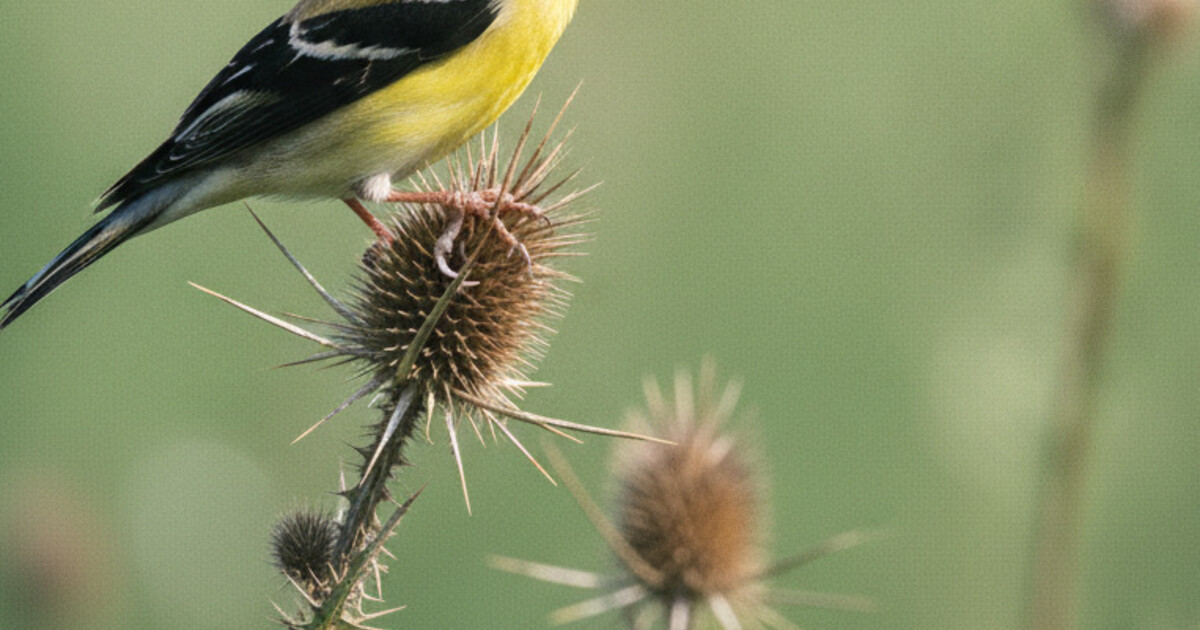
The most common small yellow bird in North America is the American Goldfinch, found year-round across the contiguous US. In breeding plumage the male is bright lemon-yellow with black wings and a black forehead patch. Both sexes go olive-yellow in winter. Bill shape separates them from warblers: goldfinches have short, stubby seed-crackers; warblers have thin, pointed insect-picking bills.
How to Read a Small Yellow Bird Quickly
Five questions settle most IDs before you even pull out a field guide.
First: how much of the body is yellow? A bird that’s yellow from crown to undertail is almost certainly a Yellow Warbler or a breeding male American Goldfinch. A bird that’s yellow only on the throat and belly is something else, most likely a Common Yellowthroat or a Pine Warbler.
Second: what color are the wings and back? Bright yellow body, black wings with white bars: goldfinch. Olive or greenish back, yellow below: most warblers. Very dark back with yellow below: Lesser Goldfinch or Yellow-breasted Chat.
Third: what’s the bill like? Thick and cone-shaped is the finch family. Thin, needle-like is a warbler or vireo.
Fourth: where is the bird and what is it doing? Clinging to a nyjer feeder or a dry thistle is almost certainly goldfinch territory. Flitting through low willows near a stream is Yellow Warbler territory. Skulking through cattails with just a yellow throat showing is the Common Yellowthroat.
Fifth: what time of year is it? American Goldfinches peak in bright yellow from May through August and molt into drab olive by October. Most warblers pass through on spring and fall migration. A small yellow bird at a seed feeder in December is probably a goldfinch in winter plumage.
American Goldfinches breed across most of the contiguous United States and into southern Canada, from the Pacific Coast to the Atlantic. Males go through 2 molts per year: a partial molt in late winter that brings in the breeding colors by April, and a complete post-breeding molt in late summer that takes both sexes back to olive-yellow by October. They run 4.3-5.1 inches long and weigh 0.4-0.7 oz, close to a Black-capped Chickadee in size. The goldfinch is the state bird of Iowa, New Jersey, and Washington. Their diet is almost entirely seeds year-round, even in winter, which is unusual for a bird that doesn’t migrate. They ignore suet and fruit but pack onto nyjer and sunflower-chip feeders. Flight is deeply undulating, a bounding wave pattern, and the bird calls per-chik-o-ree in flight once you’ve learned to listen for it.
American Goldfinch: What Changes Between Summer and Winter
The summer male is the bird on mugs and yard signs: clean lemon-yellow body, black wings with two white bars, a small black cap above the forehead, pinkish-orange bill. That’s the easy one.
The winter bird throws people off. The black cap disappears. The body fades to flat olive-yellow or yellowish-gray. The wings stay dark with white bars but look less dramatic against the duller body. A lot of people report a sick goldfinch or an unknown species when they’re actually looking at a healthy bird in winter plumage.
Female goldfinches look like winter males year-round: olive-yellow back, pale yellowish-white below, two white wing bars, no cap. They’re often logged as “a pale yellow-green bird” when seen without the bright male nearby for comparison.
One mark that holds across all plumages: white undertail coverts and white wing bars. Check under the base of the tail. If those patches are bright white and clean, you’re probably looking at a goldfinch regardless of season.
Yellow Warblers and How to Tell Them From Goldfinches
Yellow Warblers cause more goldfinch confusion than any other species, so they’re worth working through carefully.
Yellow Warbler (4.7-5.1 inches). Entirely yellow, including most of the tail, which shows yellow spots along the edges rather than the goldfinch’s black tail. Males have thin reddish streaks across the breast. The bill is thin and pointed. Habitat is almost always shrubby edges near water: willows, alders, streamside brush. They hover-glean insects from leaves, which a goldfinch never does.
Common Yellowthroat (4.3-5.1 inches). Yellow only on the throat and breast; the rest is olive-brown above and whitish below. Males have a broad black mask across the face, which makes them unmistakable. Females lack the mask and are genuinely tricky: olive above, yellowish throat, nothing particularly striking. Habitat is dense low cover, cattails, and marsh edges. You’ll usually hear the witchety-witchety song before you see the bird.
Wilson’s Warbler (3.9-4.7 inches). A round, compact yellow bird with an olive-green back and a small, sharply defined black cap on males. Active and constantly flitting through shrubby edges. Females lack the cap and look like a small, roundish yellow-green bird with a bright yellow eyebrow stripe.
Pine Warbler (5.1-5.5 inches). Yellow throat and breast, olive-gray back, white belly, two white wing bars. Found almost exclusively in pine forests, which removes most of the ambiguity. In winter this is one of the few warblers that actually visits feeders, eating suet and millet.
Prothonotary Warbler (5.1-5.5 inches). Eastern swamps and flooded bottomlands only. Brilliant golden-orange head and breast, blue-gray wings, white undertail. The richest yellow of any eastern warbler, and the only one that nests in tree cavities rather than open cup nests. Unmistakable in range.
Western and Regional Yellow Birds
West of the Rockies, add these to the mental lineup.
Lesser Goldfinch (3.5-4.3 inches). Smaller than an American Goldfinch, with a dark, often greenish-black back. Males show the same black wings with white bars, but the back is noticeably darker. Found year-round in the Southwest and along the Pacific Coast. Females are greenish-olive and nearly identical to female American Goldfinches in the field.
Yellow-breasted Chat (up to 7.5 inches). Olive-green above, bright yellow throat and breast, white spectacles, a thick hooked bill. Now classified in its own family (Icteriidae) after decades as an oversized warbler. Found in dense shrubby thickets across much of North America. Size alone prevents confusion once you get a decent look.
Other Yellow-Bellied Birds That Show Up in Searches
Two common birds have yellow bellies but don’t otherwise read as yellow birds. They generate enough “what yellow bird is this” searches to be worth knowing.
Western Kingbird (7.9-9.4 inches). Gray head and back, bright yellow belly and undertail. Found across the western US on utility wires, fence posts, and open country perches. A bird in a bush with only the belly visible can puzzle people expecting a warbler. The gray-and-yellow split is clear once you see the full bird.
Yellow-rumped Warbler (4.7-5.5 inches). Shows yellow patches on the rump, crown, and sides, but the rest of the body is streaked gray or brown. Common across North America in migration and winter. The flash of yellow on the rump in flight is the giveaway.
How Animal Identifier Helps With Yellow Birds
The harder identifications here come down to a photo being better than a description. A bird you’d call “small, yellow, in a shrub” could be a female Common Yellowthroat, a female Wilson’s Warbler, a female Yellow Warbler, or a female goldfinch, and a written description won’t separate them.
Take a photo, even a poor one through a window, and Animal Identifier will name the species. After the ID you can ask the follow-up chat how to tell a Yellow Warbler from a female goldfinch, whether a Pine Warbler turns up at feeders in your area in winter, or why your goldfinch looks olive instead of yellow. The app covers birds, mammals, reptiles, and insects, saving every identification to your history so a bird you couldn’t name in fall is still there when a similar one shows up in spring.
The same field-mark logic that works here applies to other color puzzles: birds with red heads and black and white birds follow the same size-pattern-behavior checklist. You get 2 free identifications a day on iOS and Android, no account needed.
Frequently Asked Questions
What is the most common small yellow bird in North America?
The American Goldfinch is the most widely seen small yellow bird, found year-round across the contiguous United States. The male’s bright lemon-yellow breeding plumage runs from May through August. By October both sexes go olive-yellow, which generates a lot of mystery-bird reports at winter feeders. It’s the state bird of Iowa, New Jersey, and Washington.
What small yellow bird has black wings?
Almost certainly an American Goldfinch. The breeding male has black wings with two white wing bars and a black forehead cap. In the western US, a Lesser Goldfinch shows similarly dark wings with a darker greenish-black back. No common North American warbler combines all-black wings with a bright yellow body.
Is a Yellow Warbler the same as a goldfinch?
They’re in different families with completely different bills. A goldfinch has a thick, cone-shaped bill for cracking seeds. A Yellow Warbler has a thin, pointed bill for picking insects. Yellow Warblers also show yellow spots in the tail rather than a black tail, and they’re almost always near water in shrubby habitat rather than at seed feeders.
What does a female goldfinch look like?
Female American Goldfinches are olive-yellow above and pale yellowish-white below with two white wing bars and no black cap. They look like winter males year-round. White undertail coverts and white wing bars are the reliable field marks in any plumage. In summer, with the bright male alongside, the olive-green female looks like a completely different species.
Why does my goldfinch look yellow-green in winter?
American Goldfinches complete a full post-breeding molt in late summer, and both sexes arrive at dull olive-yellow by October. The bright yellow returns gradually through late winter and peaks by April. A bird that looks olive-green at your January feeder is healthy and on schedule. If the white wing bars and white undertail are still crisp, it’s a goldfinch in winter dress.
When a small yellow bird moves through faster than you can work through the checklist, take the photo first. Animal Identifier will name the species from the picture and answer your follow-up questions about how to recognize it next time.