Small Brown Spiders in the House: What They Are
Small Brown Spiders in the House: What They Are
You’re making coffee and a small brown spider drops from the cabinet on a silk thread, or you spot one sitting motionless in a corner web you somehow missed for weeks. First question, every time: is it dangerous?
Finding a small brown spider in the house is completely normal, especially from September through November when cooling temperatures push outdoor spiders inside looking for warmth. The vast majority of what you’ll encounter are species that have lived alongside humans for thousands of years, entirely harmless and quietly useful for keeping flies and other insects down. One genuinely dangerous species exists in the US, but it has specific, identifiable features you can check in about ten seconds.
This guide covers the four most common small brown house spiders, how to tell them apart at a glance, and the two-feature rule that settles the brown recluse question without any guesswork.
The small brown spider in your house is most likely an American house spider, cellar spider, wolf spider, or southern house spider. All four are harmless. To rule out a brown recluse, check for two things: a violin-shaped mark on the back of the front body section, and six eyes instead of eight. A spider without both features is almost certainly harmless.
4 Small Brown Spiders Commonly Found in US Homes
Most “small brown spider in the house” sightings come down to four species. All are widespread across the United States, all prefer low-traffic indoor spots, and none are dangerous to people.
The American house spider (Parasteatoda tepidariorum) is the most common indoor brown spider in North America, found in all 48 contiguous states. Females measure 5 to 8 mm in body length; males run slightly smaller at 4 to 6 mm. The body is tan to dark brown with a mottled or spotted pattern on the bulbous abdomen. Cellar spiders (family Pholcidae) are the leggy ones: body length is only 2 to 8 mm, but the legspan can reach 50 mm, giving them a skeletal, daddy-longlegs look. Wolf spiders (family Lycosidae) commonly found indoors range from 10 to 20 mm and are the only house spiders that carry their egg sacs and spiderlings on their bodies, a behavior unique to this family. Southern house spiders (Kukulcania hibernalis) build funnel-shaped webs in corners and under eaves; males reach 12 mm and are routinely misidentified as brown recluses because of their uniform tan coloration and long narrow legs.
American House Spider
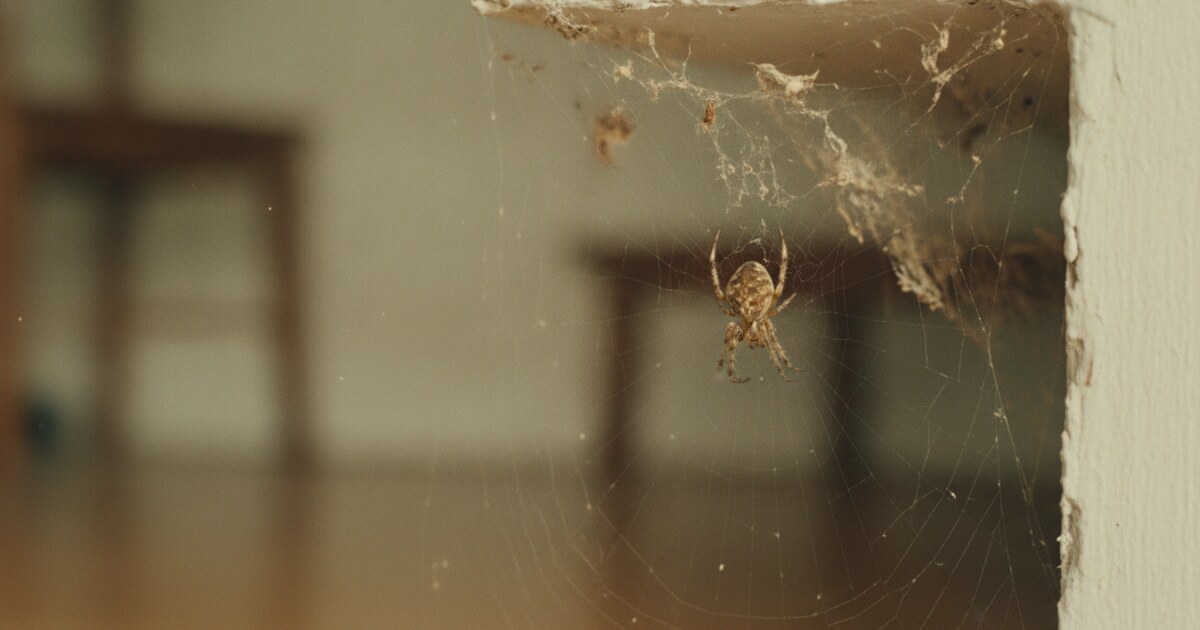
The American house spider is responsible for most of the messy cobwebs behind furniture and in window corners. The body is small (5 to 8 mm) and distinctly round and bulbous, in shades of brown and tan with faint spotting on the abdomen. The legs are thin and faintly banded.
These spiders are passive. Disturb their web and they drop to the floor and disappear. They’ll bite only if you physically pinch them, and the result is mild localized redness that clears up within a day. They’re doing useful work: the cobweb is a fly trap.
Cellar Spider
Cellar spiders look more alarming than they are because of those legs. The body itself is tiny (2 to 8 mm) and pale yellow-brown to gray, but the legs extend out to 50 mm in all directions, which creates an impression of something much larger. You’ll find them in basements, crawl spaces, garage ceilings, and the corners of utility rooms, usually hanging upside down in a loose, irregular web.
Despite the common name “daddy longlegs” (which also belongs to a completely unrelated arachnid called a harvestman), cellar spiders are harmless. Their mouthparts are too small to puncture human skin. They also prey on other spiders, including web-invaders that try to steal their webs.
Wolf Spider
Wolf spiders are the brown spiders you’re most likely to see moving. They’re hunters rather than web-builders, and they roam the floor rather than sitting in one spot. Most wolf spiders encountered indoors run 10 to 20 mm, with a stocky, hairy body and darker brown striping down the back. The middle row of eyes is noticeably larger than the others, which gives them a distinctive face if you look closely.
They move inside primarily in fall. Wolf spiders are startling to encounter at close range but not medically significant. The bite causes localized pain comparable to a bee sting for most people, and serious reactions are rare.
Southern House Spider
The southern house spider (Kukulcania hibernalis) is common across the Southeast, Gulf Coast, and southern interior of the country. Females are large (up to 19 mm) and dark charcoal-brown, with a softer, rounder body. Males are where the confusion happens: they reach about 12 mm, have a uniform light tan coloration, long narrow legs, and a body shape that genuinely resembles a brown recluse.
The distinguishing feature is the eyes. Southern house spiders have eight eyes arranged in two groups. Brown recluses have six eyes in three pairs arranged in a semicircle. That’s the check. If you’re in the Southeast and you’re not sure, start there.
How to Tell Them Apart at a Glance
Body shape is your first clue before you get close enough to count eyes.
| Spider | Body size | Key visual | Web type |
|---|---|---|---|
| American house spider | 5–8 mm | Round bulbous abdomen, spotted | Messy cobweb in corners |
| Cellar spider | 2–8 mm body | Tiny body, enormous legspan | Loose tangle web |
| Wolf spider | 10–20 mm | Stocky, hairy, dark stripes on back | None — active hunter |
| Southern house spider | 12–19 mm | Uniform tan (males), funnel web builder | Funnel web in corner |
A round, grape-like abdomen on a small tan spider in a corner web means American house spider almost every time. A tiny pale body on legs that seem too long points to cellar spider. A stout, hairy spider moving across the floor is almost certainly a wolf spider. A flattened tan spider with long legs near a funnel web in the Southeast is usually a southern house spider.
The Brown Recluse Check: Two Features That Settle It
The brown recluse (Loxosceles reclusa) is the one small brown spider with venom capable of causing significant harm. The bite can produce tissue necrosis, and in rare cases systemic symptoms including fever and nausea. It’s also among the most overdiagnosed spiders in the country: surveys of spiders submitted to university extension programs as “brown recluses” find misidentifications in the vast majority of cases.
Two features identify a brown recluse and separate it from every lookalike:
The violin mark. A dark, violin-shaped marking on the cephalothorax (the front body section), with the neck of the violin pointing toward the abdomen. It’s not always crisp in photographs, but it’s visible with a flashlight on an adult spider. No other common house spider in the US has this marking.
Six eyes. Brown recluses have three pairs of eyes arranged in a semicircle — six total. Every other small brown spider you’re likely to encounter has eight. This is the definitive check. You’ll need a phone camera in macro mode or a magnifying glass to count confidently, but if the number is six, that’s a brown recluse.
Range also matters. Brown recluses are primarily found in a band through the south-central US: Missouri, Arkansas, Kansas, Oklahoma, Texas, Mississippi, Alabama, Georgia, and neighboring states. Confirmed brown recluse sightings in New England, the Pacific Northwest, or the northern Midwest are genuinely uncommon. If you’re in those regions and a spider is being called a brown recluse, it’s worth checking the features before acting on that ID.
Where Small Brown Spiders Tend to Hide
All four common indoor brown spiders favor low-traffic, undisturbed spots. American house spiders concentrate around window frames, ceiling corners, and behind furniture that doesn’t move often. Cellar spiders take the dampest corners: basements, crawl spaces, and the area around water heaters. Wolf spiders stay lower, found near baseboards, door frames, and in garages.
Brown recluses, where they occur, hide in tighter, more enclosed spaces: inside stacked cardboard boxes, folded clothing that’s been stored for a season, under furniture that hasn’t moved in months, and in dark closet corners. If you live in brown recluse territory, shaking out shoes and stored clothing before putting them on is reasonable precaution.
Why More Brown Spiders Appear in Fall
The September-October spike in indoor spiders has two straightforward causes. Male spiders leave their retreats to search for mates in late summer and early fall, which means they’re moving around more and end up in more visible spots than at any other time of year. At the same time, dropping overnight temperatures push outdoor spiders toward warmth.
This is particularly noticeable with wolf spiders, which move inside in larger numbers in fall than in summer. The uptick is normal and temporary. By November it typically tapers off as temperatures stabilize and mating season ends.
How Animal Identifier Can Help Confirm What You Found
If you’re looking at a spider and you want confirmation rather than a best guess, a photo from a safe distance gives you something to work with. Animal Identifier takes photos of spiders (and any other animal) and returns the species along with habitat notes, behavior, and a clear indication of whether it poses any danger. Two free identifications per day, no account required.
The comparison problem covered in this article — is that a southern house spider or a brown recluse? — is exactly the kind of case where a photo ID is useful. Most of the time you’ll get confirmation it’s a southern house spider, which is a better outcome than an unresolved worry. If the app does confirm brown recluse, you have clear grounds to call pest control. For a fuller comparison of which apps handle spiders best, see the guide to apps to identify spiders. And if you’ve got a small black spider with white markings rather than a brown one, the guide to black spiders with white spots covers jumping spiders and their lookalikes.
Frequently Asked Questions
Is the small brown spider in my house dangerous?
Almost certainly not. The four most common small brown house spiders in the US — American house spider, cellar spider, wolf spider, and southern house spider — are all harmless. The only dangerous small brown spider is the brown recluse, which has a violin-shaped mark on its cephalothorax and six eyes instead of eight. A spider without both of those features isn’t a brown recluse.
How do I tell a brown recluse from a harmless house spider?
Check two things: a dark, violin-shaped mark on the back of the front body section (with the violin neck pointing toward the abdomen), and six eyes arranged in three pairs. Every other common small brown house spider has eight eyes and no violin mark. Also consider range — brown recluses are primarily south-central US; confirmed sightings elsewhere are rare.
Why are there suddenly more spiders in my house in fall?
September and October bring more indoor spider activity for two reasons: male spiders roam widely during mating season, ending up in more visible spots, and cooling outdoor temperatures push spiders toward warmth indoors. The increase is normal and temporary, typically tapering off by late November.
Should I remove spiders I find in my house?
Most indoor spiders are eating the flies, mosquitoes, and other insects in your home. If you want one gone, relocate it with a glass and a piece of paper. Killing them isn’t necessary and removes a useful predator. The exception is a confirmed brown recluse in a living space where young children spend time.
How do I keep brown spiders from coming inside?
Seal gaps around door frames, window frames, and utility entry points. Reduce clutter in basements and storage areas where spiders like to hide. In brown recluse territory, store shoes in sealed containers and shake out clothing that’s been sitting in a closet for more than a few weeks.
Most brown spiders in the house are doing nothing more threatening than sitting in a corner and waiting for a fly. The American house spider, cellar spider, wolf spider, and southern house spider account for the overwhelming majority of sightings. If you want a confirmed ID rather than a best guess, take a photo and run it through Animal Identifier — 2 free IDs a day, no account needed.