Black Spiders With White Spots: What You're Looking At
Black Spiders With White Spots: What You’re Looking At
You spotted a small black spider with white spots on the wall, the windowsill, or the basement floor. Maybe it turned to look at you. Before you grab a shoe, it helps to know what you’re actually dealing with. The species behind the majority of these sightings is a genuinely harmless insect hunter that’s probably doing you a favor.
This guide covers the six most common black spiders with white spots you’ll encounter in the United States, how to tell them apart, and the one visual rule that separates the harmless ones from the ones worth treating more carefully.
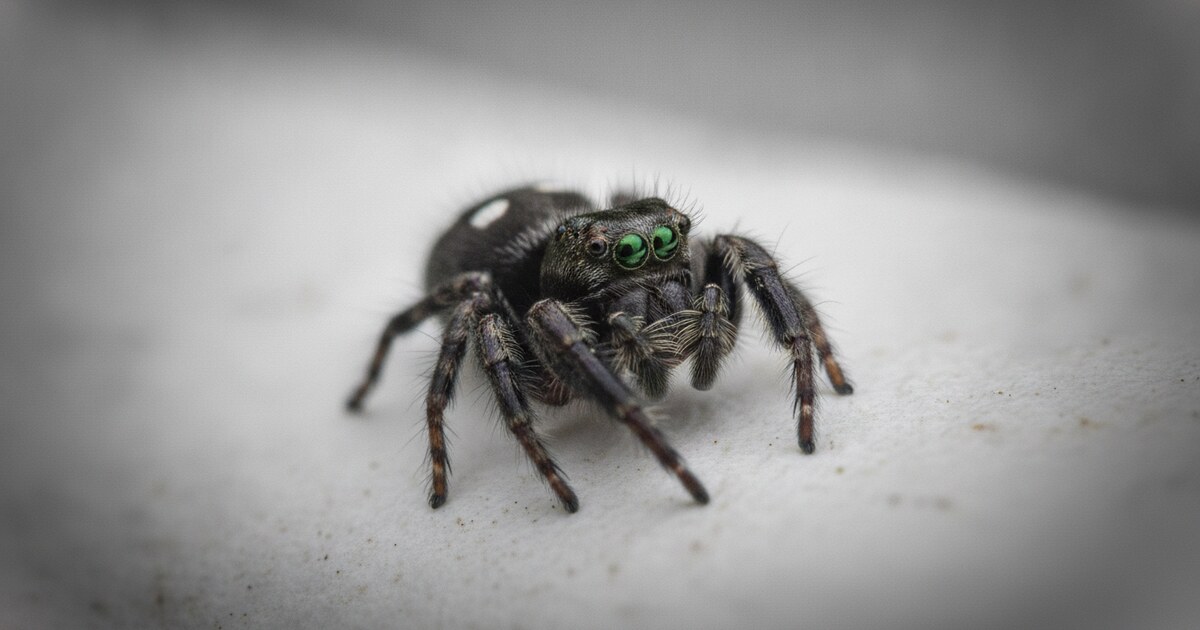
The most common black spider with white spots is the bold jumping spider (Phidippus audax): fuzzy black body, three white abdominal spots, and large front-facing eyes. It’s harmless. A smooth, shiny body on a black-and-white spider points toward a false widow or juvenile black widow; both deserve more distance before you decide what to do.
The Bold Jumping Spider: Most Common Black Spider With White Spots
The bold jumping spider (Phidippus audax) accounts for the overwhelming majority of “black spider with white spots” sightings in the US. Get familiar with it and you’ll be able to identify most of what you encounter.
Adults range from 8 to 19 mm in body length, with females consistently larger than males. The body is black and distinctly fuzzy, covered in short bristly hairs that give it an almost velvety look. Three white spots sit on the abdomen in a loose triangular arrangement, and the center spot is usually the largest. The face has two oversized forward-facing eyes flanked by two smaller pairs; that combination of large eyes and fuzzy black body is the jumping spider’s unmistakable trademark. The chelicerae (the jaw-like mouthparts below the eyes) are often iridescent blue-green. The legs are black with faint gray-white banding. Bold jumping spiders live across all 48 contiguous states, from backyards and gardens to the interior of homes. They hunt by stalking prey rather than building webs, and females can jump up to 50 times their body length. The bite is medically insignificant for most people, comparable to a bee sting.
One behavior makes identification even easier: bold jumping spiders turn to face you. If you approach and the spider pivots to look directly at you rather than running, you’re almost certainly looking at a jumping spider. They’re curious, not defensive, and they won’t charge.
Zebra Jumping Spider: Stripes Instead of Spots
The zebra jumping spider (Salticus scenicus) is smaller than the bold jumper (adults run 5 to 7 mm), and its white markings form stripes and bands rather than three distinct spots. The abdomen has alternating black and white chevron-like stripes running lengthwise, which is where the common name comes from.
You’re most likely to see zebra jumping spiders outdoors on sun-warmed surfaces: wooden fences, exterior siding, brick walls, and window frames. They’re active during the day and will turn to face you if you get close, just like the bold jumper. Their tiny size and striped pattern make them easy to distinguish from the bold jumper once you’ve seen both.
Zebra jumping spiders are found throughout North America and Europe. Completely harmless.
White-Spotted Jumping Spider: The Bigger Southern Variant
If you’re in Florida, Georgia, or elsewhere in the Southeast and the spider seems larger than expected, it may be Phidippus regius, the regal jumping spider, also called the white-spotted jumping spider. Females reach up to 22 mm, making this the largest jumping spider in North America.
Males are black with white banding and spots similar to the bold jumper. Females can be gray or orange-brown. The white markings on males include spots and bands on both the abdomen and legs, giving a more heavily patterned look than P. audax. Range is mostly the Southeast US plus scattered Caribbean populations.
Same rules apply: fuzzy body, forward-facing eyes, turns to look at you. Harmless.
Spotted Orb Weaver: The Web-Builder in the Corner
The spotted orb weaver (Neoscona domiciliorum) is the one spider in this list that’s not a jumper. Adults are 5 to 15 mm, with dark brown to black coloring and white or yellow spots on the abdomen, sometimes arranged in two rows.
The biggest difference from jumping spiders: orb weavers build webs. If the black-and-white spider you found is sitting in the center of a spiral web in a corner or along a porch ceiling, it’s almost certainly an orb weaver rather than a jumper. They’re most common in late summer and fall when adults reach full size.
Spotted orb weavers are found across the eastern United States. They’re not considered dangerous to humans, and bites (rare) cause only minor localized pain.
False Widow: Why the Smooth Body Matters
The false widow (Steatoda grossa) is a species that can cause confusion because it superficially resembles a black widow. Adults are 6 to 10 mm with a glossy, smooth, rounded abdomen, sometimes dark brown rather than true black, with pale cream or white markings on the back.
The key difference from jumping spiders: no fuzz. The false widow’s body is smooth and shiny, not velvety. It also lacks the jumping spider’s large front-facing eyes. False widows hang in messy cobwebs rather than sitting out in the open on flat surfaces.
Bites from false widows are more significant than jumping spider bites: pain, redness, and swelling are possible, occasionally worse in sensitive individuals. Unprovoked bites are uncommon, but if you’re bitten and symptoms don’t resolve in a few hours, a doctor visit is reasonable.
Juvenile Black Widow: When White Spots Belong to a Venomous Spider
Juvenile black widows look nothing like the adult female’s iconic glossy black body with a red hourglass. Young black widows (males and juveniles of either sex) are black with white, yellow, or orange stripes and spots on the abdomen. This is exactly what many people describe when they search “black spider with white spots.”
What to look for:
- Smooth, shiny body (never fuzzy)
- Thin, long legs relative to body size
- Round, globular abdomen
- Messy tangled web low to the ground, under rocks or debris, or in dark sheltered corners
- No large front-facing eyes
Adult female black widows are among the most venomous spiders in North America. Juvenile specimens are smaller and their venom delivery is less efficient, but bites still warrant medical attention. If the spider matches the smooth-body, long-legs, low-web description, especially under a rock or in a garage corner, give it space.
One Rule for Telling Black and White Spiders Apart
You don’t need to identify every species on the spot. One feature tells you almost everything you need to know:
Fuzzy body (short bristly hairs covering the abdomen and legs) means you’re almost certainly looking at a jumping spider. Every jumping spider in North America is harmless to humans. The bold jumper, zebra jumper, and white-spotted jumper all have this texture, and you can spot it from a foot away without getting close.
Smooth, shiny body (particularly a round, glossy abdomen) means take a photo before deciding anything. False widows, juvenile black widows, and some orb weavers have smooth bodies. None of them are instinctively aggressive, but knowing which you have is worth 30 seconds.
Body size alone won’t tell you much. A large fuzzy spider is still a harmless jumper. A small smooth spider deserves a second look.
How Animal Identifier Can Help
If the spider is somewhere you can’t get a clear look, such as a dark corner, behind furniture, or moving fast across the floor, a photo ID works better than trying to recall the details later. Animal Identifier lets you photograph the spider and get the species back in seconds, with information on whether it’s considered venomous.
After the ID, the follow-up chat lets you ask specific questions like “how dangerous is this spider to a child?” or “does this species bite unprovoked?” The chat is scoped to animals, so it sticks to what it actually knows. Two free identifications per day, no account required.
For a side-by-side comparison of apps, the apps to identify spiders guide covers four tools and how they each handle tricky specimens.
If you’re finding multiple unexpected arthropods in your home and wondering what else is around, the photo-ID approach works just as well for bugs that look like roaches and similar household finds.
Frequently Asked Questions
Are black spiders with white spots dangerous?
Most are not. The bold jumping spider, zebra jumping spider, and white-spotted jumping spider (the species behind the majority of sightings) are harmless to humans. A smooth, shiny body on a black-and-white spider is the signal to look more carefully, since false widows and juvenile black widows fit that description. Neither is aggressive, but knowing which you have is useful.
What is the black spider with three white dots on its back?
The bold jumping spider (Phidippus audax). The three spots sit in a loose triangular arrangement on the abdomen, with the middle spot usually the largest. The spider is fuzzy, compact, and has very large front-facing eyes. It’s one of the most common spiders in North American homes and gardens, and it’s harmless.
How do I tell a jumping spider from a black widow?
Texture is the easiest tell. Jumping spiders are fuzzy, compact, and sit out in the open, often turning to face you. Black widows (including juveniles with white or yellow markings) have smooth, shiny bodies with a round abdomen and long thin legs. They build messy, low-to-the-ground webs in dark, sheltered spots under rocks, in woodpiles, or behind garage equipment. Fuzzy body means jumping spider; smooth and glossy in a dark corner web means look again.
Do jumping spiders bite?
They can, but they rarely do. Jumping spiders are curious rather than defensive, and bites typically only happen if someone handles them roughly or traps them against skin. The bite produces minor pain and localized redness comparable to a small bee sting. No medical treatment is needed in the vast majority of cases.