Skunk Poop: How to Identify Skunk Droppings
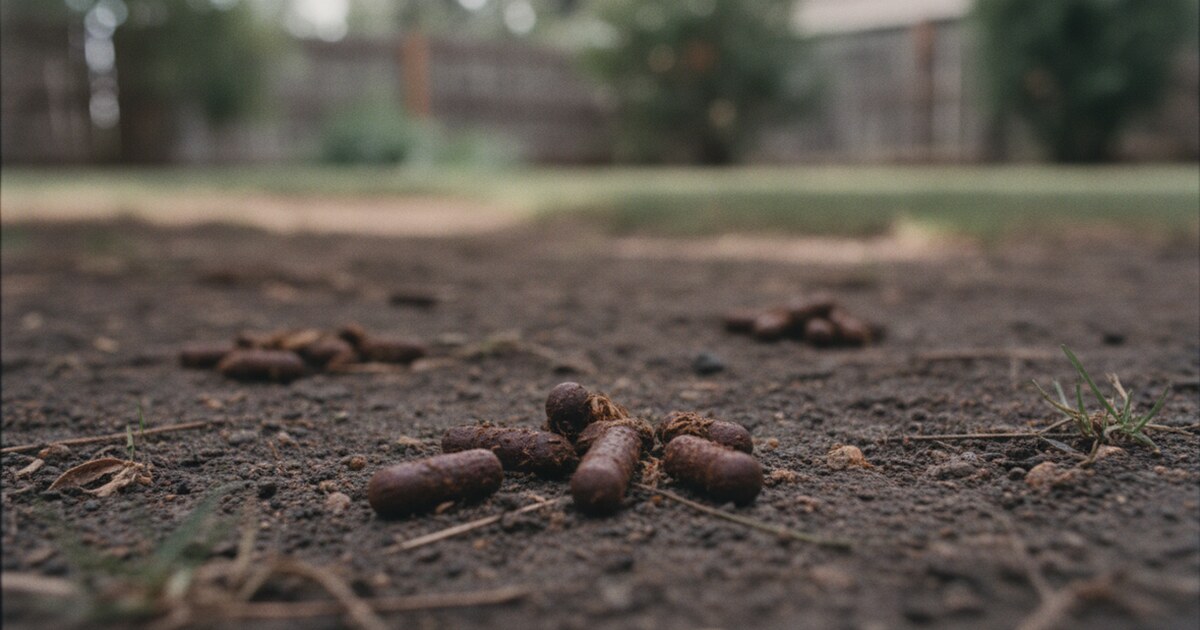
You’re cleaning up a garden bed, checking under the deck, or investigating a suspicious corner of the garage — and you find a cluster of dark, tubular droppings. The first question is whether you’re looking at skunk poop, raccoon scat, or what a neighborhood cat left behind. That distinction matters. Skunks carry Leptospirosis, Salmonella, and roundworm in their feces, and knowing what made the mess tells you what animal is denning on your property. This guide covers what skunk droppings look like, how they compare to similar scat, where you’ll find them, and what to do once you’ve confirmed the ID.
Skunk poop is tubular with blunt ends, roughly 1/4 to 1/2 inch in diameter and 1 to 2 inches long. Fresh droppings are dark brown to black. The clearest giveaway is the contents: shiny insect wing cases, berry seeds, and small bone fragments, reflecting the skunk’s omnivorous diet. The smell is musky and strong.
What Skunk Poop Looks Like
Fresh skunk droppings are dark brown to nearly black, tubular in form, with rounded or blunt ends on both sides. Diameter runs from about 1/4 inch on the small end to 1/2 inch for an adult, and length typically falls between 1 and 2 inches per piece.
As the droppings dry, the color shifts from dark brown toward grayish-tan. The surface loses its sheen and the material gets crumbly. A few days of sun and weather can make dried skunk scat look noticeably different from what you’d expect.
Skunk droppings are one of the most diagnostic examples of diet reflected in scat. North American skunks, primarily the striped skunk (Mephitis mephitis), are opportunistic omnivores that shift their diet seasonally: insects and grubs in summer and fall, berries and plant matter in late summer, small vertebrates and carrion year-round. Fresh droppings measure 1/4 to 1/2 inch in diameter and 1 to 2 inches in length, with blunt ends and a tubular form. Color runs from dark brown to black when fresh, fading to gray-tan as the scat dries. The musky odor comes from sulfur compounds. Health risks are real: Leptospirosis (Leptospira spp.), Salmonella, and roundworm eggs can all be present. Roundworm eggs remain viable in dry droppings for months, meaning old scat is as hazardous as fresh. Skunk droppings are typically deposited as a loose cluster near a den entrance or feeding site, not in communal piles like raccoon latrines. Always treat found droppings as biohazardous material.
The most reliable single clue is what’s inside. When you pull a dropping apart carefully with gloved hands, you’ll often find shiny beetle wing cases, seed husks, or small bone fragments. A cat that eats commercial kibble, or a raccoon raiding a garbage can, doesn’t leave that specific combination. If you see what looks like broken insect armor mixed into dark, tubular scat in your yard, you’re almost certainly looking at skunk poop.
Skunks don’t use communal latrines like raccoons. Their droppings show up in small clusters or scattered single pieces near feeding sites and den entrances, not in a single growing pile. That loose, distributed pattern is another clue.
Skunk Poop vs. Raccoon, Cat, and Possum Droppings
The most common confusion is between skunk poop and cat feces. Both are tubular with blunt ends, in roughly the 1 to 2 inch range. The differences: cat scat has a sharper ammonia smell rather than the sulfurous musk of skunk, and cat poop from a pet or feral cat fed on prey rarely contains shiny insect parts. Skunk droppings almost always show dietary evidence if you look closely.
Raccoon droppings are noticeably larger, averaging about 3/4 inch in diameter and up to 3 inches in length. They’re often twisted or segmented at the ends. Raccoons also use communal latrines, depositing repeatedly in the same spot, so you’ll find a concentrated pile rather than scattered pieces. See our full animal poop identification chart for a broader view of common wildlife scat.
Possum poop sits in a similar size range to skunk scat, but opossum droppings tend to have pointed or tapered ends rather than blunt ones, and the color often runs paler, toward gray or tan even when fresh. Opossums eat a lot of plant matter and carrion; their droppings don’t typically contain shiny insect cases. For a closer comparison, see our guide on possum poop identification.
Quick reference:
| Animal | Diameter | Length | Ends | Color (fresh) | Key content clue |
|---|---|---|---|---|---|
| Skunk | 1/4–1/2 in | 1–2 in | Blunt | Dark brown to black | Insect wing cases, seeds |
| Raccoon | ~3/4 in | 2–3 in | Twisted, blunt | Dark brown | Berry seeds, twisted form |
| Cat (domestic) | 1/4–1/2 in | 1–2 in | Blunt | Brown | Minimal (kibble-fed) |
| Opossum | 1/4–1/2 in | 1–1.5 in | Pointed | Grayish-tan | Plant matter, pale color |
Where Skunk Droppings Turn Up
Skunks den in low, sheltered spaces: under decks, in crawl spaces, beneath porches, under sheds, in hollow logs, and occasionally in abandoned burrows. Droppings accumulate near the den entrance, typically within a few feet of where the skunk sleeps.
You’ll also find scattered droppings along foraging routes. Skunks dig shallow, conical holes in lawns as they root for grubs — small divots about golf-ball size, usually in a loose cluster. Droppings often appear within a few yards of the dig sites.
Near vegetable gardens, compost bins, and fruit trees is another high-probability zone. Skunks raid berry plants, root through soft soil, and investigate grub-rich compost. Finding droppings alongside small claw marks or shallow dig holes in a garden bed points strongly to skunk, not cat or raccoon.
One useful rule of thumb: skunks rarely climb. If droppings appear on a deck surface, an elevated structure, or a tree crotch, raccoon is the more likely culprit. Skunk activity stays low to the ground.
Health Risks: Why Skunk Droppings Require Care
Skunk feces can carry several pathogens worth knowing by name:
Leptospirosis is caused by Leptospira bacteria. Mild infections produce flu-like symptoms: fever, headache, muscle aches. Severe leptospirosis can progress to liver or kidney failure. Both people and dogs are susceptible, and transmission can happen through direct contact with droppings or contaminated soil and water.
Salmonella causes diarrhea, vomiting, fever, and abdominal cramps. Usually self-limiting in healthy adults, but serious for children, older adults, and immunocompromised individuals.
Roundworm eggs can be present in skunk feces. The eggs survive for months in dried droppings and are ingested through hand-to-mouth contact. In rare cases, roundworm larvae migrate through tissues and cause neurological or respiratory complications.
Dogs are at particular risk. They’re likely to sniff or lick droppings in the yard, and Leptospirosis transmits easily through mucous membranes. Contact your vet if your dog gets into skunk droppings.
The hazard doesn’t go away as droppings age. Roundworm eggs stay viable in dried scat, and Leptospira can persist in moist soil for weeks. Treat old droppings as carefully as fresh ones.
How to Clean Up Skunk Droppings Safely
Gear up before you start: disposable gloves, an N95 respirator mask, eye protection, and clothes you can wash immediately afterward.
Skip dry sweeping or blowing. Disturbing dry scat aerosolizes the material, which is the main inhalation risk. Instead, dampen the droppings first with a dilute bleach solution (about 1 tablespoon bleach per quart of water), then scoop the material into a sealed plastic bag.
Disinfect the surface with the same bleach solution. Hard surfaces like concrete are straightforward to clean. If the droppings are on soil or lawn, remove the top inch of material, bag it, and apply disinfectant to the exposed area.
Bag and seal everything in two layers of plastic, then put it in the regular trash. Wash your gloves, the soles of your shoes, and any tools used. Then wash your hands thoroughly.
If you find a large accumulation in a confined space, like a crawl space under the house, professional cleanup is the safer route. The enclosed area raises inhalation exposure and the volume may be more than’s safe to handle without commercial equipment.
Frequently Asked Questions
What does skunk poop look like?
Skunk droppings are tubular with blunt ends, 1/4 to 1/2 inch in diameter and 1 to 2 inches long. They’re dark brown to black when fresh and fade to grayish-tan as they dry. The defining feature is the contents: shiny insect wing cases, seeds, or small bone fragments mixed throughout, reflecting the skunk’s omnivorous diet.
How do you tell skunk poop from raccoon droppings?
Raccoon droppings are larger (around 3/4 inch wide and up to 3 inches long), often twisted or segmented, and deposited in communal piles at a fixed latrine site. Skunk scat is smaller, has blunt ends without the twist, and turns up scattered near den entrances or feeding spots rather than in a concentrated pile.
Are skunk droppings dangerous to dogs?
Yes. Leptospirosis is the main concern: dogs can pick it up by sniffing or licking skunk feces, and it can cause serious kidney and liver damage if left untreated. Call your vet if you know your dog made contact with skunk droppings, especially if the dog develops fever or lethargy in the days following.
Will skunks leave on their own?
Sometimes, particularly if the den is a temporary shelter and the food source near it is removed. Skunks with young, which are born between May and July, are less likely to relocate voluntarily. The most reliable long-term fix is sealing den access points after you’ve confirmed the skunk has left. Do that before denning season in early spring.
What time of day do skunks come out?
Skunks are primarily nocturnal and most active from dusk through the early hours of night. A skunk out in full daylight can indicate a large local population competing for resources, or occasionally a health issue with that individual. If you see one moving erratically or approaching people without apparent concern, keep your distance.
If you find droppings and want to confirm which animal made them, spotting the animal itself gives you a definitive answer. A photo works well for this: Animal Identifier can ID a skunk, raccoon, opossum, or any other mammal from a single picture, and the follow-up chat lets you ask about behavior, typical range, and what to do next. Free on iOS and Android, 2 identifications per day at no cost.