Poisonous Caterpillars in Michigan: Species That Sting
Poisonous Caterpillars in Michigan: Species That Sting
You spot a fuzzy or spiky caterpillar on a branch and wonder whether picking it up is a mistake. Michigan has real caterpillars that cause painful stings, burning rashes, and welts on contact. Most of what you’ll find outdoors is completely harmless, but five species carry either venomous spines or irritating hairs worth knowing about before you reach out and grab one.
Technically, “stinging” is the right word rather than “poisonous.” A poison must be swallowed or absorbed to cause harm; these caterpillars don’t poison you through skin contact. They sting or cause contact dermatitis. The colloquial use of “poisonous” persists because it’s the word most people search for, and the discomfort is real either way.
Yes, there are poisonous caterpillars in Michigan. The Io moth caterpillar (bright green with stinging spines), saddleback caterpillar (brown saddle marking), hickory tussock moth caterpillar (white and black fuzzy), and buck moth caterpillar are the main species to watch for. Contact causes burning, rash, or welts.
Michigan Caterpillars That Can Sting
Five species in Michigan are worth knowing before you handle one. Here’s what each looks like and when you’ll find them.
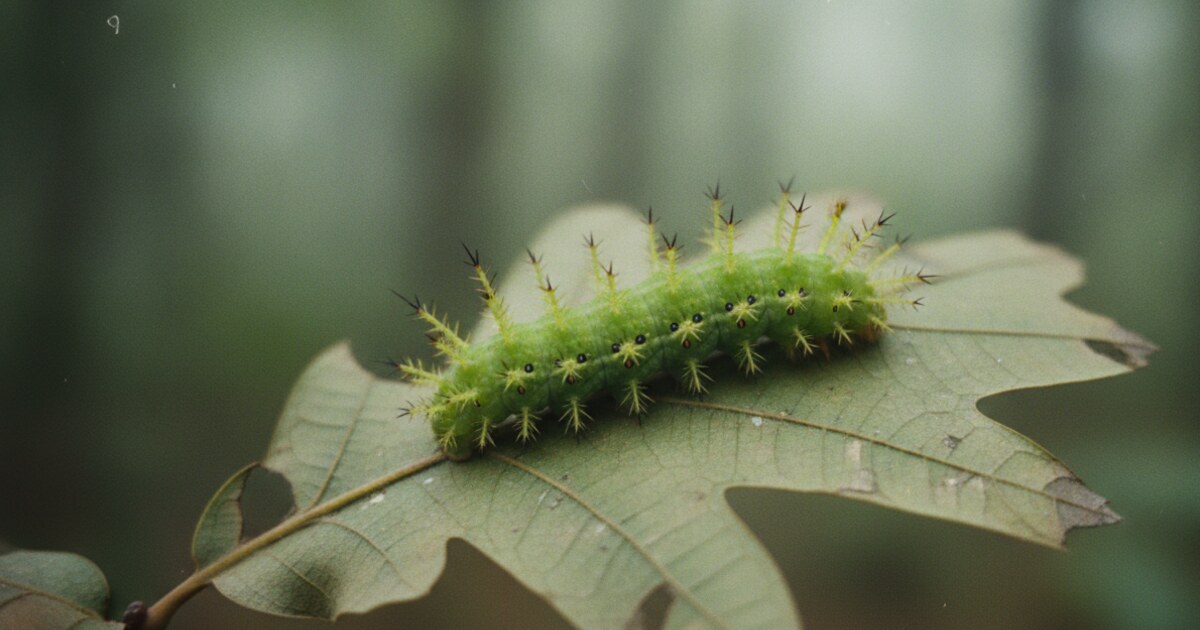
Io moth caterpillar (Automeris io): Bright lime-green, roughly 2 to 2.5 inches long at full size. The body bristles with tight clusters of branching green spines, each hollow and connected to a venom gland at the base. Press your finger against one and the spines break off, injecting venom directly into skin. The pain starts within seconds and can last one to two hours. Io moth caterpillars appear from June through August across southern Michigan on willows, oaks, cherries, and maples.
Saddleback caterpillar (Acharia stimulea): Brown at both ends, bright green in the middle, with a distinct purplish-brown oval on the back that looks like a saddle. Venomous spines project from all four corners and along the sides of the body. The sting is sharp, and some people develop a spreading rash or swelling beyond the contact site. Look for saddlebacks from August into October on oaks, basswood, elms, and maples.
Hickory tussock moth caterpillar (Lophocampa caryae): Covered in dense white hairs with patches of black tufts and a few longer stiff black hairs along the midline. One of the most common Michigan caterpillars people pick up by mistake, because it looks soft and approachable. The white hairs are barbed and break off on contact, causing a rash that may take several hours to appear. Found on hickory, walnut, butternut, and elm from July through September.
Buck moth caterpillar (Hemileuca maia): Dark brown to nearly black, covered in tight clusters of branching spiny tufts. Michigan’s spring stinging species: active in May and June, earlier than most others on this list. It concentrates in oak barrens and savanna habitats, so it’s most common in southwestern Michigan. The sting can be intense.
White-marked tussock moth caterpillar (Orgyia leucostigma): Has a distinctive look: red head, yellow-and-black body, four dense cream or white tufts running down the back, and two long black hair tufts projecting forward from near the head. Very common across Michigan through late summer on a wide range of hardwood trees. The hairs cause skin irritation and eye inflammation on contact.
Michigan has five caterpillar species that cause reactions on contact, split across two mechanisms. The Io moth and saddleback caterpillars carry hollow venomous spines: press against them and the spines break, injecting venom subcutaneously and producing immediate burning pain with localized redness. The tussock moth species (hickory tussock and white-marked tussock) and buck moth use urticating hairs that are mechanically barbed, break off into skin or mucous membranes, and cause contact dermatitis that may take hours to appear. Peak season runs from July through September in the southern Lower Peninsula, with the buck moth appearing earlier in May and June. Encounters happen most often when people brush against host trees or lift fallen wood. The saddleback is less common than the tussock moths but causes stronger reactions. None of Michigan’s stinging caterpillars are considered medically dangerous for healthy adults; severe reactions are rare and typically limited to highly sensitive individuals.
How to Spot a Poisonous Caterpillar in Michigan
The clearest warning signs are stiff branching spines and dense tufted hairs. True venomous spines are rigid and usually branched, like a miniature Christmas tree. Urticating hairs are softer but come off easily when touched. Any caterpillar that looks armored or heavily tufted deserves a closer look before you handle it.
Quick color shortcuts:
- Bright lime green with clusters of branching spines: Io moth caterpillar
- Green body, brown saddle marking, spines at the corners: saddleback caterpillar
- White fuzzy body with black tufts and stiff black hairs: hickory tussock moth caterpillar
- Yellow-black body, four white tufts along the back, red head: white-marked tussock moth caterpillar
- Dark brown or black with spiny clusters, present in May-June: buck moth caterpillar
For a broader look at Michigan caterpillar species with full field marks (harmless and stinging alike), the caterpillar identification guide for Michigan covers nine species by host plant and season.
What Happens If You Touch One
Reactions fall into two categories depending on the species.
For venomous-spine species (Io moth, saddleback, buck moth):
- Sharp burning pain at the contact point within seconds
- Redness and raised welts within a few minutes
- Occasionally a spreading rash or swelling beyond the original contact area
- Rarely, nausea or headache in people with sensitivity
For urticating-hair species (hickory tussock, white-marked tussock):
- Rash or hives that may take a few hours to develop
- Intense itching rather than sharp pain
- Eye irritation or inflammation if hairs contact the eyes
What to do:
- Don’t rub the area. Rubbing drives spines or hairs deeper into skin.
- Use clear tape to lift spines out: press the tape flat over the contact area and peel slowly.
- Wash with soap and water.
- Apply hydrocortisone cream or calamine lotion.
- Take an antihistamine if the rash spreads.
See a doctor if swelling is severe, if the rash spreads well beyond the contact site, or if the reaction involves the eyes. Anaphylaxis from caterpillar contact is extremely rare but documented in highly sensitive individuals.
Common Michigan Caterpillars That Won’t Hurt You
Most of what you’ll encounter in Michigan is safe to observe closely, and several species look far more threatening than they are.
Woolly bear: Rust-brown in the middle, black at both ends, covered in dense soft hairs. Looks like it should sting. It doesn’t. Completely harmless, and one of the most common Michigan caterpillars seen in fall.
Monarch caterpillar: Yellow, black, and white banded. Feeds exclusively on milkweed and is toxic if swallowed (that’s its defense against birds), but contact with your skin won’t cause any reaction.
Eastern tent caterpillar: Black with a white stripe down the back and blue spots along the sides. Colonial species that builds silk tents in cherry and apple trees. The hairs are soft and harmless.
Luna moth caterpillar: Bright lime green, fat, up to 3.5 inches at full size. One of the largest caterpillars in Michigan. Completely safe to handle. It turns into the Luna moth, a large pale green moth with distinctive curved tail extensions.
Polyphemus moth caterpillar: Also large and green, with yellow stripe segments and a rounder profile than the Luna moth larva. Harmless to touch. Turns into the Polyphemus moth, a large brownish moth with prominent eyespots on its hind wings.
A large green caterpillar without obvious spines or branching tufts is almost certainly one of the harmless silk moths. For a full breakdown of spiny caterpillars across North America with sting risk levels, the spiky caterpillars guide covers each species in detail, including the Io moth.
Identifying a Caterpillar You’re Not Sure About
If you find a caterpillar and can’t tell whether it’s one of the stinging species, a photo gets you the answer fast. Animal Identifier lets you photograph any caterpillar and returns a species identification in seconds, including Michigan’s stinging species. After the ID, the app’s chat feature lets you ask follow-up questions like “does this species sting?” or “what does this caterpillar turn into?”
That’s especially useful for edge cases like the American dagger moth caterpillar (pale yellow with long white hairs and stiff black tufts) or the spiny elm caterpillar, which looks alarming but is harmless.
Animal Identifier covers insects and caterpillars broadly, including less common species you might not find in a regional field guide. Two free identifications per day, no account required. Download it on the App Store or Google Play.
Frequently Asked Questions
Which types of caterpillars are dangerous to humans?
Caterpillars with venomous spines or urticating hairs cause the most problems. In North America, the most frequently reported are the saddleback caterpillar, Io moth caterpillar, puss caterpillar (mainly in southeastern states), buck moth caterpillar, and tussock moth species. In Michigan, the Io moth caterpillar and saddleback caterpillar are the two to watch most carefully. None are life-threatening to healthy adults.
What do giant green caterpillars turn into?
Two large green caterpillars are common in Michigan: the Luna moth caterpillar (lime green, up to 3.5 inches, harmless to touch) and the Polyphemus moth caterpillar (also green, stockier build, also harmless). The Luna moth larva turns into a large pale green moth with long curved tail extensions. The Polyphemus turns into a large brownish moth with prominent circular eyespots. If the green caterpillar you found has clusters of branching spines, it’s most likely an Io moth larva.
What is a yellow caterpillar with black spikes?
The most common yellow caterpillar with dark spike-like tufts in Michigan is the American dagger moth caterpillar (Acronicta americana). Its body is covered in pale yellow or cream-white hairs, with several long stiff black tufts projecting upward from the back. The black tufts are stiff hair bundles rather than true venomous spines. Contact causes mild skin irritation in some people, particularly children, but it’s considerably less severe than the Io moth or saddleback caterpillar.
What are some common caterpillars found in Michigan?
Michigan’s most commonly seen caterpillars include the woolly bear (rust-brown banded, found crossing roads in fall), the eastern tent caterpillar (black with a white stripe, builds silk tents in cherry trees), the monarch caterpillar (yellow, black, and white bands on milkweed), the Io moth caterpillar (bright green with stinging spines), the hickory tussock moth caterpillar (white and black fuzzy), and the Luna moth caterpillar (large, bright green, harmless). The woolly bear and monarch are the ones most people recognize immediately.
The Short Answer
Michigan has stinging caterpillars, but they’re a small fraction of what you’ll encounter. The Io moth caterpillar, saddleback caterpillar, and tussock moth caterpillars are the most likely to cause a reaction. Treat any densely spined or heavily tufted caterpillar as potentially irritating until you know the species, and nudge it onto a stick rather than picking it up bare-handed.
If you come across a caterpillar in Michigan and want a fast ID, Animal Identifier can identify it from a photo in seconds. Two free identifications per day, no signup needed. Download it on the App Store or Google Play.