Lizard Poop: How to Identify Lizard Droppings
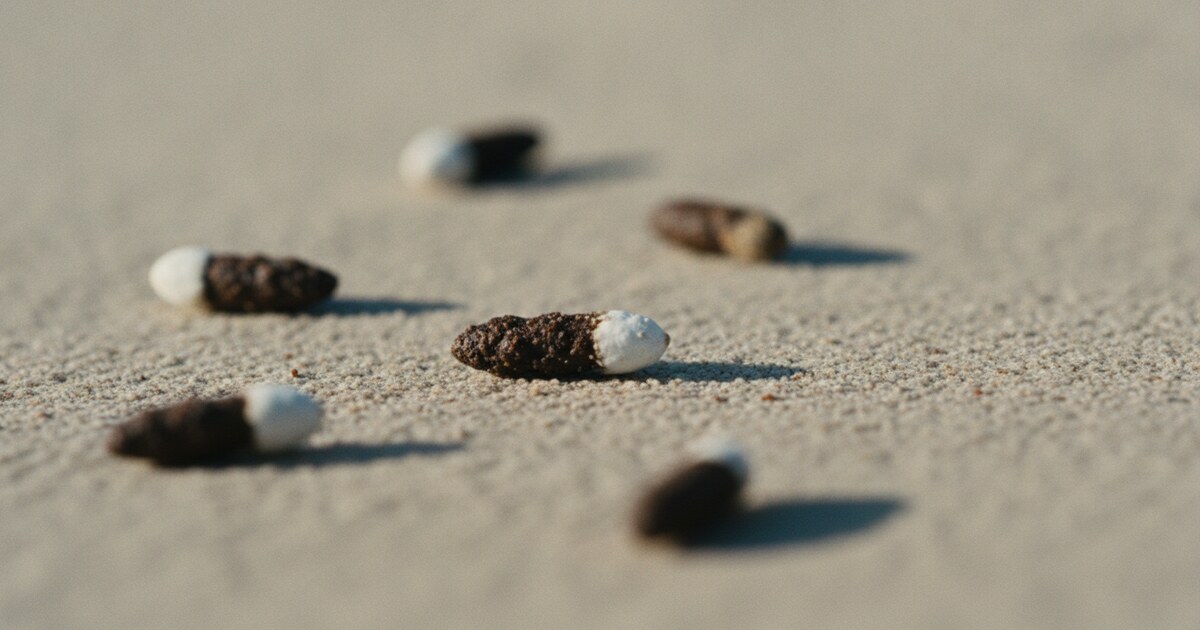
Found some small dark droppings on your windowsill, behind a piece of furniture, or near an outdoor light? The shape and color narrow down the suspect list, but one feature makes lizard droppings unmistakable: a white tip. No other common household pest leaves droppings with a chalky white cap, and that single detail makes lizard poop one of the easier wildlife signs to identify once you know what you’re looking for.
Lizard poop is a dark brown or black pellet with a white chalky cap at one end. The white portion is solid uric acid (urates) that lizards excrete alongside solid waste, because reptiles don’t produce liquid urine. Common house lizards like geckos and anoles leave droppings 3 to 10mm long. Fresh droppings are soft; older ones crumble.
What Does Lizard Poop Look Like?
Lizard droppings have two distinct parts: a dark fecal pellet and a white urate cap. The fecal portion ranges from dark brown to near-black and is cylindrical with blunt ends. The urate cap is chalky white or sometimes pale yellow, firmly attached to one end.
Fresh droppings are soft and slightly moist. Within a few hours in a warm room they firm up considerably, and the urate cap turns dry and crumbly. In older deposits, the dark fecal portion may break down entirely, leaving what looks like a pile of white powder.
Lizards excrete uric acid as a solid paste rather than liquid urine, an adaptation shared with birds and other reptiles that helps conserve water. Among lizards worldwide, roughly 6,000 species use this same elimination method. A house gecko hunting insects near a porch light deposits small dark pellets a few millimeters long, while a wild iguana in a Florida yard leaves much larger segmented scat several centimeters long. Both carry the characteristic white urate cap, which is the most reliable identifying feature. Defecation frequency varies with body size and diet: a well-fed gecko may go every 1 to 3 days, while larger species defecate every several days. Snake droppings can also contain urates, but the urates typically appear as a separate whitish smear alongside the fecal mass rather than a clean attached cap, which helps separate the two.
Lizard Poop Size by Species
Size tells you a lot about which lizard you’re dealing with. Common North American species stay small:
House gecko (Hemidactylus frenatus): Droppings run 3 to 8mm long and roughly 1 to 2mm wide. These are the droppings most people find near outdoor light fixtures or on windowsills in the southern US, where house geckos are widespread.
Green anole (Anolis carolinensis): Similar to gecko droppings in size and shape. These turn up on porches, fences, and exterior walls across the Southeast.
Skinks (Plestiodon species): A bit longer and more uniformly cylindrical. A five-lined skink leaves droppings in the 5 to 10mm range, tapered at the fecal end with a clean white cap.
Green iguana (Iguana iguana): Much larger. A full-grown iguana in South Florida produces droppings 2 to 3 centimeters long with multiple segments. The urate portion often appears as a separate white blob alongside the fecal mass rather than a neat cap.
Monitor lizard (Varanus species): Large monitors are rare across most of North America. Their scat is bulkier and elongated, similar in scale to a small dog’s output, with a substantial separate urate deposit.
When you find droppings and want to confirm the species, size narrows the field. But for a confident ID you need to see the animal itself.
Lizard Poop vs Mouse Poop: How to Tell Them Apart
This comparison comes up constantly, because both mouse droppings and small lizard droppings are dark, cylindrical, and appear in the same spots: behind appliances, on windowsills, in kitchen cabinets.
The white tip settles it fast. Mouse droppings are uniformly dark brown to black with a granular texture and two slightly tapered, pointed ends. They have no white cap. If the dropping has a chalky white cap, it came from a lizard or another reptile.
Shape is the secondary check. Mouse droppings are slightly curved with both ends tapered to a point, like a tiny curved seed. Lizard droppings are more cylindrical with a blunt end where the urate cap sits.
Size overlaps enough to cause confusion. A house mouse produces droppings 3 to 6mm long, right in the range of a gecko or small anole. Don’t rely on size alone. Mice also deposit droppings constantly as they travel, often 50 to 80 pellets per day scattered along their routes. Lizard droppings pile up in specific spots near hunting areas or basking perches: a tight cluster near the porch light, or a few drops on the same section of windowsill. A scatter of identical dark pellets throughout a drawer points to mice; a few isolated droppings below the light fixture points to a gecko.
Lizard Poop vs Snake Poop
Near a foundation gap, under a wood pile, or along a garage wall, snake poop is also worth considering. The two look similar at first glance.
Snake droppings are generally larger relative to the snake’s body length and more elongated in shape. They often contain undigested material like fur fragments or tiny bone pieces from prey, which lizard droppings almost never include (lizards eat insects and digest them more completely). Urates are present in snake scat but typically appear as a separate off-white liquid smear alongside the fecal matter rather than a clean white cap.
Lizard droppings are almost always smaller and pellet-shaped, with a consistent attached white tip. If you’re finding scat near a small crack at baseboard level and the white cap is clean and firmly attached, lizards are the more probable source.
For a broader look at how different reptile and mammal droppings compare, our animal poop identification chart covers the most common finds in one place. And for a focused comparison between these two reptile species, see our snake poop identification guide for photos and key differences.
Where Lizard Droppings Show Up
Lizards hunt and bask in predictable spots, so their droppings cluster in the same locations.
Near exterior lights. House geckos hunt moths, mosquitoes, and other insects drawn to porch lights and illuminated windows after dark. Droppings accumulate on window frames, ledges, and outdoor walls directly below the light source. A dark staining pattern over time is a reliable sign.
On windowsills and sun-warmed walls. Anoles and skinks bask on warm surfaces during the day. Droppings on a wide concrete windowsill or a sunny exterior step are common finds in the South and Southwest.
Behind appliances and furniture. Indoor geckos move toward warm, dark gaps. Droppings behind a refrigerator, along a baseboard, or in the corner of a cabinet tell you a gecko has been using that route regularly.
In garages and sheds. Insect access, warmth, and shelter make garages prime lizard habitat. Droppings on shelving, the tops of boxes, or near the water heater are normal in lizard-friendly regions.
Outdoors under rocks and logs. Ground-dwelling skinks shelter in debris piles and under flat stones. Droppings in these spots signal a healthy yard ecosystem rather than a pest problem.
Is Lizard Poop Dangerous?
The main concern is Salmonella. Lizards carry Salmonella bacteria in their gut and shed it in their droppings without appearing ill. The CDC treats contact with reptile feces as a Salmonella exposure risk, particularly for young children, elderly adults, and immunocompromised individuals.
Dry droppings can crumble into dust when disturbed. In an enclosed space with a heavy accumulation, a dust mask is a reasonable precaution.
Cleanup is straightforward:
- Dampen the droppings with a disinfectant spray before disturbing them. This keeps dust down.
- Wipe up with paper towels and seal them in a plastic bag before putting them in the trash.
- Disinfect the surface with a diluted bleach solution (1 part bleach to 9 parts water) or a household disinfectant rated for Salmonella.
- Wash your hands thoroughly with soap and water for at least 20 seconds.
A few gecko droppings near the porch light don’t require a pest control company. Regular cleaning and caulking window frames, door gaps, and utility penetrations will reduce how many lizards get inside.
What Kind of Lizard Left Those Droppings?
Droppings confirm a lizard was there, but the dropping alone won’t tell you the species. For that, you need a photo of the animal itself.
When you spot the lizard, take a clear photo and open Animal Identifier. Point the app at the animal (not the droppings) and you’ll get the species name along with details on its habitat, diet, and behavior. That extra information tells you whether you’re dealing with a harmless house gecko, a native skink, or a larger species that may need a different response.
Animal Identifier covers mammals, birds, reptiles, and insects worldwide. It’s free to start with 2 identifications per day, no account required.
Frequently Asked Questions
What does lizard poop look like?
Lizard poop is a dark brown to black cylindrical pellet with a distinct white or off-white chalky cap at one end. The white portion is solid uric acid (urates) excreted at the same time as solid waste. Fresh droppings are soft and slightly moist; older ones dry out and become crumbly. Size ranges from about 3mm for small house geckos to several centimeters for large iguanas.
How do you tell lizard poop from mouse poop?
The white tip is the fastest test. Mouse droppings are uniformly dark brown or black with two tapered ends and no white cap at all. Lizard droppings have a cylindrical dark body with a chalky white urate cap on one end. If the dropping has a white cap, it’s from a reptile. Distribution also helps: mice scatter droppings all along their travel routes, while lizards deposit in tight clusters near the same spots.
Is lizard poop dangerous?
Lizard droppings can carry Salmonella, which is the primary health concern. Avoid direct skin contact, dampen the area before cleaning to reduce dust, disinfect the surface afterward, and wash your hands. The risk is low for healthy adults in normal household quantities, but higher for young children and people with weakened immune systems.
Where do house lizards leave droppings?
House geckos and anoles most commonly leave droppings near outdoor light fixtures where they hunt insects, on windowsills and sun-warmed walls, behind appliances and furniture, and in garages and sheds. Droppings cluster in specific spots because lizards return to the same hunting areas and basking perches day after day.