Hawk vs Falcon: How to Tell the Difference
A large raptor crosses overhead and you reach for your phone. Is it a hawk or a falcon? Hawk vs falcon identification trips up beginners and experienced birders alike, because both groups are fierce predators with hooked beaks and sharp talons. Once you learn the right field marks, though, you’ll never mix them up again.
The confusion is understandable. North America is home to about 25 hawk species and 7 falcon species, and they share enough surface traits to fool birders at any level. The good news: three reliable clues work even at distance, even in poor light, even when the bird is moving fast.
This guide covers the three fastest ways to separate hawks from falcons, goes deeper on each field mark, and runs through the most common species you’re likely to encounter across North America.
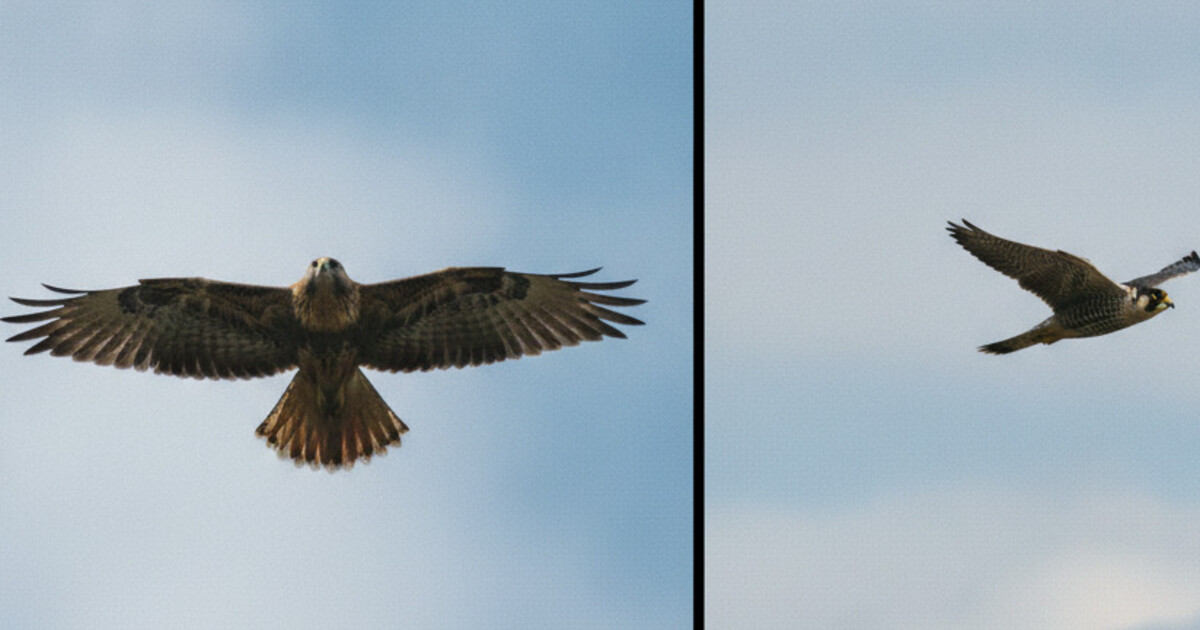
To tell a hawk from a falcon, look at the wings first. Falcons have long, pointed wings that taper to a narrow tip; hawks have broader, more rounded wings. In flight, falcons show rapid, shallow wingbeats while hawks soar on flat wings and flap less often. The falcon’s beak also has a notched tooth on the upper mandible that hawks lack.
Wing Shape: The Fastest Hawk vs Falcon Field Mark
Wing shape is the single most reliable clue when a bird is overhead and moving fast.
Falcons carry long, swept-back wings with pointed tips. Think of a fighter jet silhouette. When a Peregrine Falcon cruises level, the wing tips angle sharply backward and come to a clear point.
Hawks carry broader wings with more surface area. The tips are rounded or slightly fingered. On a soaring buteo like a Red-tailed Hawk, you can see the individual primary feathers spread apart like fingers on a hand.
North America has about 25 hawk species and 7 falcon species. Hawks belong to the family Accipitridae; falcons belong to Falconidae. Despite looking similar in the field, they’re not closely related. Genetic studies placed falcons closer to parrots and passerines than to hawks. Wing shape is the fastest field mark because it holds even in poor light or when the bird is directly overhead. Falcons carry narrow, pointed wings with a swept-back silhouette similar to a jet fighter. Hawks carry broader wings with more surface area for soaring on thermals. The Red-tailed Hawk has a wingspan of 45 to 52 inches and can soar for hours without a single wingbeat. The Peregrine Falcon has a wingspan of 39 to 43 inches but enters a stoop at over 240 miles per hour, making it the fastest animal on record. That speed depends entirely on the narrow, swept wing profile.
If the bird is perched, the wing tips continue to give you the answer. A perched falcon’s wing tips reach almost to the end of its tail, sometimes past it. A perched hawk’s wing tips typically stop well short of the tail tip.
Tail Shape, Beak, and Facial Markings in Hawk vs Falcon Identification
Three secondary clues lock in the ID when wing shape alone leaves doubt.
Tail shape. Hawks generally have shorter, broader tails. Red-tailed Hawks carry a distinctive rusty-red tail visible from above in adults. Other buteos show banded tails with alternating dark and pale bars. Falcons have longer, narrower tails that add to their streamlined look. Tail shape is also useful for separating species within the hawk family itself; for a broader look at how tail length varies across bird families, see our guide to birds with long tails.
The tomial tooth. Look at the cutting edge of the upper mandible on a falcon and you’ll see a notch, called a tomial tooth. Hawks don’t have this structure. The tooth evolved to let falcons sever a prey animal’s spinal cord quickly during a capture. It’s subtle at a distance but unmistakable in a clear photo or a close view.
Malar stripe (the mustache mark). Many falcons, including the Peregrine and the Merlin, show a dark vertical stripe running down from the eye toward the throat. This mustache pattern runs through much of the falcon family. Hawks don’t show the same consistent stripe, though some species have partial facial markings.
How Hawks and Falcons Fly Differently
Once you know the flight style differences, you can often separate the two groups before you even register the wing shape.
Hawks are soarers. A Red-tailed Hawk will lock its wings flat and drift in wide circles for minutes at a time, riding thermal columns of warm air. When a hawk does flap, it uses slow, deep strokes. Accipiters like the Cooper’s Hawk and Sharp-shinned Hawk flap faster and move in a flap-flap-glide rhythm through forest and woodland edges.
Falcons are speed machines. A Peregrine Falcon in a hunting stoop tucks its wings against its body and drops at over 240 mph. In level flight, falcons use quick, stiff wingbeats, not the rolling flaps of a buteo. An American Kestrel hovering over a field holds position with rapid wingbeats, then drops in a sudden dive. No hawk hovers like this.
Glide silhouette. A gliding hawk holds its wings in a slight upward V (called a dihedral). A gliding falcon holds its wings flat or pressed slightly downward. That angle, even at long distance, is often enough to call the family.
Common Hawks Across North America
Four species account for the majority of everyday hawk sightings.
Red-tailed Hawk. The most common hawk across the continent, with a wingspan of 45 to 52 inches. Adults carry the brick-red tail that gives the species its name. Look for the dark belly band across a pale underside. Found along roadsides, on power poles, and over open farmland year-round. Their brick-red coloring puts them among the most vividly marked raptors, similar in intensity to the red-headed birds you might spot at a backyard feeder.
Cooper’s Hawk. A crow-sized accipiter with a rounded tail and a flap-flap-glide pattern through dense cover. Adults show a blue-gray back and rusty barring on the chest. Cooper’s Hawks appear regularly at backyard feeders, targeting songbirds attracted to seed.
Sharp-shinned Hawk. North America’s smallest hawk at 9 to 13 inches. Nearly identical to Cooper’s but with a squarish tail rather than a rounded one, and a smaller, flatter head. Size comparison helps when both are visible at the same time.
Red-shouldered Hawk. A forest hawk of moist woodlands and bottomlands. Shows a bold checkered black-and-white pattern on the flight feathers and rusty-orange barring on the breast. Often heard before it’s seen; the loud, repeated call is one of the most distinctive sounds in eastern woodlands.
Common Falcons Across North America
Seven falcon species breed in North America, but four account for most encounters.
Peregrine Falcon. Found on every continent except Antarctica. Adults show a slate-blue back, pale underside with fine dark barring, and a strong dark malar stripe. Wingspan 39 to 43 inches. Historically a cliff-nesting bird, the Peregrine now nests widely on tall buildings, bridges, and towers. After near-extinction from DDT, it recovered to an estimated 3,000 breeding pairs in North America by 2015.
American Kestrel. North America’s smallest falcon at 9 to 12 inches and 3 to 6 ounces. Males show blue-gray wings; females are rusty all over, with a rusty-red back and tail. Kestrels regularly hunt by hovering over open fields, a behavior no hawk duplicates. Look for them perched on utility wires scanning the ground below.
Merlin. A stocky little falcon about the size of a large robin. Extremely fast in direct flight, chasing small birds with twisting aerial pursuit. Shows a streaked brown-and-cream pattern and a less prominent malar stripe than the Peregrine. Often spotted at hawk-watch sites during fall migration.
Prairie Falcon. A pale, sandy-brown falcon of open grasslands and arid country from the Great Plains through the West. The clearest field mark in flight is the dark axillar (armpit) patch visible from below. Wingspan 35 to 45 inches.
Using Animal Identifier for Hawk and Falcon ID
Even with these field marks memorized, raptors are genuinely hard to pin down in the field. A bird banking away, backlit by sky, may not show wing tips clearly enough for a confident call.
A photo taken at the moment the bird pauses or circles gives you a record to work with. Animal Identifier lets you upload that photo and get the species back in seconds. It covers the full range of North American raptors, from common Red-tailed Hawks to less familiar Prairie Falcons, and follows each ID with detailed species information on range, habitat, and distinguishing features.
After the ID, the app’s follow-up chat lets you dig deeper: “How does this compare to a Cooper’s Hawk?” or “What are the Peregrine subspecies differences?” It answers based on the identified animal, so you’re not starting from zero with a search engine.
Animal Identifier is free to start with 2 identifications a day and no account required. Available on iOS and Android.
Frequently Asked Questions
Is a hawk or falcon faster?
Falcons are faster by a wide margin. The Peregrine Falcon is the fastest animal on record, reaching over 240 miles per hour in a hunting stoop. In level flight, falcons also outpace most hawks because of their narrow, pointed wings. Hawks are more efficient at sustained soaring but don’t come close to falcon speed in a chase.
Can hawks and falcons interbreed?
No. Hawks and falcons aren’t related closely enough to produce offspring together. Genetic research places falcons in a separate order (Falconiformes) from hawks (Accipitriformes), and DNA studies show falcons are more closely related to parrots and songbirds than to any hawk. Interbreeding only occurs between species within the same genus.
Why do some hawks look like falcons?
Convergent evolution. Both groups are aerial hunters facing similar aerodynamic pressures, so some species evolved similar shapes independently. A fast-flying Cooper’s Hawk has narrower wings than a Red-tailed Hawk because it chases birds through dense cover. Even the narrowest hawk wing doesn’t taper to the same clean point as a falcon’s, though.
What is the malar stripe on a falcon?
The malar stripe (sometimes called the mustache mark) is a dark vertical band running from the eye down toward the throat. It’s most prominent on Peregrine Falcons and present to varying degrees on many other falcon species. The stripe works as a quick visual field mark because it’s consistent across the falcon family while absent in most hawks.
How do I tell a kestrel from a Sharp-shinned Hawk?
Wing shape and hovering behavior are the fastest clues. Kestrels hover over open ground using rapid wingbeats; Sharp-shinned Hawks never hover. A kestrel has pointed wings and a rusty-red back; Sharp-shinned has rounded wings and a blue-gray back in adults. Both are small, but the silhouettes are quite different once you’re watching for them.