Black Birds With White Wing Stripes: Identification Guide
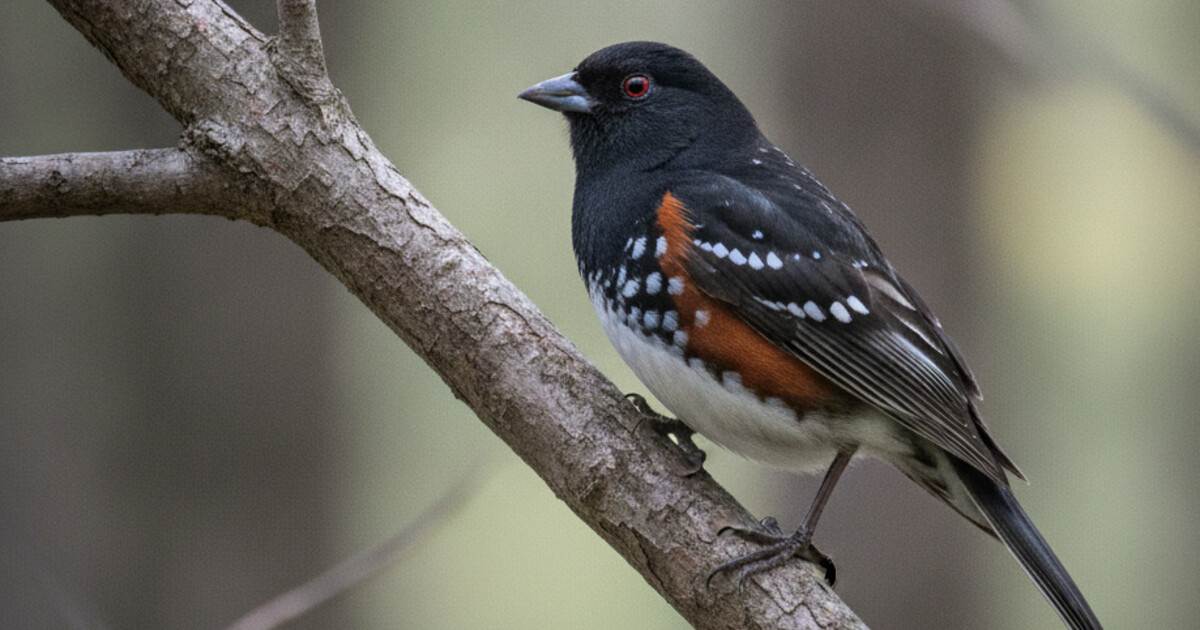
A dark bird lands on your fence and flicks its wings before dropping into the shrubs, and you catch it: a white stripe across otherwise-black feathers. That single mark narrows your ID list considerably. Several unrelated North American species share this pattern, from chunky towhees that scratch in leaf litter to sea ducks that show white only while beating across open water. This guide covers the 8 birds most often described as a black bird with a white wing stripe, with the habitat clues and field marks that separate them.
A black bird with a white wing stripe is most often a Spotted or Eastern Towhee at feeders, a Lark Bunting or Bobolink in open grasslands, or a Common Nighthawk passing overhead at dusk. Bufflehead and White-winged Scoter show large white wing panels in flight over water. Habitat and the shape of the white marking narrow the list fast.
Black Birds With White Wing Stripes at the Feeder
The towhees and the Rose-breasted Grosbeak are the birds most backyard watchers ask about. All three visit feeders, have black heads or backs, and show some form of white marking in the wings.
Spotted Towhee
The Spotted Towhee is the most common black bird with white wing stripes at feeders in the western and central US. Males wear a jet-black hood, back, and tail; bright rufous sides; and a white belly. Their wings are black, covered in white spots that form 2-3 rows across the coverts and a narrow white edge at the tertials. In good light, those dots line up almost like a dashed stripe along the folded wing.
North American bird researchers estimate Spotted Towhee populations at roughly 15 million individuals, making them one of the most abundant resident songbirds in the western US. Males hold breeding territories averaging 1-4 acres and return to the same shrubby patches year after year. The species spans 8 recognized subspecies, from the heavily spotted Pacific Coast race (Pipilo maculatus oregonus) to the Great Plains race (P. m. arcticus), which has reduced white spotting and was once classified as a separate species. Eastern Towhees (Pipilo erythrophthalmus) overlap with Spotted Towhees across a wide zone from the Dakotas to Texas, where the two interbreed and produce intermediates with variable amounts of white in the wings. Both species hold a white eye ring in some populations. Together, towhees account for a significant share of “black bird with white wing markings” queries that reach bird identification forums each spring.
One reliable giveaway: Spotted Towhees scratch in leaf litter with both feet simultaneously, hopping backward to expose seeds and insects. If your black-and-rufous bird is thrashing around in fallen leaves under a bush, this is almost certainly your species.
Range: the Pacific Coast east through the Great Plains, from British Columbia south to Guatemala. Western birds tend to stay put year-round; northern interior populations shift south in winter.
Eastern Towhee
East of the Rockies, the Spotted Towhee gives way to the Eastern Towhee. It shares the black hood, rufous sides, and white belly, but carries fewer white spots on the wing, often just a small white patch near the primary tips instead of the Spotted’s full rows of dots. Some Eastern Towhees in the southern Appalachians have almost no visible white in the wing at all.
Both towhees scratch in the same enthusiastic style, so behavior is a backup when plumage is ambiguous. Range: breeds from Saskatchewan and Newfoundland south to Florida and the Gulf, wintering across the southeastern US.
Rose-breasted Grosbeak
The Rose-breasted Grosbeak male is worth knowing separately. It has a black head, back, and wings with 2 parallel white wing bars running across the coverts, plus a triangular bright-red patch on the chest. That red patch rules out the towhees immediately. The bill is large and conical: built for cracking sunflower seeds, which is why this bird turns up readily at feeders across the eastern US during spring and fall migration.
Black Birds With White Wing Stripes in Open Country: Lark Bunting and Bobolink
Leave the backyard and head into fields and prairies. These two species show some of the boldest black-and-white wing patterns of any North American songbird, but only during breeding season.
Lark Bunting
The male Lark Bunting in breeding plumage is black from head to tail except for one enormous white wing patch covering most of the greater coverts. It’s among the most striking wing markings on any songbird on the continent. Lark Buntings breed across the shortgrass and mixed-grass prairies of the Great Plains, from southern Canada to New Mexico, with Colorado holding dense breeding populations (it’s the state bird there).
Males perform an undulating song flight above the grass in April and May, showing off the white patch. Watch for the season: from August through spring, males molt into streaky brown plumage with a reduced white wing patch, and the bold black-and-white look disappears until the following spring.
Size: 6-7 inches, stocky, with a bluish-gray bill. Often seen in flocks of dozens to hundreds on the breeding grounds.
Bobolink
The breeding male Bobolink is black below and white above, which is the reverse of nearly every other bird on this list. White covers the shoulders, back, and rump; the folded wing shows white stripes along the scapulars against a dark wing. People often describe the male as wearing a tuxedo backward.
Bobolinks breed across northern prairies and hayfields from New England to the Pacific Northwest, then migrate to Bolivia and Argentina for winter. That round trip totals roughly 12,500 miles. Males arrive on the breeding grounds in May and produce a cascading, metallic bubbling song that sounds like nothing else in North American birding.
Like the Lark Bunting, Bobolinks are seasonal: by August, males look like large streaky sparrows with no obvious white wing markings. Females are streaky brown year-round.
Overhead at Dusk: The Common Nighthawk’s White Wing Bar
If your black bird with a white wing stripe was airborne, especially at dawn or dusk, it’s probably a Common Nighthawk. This species is almost never seen perched in the open; it catches insects in erratic swooping flight above cities, parks, and open fields.
The white wing band cuts across 4 outer primary feathers on each wing, forming a clean white stripe visible from well below. Males also carry a white throat patch and a white subterminal tail band. Wingspan runs 20-22 inches, so this is a noticeably bigger bird than it looks from the ground.
Despite the name, nighthawks aren’t hawks at all; they belong to the nightjar family (Caprimulgidae), the same group as Whip-poor-wills. The best giveaway besides the wing stripe is the nasal “peent” call, often heard before the bird is spotted. Flight is erratic and buoyant, with deep wingbeats and frequent course changes. For more birds that carry striking black-and-white markings, the guide to black and white birds covers additional species.
On the Water: Bufflehead and White-winged Scoter
Two diving duck species show white on otherwise-dark wings. Both reward a second look if you’re near a bay, lake, or coastal inlet.
Bufflehead
The Bufflehead is the smallest diving duck in North America, about 13 inches long. Males are black on the back with a large white patch on the rear half of the head and a white body. In flight, the wings show a large white panel across the secondaries and inner primaries, which reads as a white wing stripe against the black outer flight feathers.
Buffleheads breed in boreal forests of Canada and Alaska, nesting in tree cavities, and winter across coastal bays, inland lakes, and reservoirs throughout the US. They dive frequently and pop back up seconds later, rarely sitting still for long.
White-winged Scoter
The White-winged Scoter is a large, stocky sea duck. Males are all black with white secondaries that show as a white stripe on each wing, most obvious during flapping flight. At rest on the water, the white is often tucked under the folded wing. Look for a small white teardrop mark below the eye and an orange-yellow bill with a black knob at the base.
White-winged Scoters breed across boreal Canada and Alaska, then winter on both coasts and on the Great Lakes, often in large mixed flocks with Surf and Black Scoters. The white wing panel in flight is the fastest way to pick this species out of a flock. If you’re trying to identify other birds by shape in flight, the guide to birds with long tails covers more useful field marks.
How Animal Identifier Can Help
When you’ve got a photo and can’t pin down the species, Animal Identifier gives you a fast answer. Photograph the bird, upload the image, and the app returns the species name along with habitat, behavior, and diet details within seconds. After the ID, the built-in chat lets you ask follow-up questions: “how do I tell this from a Spotted Towhee?” or “does it have a white wing stripe year-round?” gets you a direct response rather than sending you back to Google.
The app covers the whole animal kingdom, birds included, so whether you’re dealing with a towhee at your feeder or a scoter on the bay, it can help you narrow it down fast. Animal Identifier is free to start, with 2 identifications per day at no charge and no account required. Available on iOS and Android.
Frequently Asked Questions
What small black bird with white spots on its wings visits feeders?
The Spotted Towhee (western US) and Eastern Towhee (eastern US) are the most likely candidates. Both have black heads and backs, rufous sides, and a white belly. Spotted Towhees show 2-3 rows of white spots across the wing coverts; Eastern Towhees often have just a small white patch near the primary tips. Both scratch loudly in leaf litter under feeders and are about the size of a robin.
What’s the black bird with 2 white stripes on its wings?
The Rose-breasted Grosbeak male has 2 parallel white wing bars on black wings, along with a bright-red triangular chest patch. It visits feeders east of the Rockies, especially during spring and fall migration. The Lark Bunting has a single large white wing patch rather than 2 bars, and it lacks any red coloring entirely.
Is the Common Nighthawk’s white wing bar visible when the bird is perched?
Rarely. Nighthawks roost lengthwise along a branch or flat rooftop, and the mottled plumage blends the white bar into the overall pattern. You almost always notice the stripe in flight, when the bird tilts and the white slashes across each wing become obvious against the dark underwing.
Do Bobolinks always show white wing markings?
Only breeding males, and only from about May through July. From late summer onward, males molt into streaky brown plumage that resembles a large sparrow. Females are streaky brown year-round and don’t show the black-and-white pattern at any season. If you spot a “black bird with white wing stripes” in a hayfield in late spring, a Bobolink is a strong candidate; the same field in September will be empty of them.
How do I tell a Bufflehead from a Hooded Merganser in flight?
Both are small black-and-white ducks with white in the wing. The Bufflehead’s white wing panel covers most of the secondaries and shows as a large white block in flight. The Hooded Merganser has a narrower white wing stripe and a longer, thinner body with a fan-shaped crest visible even in fast flight. In direct comparison, the Bufflehead looks rounder and shorter-necked.
A black bird with a white wing stripe can be a backyard towhee, a grassland songbird, a diving duck, or a nightjar passing overhead at dusk. The key variables are habitat, the size of the white marking, and season. When those clues don’t quite add up, a photo is faster than a field guide. Snap it and upload it to Animal Identifier for a quick species ID, habitat details, and a follow-up chat where you can ask about lookalikes. It’s free to start on iOS and Android.