Texas Snake Identification Chart
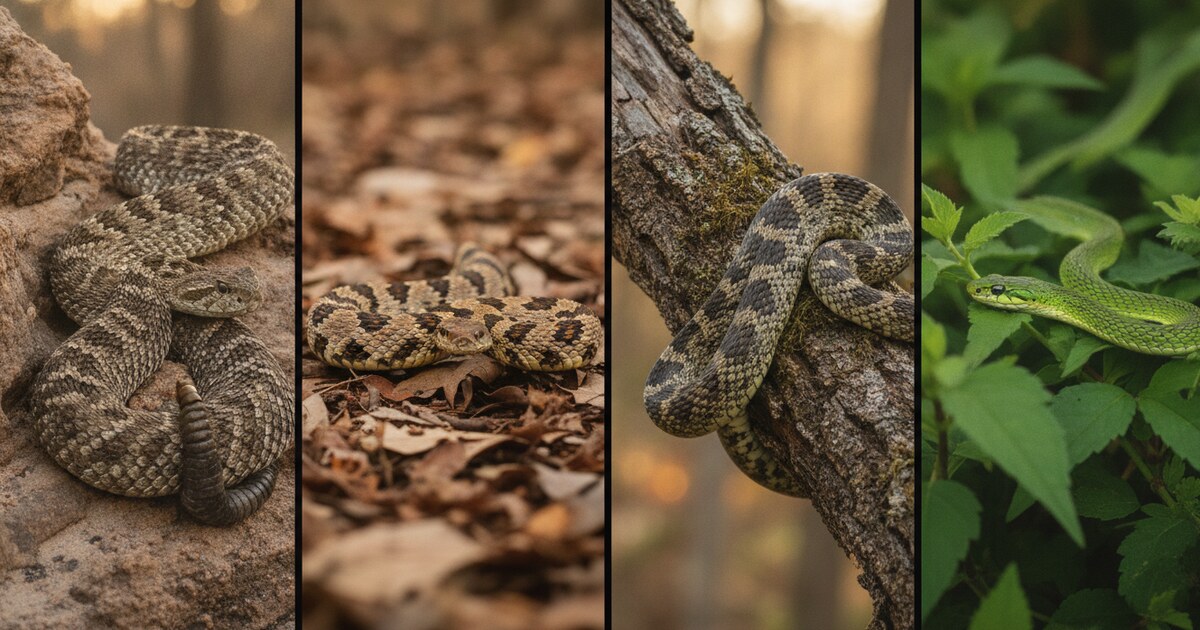
Texas Snake Identification Chart
Texas holds 96 snake species, more than almost any other US state, spread across Gulf Coast marshes, Hill Country cedar breaks, Piney Woods, and Chihuahuan Desert flats. The good news: only 14 of those 96 are venomous. The less good news: those 14 are distributed statewide, and the visual gap between a Western Diamondback and a harmless bull snake isn’t always obvious from a quick glance. This Texas snake identification chart organizes the most common species by what you actually see first: color and pattern, then walks through the field checks that matter.
Texas has 96 snake species, 14 of them venomous, split across 4 groups: rattlesnakes, copperheads, cottonmouths, and the Texas coral snake. Most snakes you encounter are harmless rat snakes, racers, garter snakes, or kingsnakes. The fast field check for pit vipers: broad triangular head, elliptical pupils. For coral snakes: red touches yellow means venomous.
Texas Venomous Snakes: The 4 Groups to Know
Fourteen venomous species sounds like a lot. In practice they fall into 4 groups, and recognizing a group is enough to tell you to back up.
Texas is home to 96 snake species, with 14 confirmed venomous, split across 4 biological groups. Rattlesnakes account for 8 of those 14, including the Western Diamondback (the most medically significant species in the state), Timber Rattlesnake, Western Pygmy Rattlesnake, Massasauga, and 4 additional regional species. The Western Diamondback averages 3.5 to 5 feet (maximum 7 feet); its diamond-back dorsal pattern, black-and-white ringed tail, and broad triangular head make it the most recognizable venomous snake in the state. Copperheads (2 species) reach 2 to 3 feet with distinctive hourglass crossbands, narrow at the spine and wide at the flanks. The cottonmouth averages 2 to 4 feet, identified by its heavy body, flat head, and the white interior of its open mouth. The Texas coral snake is slender, typically under 3 feet, with bright red, yellow, and black bands fully encircling the body; the rhyme holds: red touches yellow, kill a fellow. All 4 groups are present statewide, though species mix shifts by habitat.
Western Diamondback Rattlesnake (Crotalus atrox)
Length: 3.5 to 5 feet typical, up to 7 feet. Pattern: gray or brown diamond shapes outlined in white along the spine, fading to a black-and-white ringed tail section just before the rattle. Head: broad, triangular, clearly wider than the neck. Found in every habitat type statewide. This species accounts for the majority of serious snakebite cases in Texas.
Copperhead (2 species: Southern, Agkistrodon contortrix; Broad-banded, Agkistrodon laticinctus)
Length: 2 to 3 feet. Pattern: pale tan with dark brown hourglass crossbands. The crossbands are wide at the flanks and pinch narrow at the spine. The Broad-banded variety has thicker, darker bands than the Southern. Habitat: rocky hillsides, wooded areas, brushy fields. Most common in Central and East Texas.
Cottonmouth / Water Moccasin (Agkistrodon piscivorus)
Length: 2 to 4 feet. Body: heavy, with a flat, wide head and thick neck. Pattern: dark brown to nearly black in older adults; some retain faded banding. The defining behavior: when threatened, it opens its mouth wide, showing the white interior. One useful field check: cottonmouths float with their whole body on the water’s surface, while harmless water snakes hold their body below the waterline and only their head rides up. Habitat: rivers, swamps, ponds, and slow or still water in East and Central Texas.
Texas Coral Snake (Micrurus tener)
Length: 18 to 30 inches. Body: slender, smooth-scaled, with a small rounded head barely wider than the neck. Pattern: bright red, yellow, and black bands that encircle the body completely. The rhyme: red touches yellow, kill a fellow. Non-venomous lookalikes (Milk Snake, Scarlet Snake) have red touching black instead. Habitat: loose sandy soils, wooded areas, under leaf litter and logs, primarily in Central and East Texas.
Texas Snake Identification Chart: By Color and Pattern
This table organizes the most common species by the visual impression you get first. The venomous entries are marked.
| Color / Pattern | Most Likely Species | Venomous? |
|---|---|---|
| Brown or gray diamonds, rattle on tail | Western Diamondback Rattlesnake | Yes |
| Tan with dark hourglass crossbands | Copperhead | Yes |
| Dark brown to black, heavy body, near water | Cottonmouth | Yes |
| Bright red + yellow + black bands (red touches yellow) | Texas Coral Snake | Yes |
| Red + black bands (red touches black) | Milk Snake, Scarlet Snake | No |
| Black, solid or faintly patterned | Texas Rat Snake (adult), Eastern Black Racer | No |
| Gray-brown with dark square blotches | Texas Rat Snake (juvenile), Bull Snake | No |
| Bright lime green, very slender | Rough Green Snake | No |
| Brown, upturned shovel nose | Western Hognose Snake | No |
| Brown or tan, very thin, fast-moving | Coachwhip | No |
| Black with yellow or white speckles | Speckled Kingsnake | No |
| Olive or brown, thin lengthwise stripes | Texas Garter Snake | No |
Common Non-Venomous Snakes in Texas
These are the species you’re most likely to encounter in a yard, on a trail, or near water.
Texas Rat Snake (Pantherophis obsoletus lindheimeri)
The most frequently encountered snake in the state. Juveniles are gray-brown with dark square blotches that look, at a quick glance, similar to a copperhead’s banding. Adults often turn dark brown to nearly black, especially in East Texas. Adults reach 4 to 6 feet. Commonly found near sheds, barns, and homes because they follow rodents. Entirely harmless to humans, though they’ll bite if cornered or grabbed.
Western Hognose Snake (Heterodon nasicus)
The upturned, keeled snout is unmistakable: it looks like a small shovel bolted to the front of the head. Brown with dark blotches. Length 1.5 to 3 feet. When threatened it spreads its neck flat and hisses, or flips onto its back and plays dead with its mouth open. Found across Central and West Texas in sandy or loose soils.
Coachwhip (Masticophis flagellum)
Slender and very fast. Body color in Texas ranges from tan to brown, sometimes with a braided-whip pattern on the tail section. Reaches 4 to 6 feet. Typically found in dry open habitats and moves quickly when disturbed. Raises its head and holds it upright when scanning, which can briefly look alarming. Completely harmless.
Texas also has several species of non-venomous black snakes (rat snakes and racers) that are sometimes confused with cottonmouths. If you’ve spotted a black snake with a pale or white belly, see our black snakes with white bellies identification guide for a species-by-species breakdown.
Rough Green Snake (Opheodrys aestivus)
Bright lime green above, yellow-white below. Slender, up to 3 feet. Spends most of its time in shrubs and low vegetation, eating insects and soft-bodied invertebrates. Virtually invisible when still among foliage. Found in Central and East Texas near streams and in gardens.
Speckled Kingsnake (Lampropeltis holbrooki)
Black with small yellow or white spots across most scales, giving it a salt-and-pepper look. Reaches 3 to 4 feet. Immune to pit viper venom and actively hunts other snakes, including rattlesnakes and copperheads. Found statewide. One of the most beneficial snakes to have around a property.
Texas Garter Snake (Thamnophis sirtalis annectens)
Thin, with one central and two lateral yellow or orange stripes running lengthwise on a dark body. Typically 18 to 26 inches. Common near water in Central and East Texas. Docile and easy to identify once you know the stripe pattern.
How to Tell Venomous from Non-Venomous in Texas
Four quick field checks work for the pit vipers (rattlesnakes, copperheads, cottonmouths):
Head shape. Pit vipers have a head that’s noticeably broad and triangular, wider than the neck. Non-venomous snakes typically have a head that tapers smoothly from the body, or a rounded head similar in width to the neck. Caution: a harmless snake that’s startled will sometimes flatten its head to look more triangular, so don’t rely on head shape alone.
Rattle. Any rattle is definitive. If you hear or see a rattle, you’re looking at a rattlesnake. Young rattlesnakes have a small button rattle that doesn’t make sound yet, so absence of rattle sound doesn’t rule out a juvenile.
Pupils. Pit vipers have vertical, elliptical pupils. Non-venomous Texas snakes have round pupils. This check is only practical from a photograph, not something you want to verify by crouching down close.
Cottonmouth float test. Near water: a snake floating with its whole body on the surface is almost certainly a cottonmouth. A snake with its body below waterline and just its head above is almost certainly a harmless water snake.
For coral snakes, the color pattern is the check: red touches yellow on a coral snake, red touches black on every harmless lookalike in Texas. This rule applies specifically to US species.
If you’re looking at a snake from a safe distance and can’t make a confident call, photograph it and use an app to get a species ID. Our guide to apps to identify snakes covers the free and paid options side by side. You can submit a photo without getting any closer, and a follow-up chat lets you confirm specific field marks.
What to Do When You Encounter a Texas Snake
Back up and give it space. Most defensive snakebites in Texas happen when someone steps on a snake, reaches under a log without looking, or tries to pick up a snake they’ve already startled. The snake’s default response to a human is to move away, not to attack.
If you’re near a snake you can’t immediately identify:
- Stay at least 6 feet back.
- Shuffle your feet on the ground as you move away to alert it to your presence.
- Never pick up or move a snake you haven’t confirmed as non-venomous. Dead snakes can still envenomate via a bite reflex.
If a bite does occur: keep the bitten limb below heart level, remove any tight clothing or jewelry near the site, and get to an emergency room. Don’t cut, suck, or apply ice to the bite. Call Texas Poison Control at 1-800-222-1222 while you’re en route.
For photographing a snake you want to identify safely, Animal Identifier handles the ID from the photo so you don’t need to close the distance. It covers snakes, mammals, birds, and insects, and the follow-up chat can walk you through the specific field marks for the species it returns.
Frequently Asked Questions
What is the most dangerous snake in Texas?
The Western Diamondback Rattlesnake is responsible for the most serious snakebite cases in Texas. It’s the largest venomous snake in the state, found in every habitat type, and carries a large venom yield. The cottonmouth (water moccasin) and copperhead are responsible for more total bites, but Western Diamondback bites typically cause more tissue damage.
How do I tell a copperhead from a harmless snake in Texas?
Look for the hourglass crossbands: dark brown, wide at the sides, and pinched narrow at the spine. No common non-venomous Texas snake has this exact hourglass shape. Juvenile rat snakes have dark blotches, but they’re squarish rather than pinched, and the rat snake body is noticeably thinner for its length.
Are there water moccasins (cottonmouths) all over Texas?
Cottonmouths are concentrated in East and Central Texas near rivers, swamps, ponds, and drainage ditches. They’re uncommon in West Texas and the Panhandle. If you see a water snake in arid regions, it’s almost certainly one of Texas’s several harmless water snake species.
Is the coral snake color rhyme reliable in Texas?
For snakes native to Texas, yes. All four of Texas’s venomous groups follow the rule, and the three common harmless lookalikes (Milk Snake, Scarlet Snake, Louisiana Milk Snake) all have red touching black rather than red touching yellow. The rhyme applies only to species found in North America.
Can you identify a Texas snake from a photo?
Yes, with good accuracy for most common species. An AI photo identification app like Animal Identifier can match a photo against known species in seconds. For any snake you genuinely can’t ID, photographing it from a safe distance gives you something concrete to show an emergency physician or herpetologist. Don’t rely solely on memory of a pattern you saw briefly.
Texas has more snake diversity than most people expect, and the majority of what you’ll see is harmless. Know the 4 venomous groups, check the color-pattern table when you’re uncertain, and photograph anything you can’t immediately confirm. If you spend time outdoors in Texas regularly, Animal Identifier can back up your visual ID with a photo-based confirmation whenever you need it.