Best Butterfly Identification Apps in 2026
Best Butterfly Identification Apps in 2026
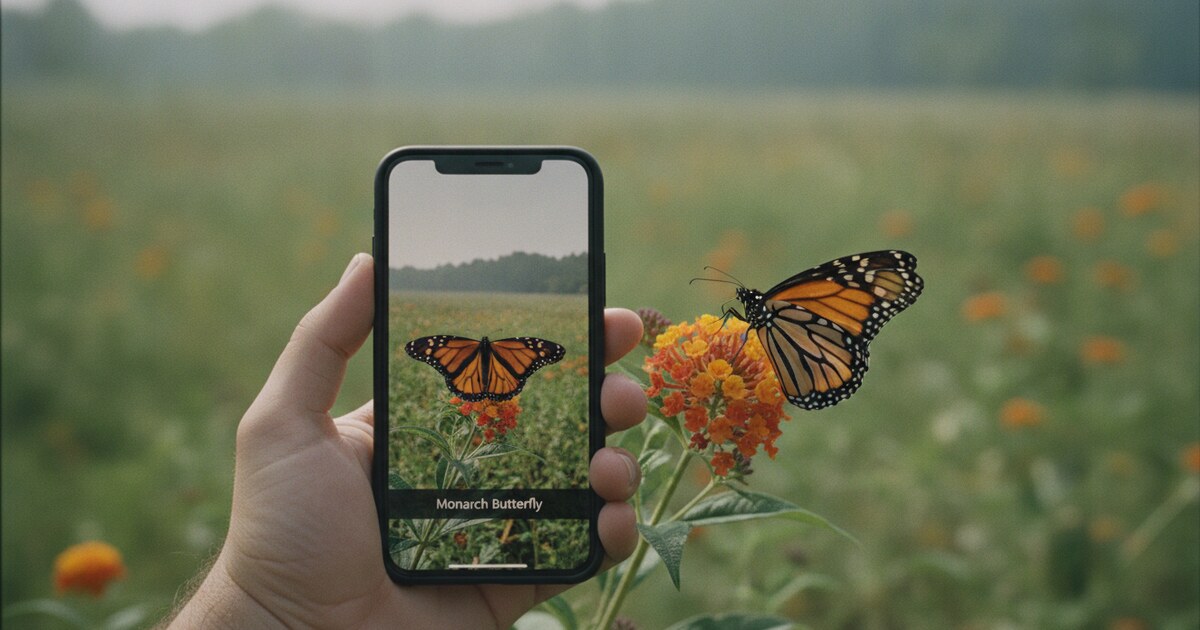
You’re on a trail and a butterfly lands on the railing two feet away. The wings are orange and black with white dots along the edges. Monarch? Viceroy? Gulf Fritillary? All three share similar coloring, and the differences come down to specific markings that are easy to miss in the moment. A good butterfly identification app gives you the species name in the time it takes to snap the photo, plus enough detail to understand what you’re actually looking at.
This guide covers 5 apps that identify butterflies from a photo, with honest detail on free tiers, species coverage, accuracy limitations, and who each one suits best.
The best butterfly identification app for most people is Seek by iNaturalist: completely free, no account required, covers about 80,000 species, and carries 4.8 stars from over 31,000 App Store reviews. For follow-up questions after the ID and broader coverage across all wildlife, Animal Identifier is the strongest alternative at 2 free identifications per day.
What to Look for in a Butterfly Identification App
Not every butterfly ID app handles this well. The tools differ on three things that matter: species coverage, how generous the free tier is, and what you can do with the result after the app names the species.
Species coverage determines whether the app can identify the butterfly in front of you, not just the dozen species in every field guide. North America has about 750 butterfly species; worldwide the count sits around 20,000. An app with a thin database will miss regional variants and less-photographed species consistently.
Free tier structure matters more than most app reviews mention. Some apps give unlimited free identifications. Others give you 2 or 3 per day before locking the rest behind a subscription, and some prompt for an upgrade after every single ID. Know what you’re getting before you open the camera.
What happens after the ID often decides whether you keep the app or delete it. Do you get a species name only, or natural history detail on habitat, range, and behavior? Can you ask a follow-up question like “is this one dangerous?” or “where does it breed?”
There are roughly 20,000 butterfly species worldwide, with about 750 native to North America and around 180 found regularly east of the Rockies. Most AI butterfly ID apps use image recognition trained on reference photo datasets, comparing wing shape, color distribution, and dorsal and ventral surface patterns. Accuracy is strongest from a clear, well-lit shot of open wings and weakest from angled, blurry, or partially obscured photos. Free tiers differ significantly: Seek by iNaturalist (4.8 stars, 31,012 App Store reviews as of 2026) offers unlimited identifications with no subscription or account requirement. Leps by Fieldguide (Developer: Change Theory, 4.3 stars, 25 reviews) is also completely free with no ads or in-app purchases, focused specifically on butterflies and moths. Animal Identifier provides 2 free identifications per day without requiring account creation. iNaturalist (4.6 stars, 4,718 reviews) is free and logs your observation to a citizen-science database used by researchers worldwide.
The 5 Best Butterfly Identification Apps
1. Animal Identifier: Best for Wildlife Coverage Beyond Butterflies
Animal Identifier uses AI to identify butterflies, moths, and insects from a photo you take or upload. You get the species name in seconds. A built-in follow-up chat lets you ask questions about what you found: how to tell it from a lookalike, what it eats, where it overwinters, whether it’s rare in your region. The chat stays focused on animals and won’t wander off-topic.
The free tier gives 2 identifications per day with no account required. The app covers birds, mammals, reptiles, and insects on the same platform, so you don’t need a separate app every time you encounter something unfamiliar on a hike. It works on iOS and Android, requires an internet connection to process each photo (cloud-based AI), and doesn’t claim perfect accuracy. A clear shot of a common species with open wings works reliably. A partial view in poor light is harder for any app to handle.
Two honest limits to flag. First, identification is photo-only: you take a picture, and the app works from that. Second, there’s no offline mode, so the app needs a data connection for each ID. If you’re in a remote area, save the photo and submit when you’re back in range.
Best for: Hikers and nature explorers who want one app for all wildlife, butterflies included, with the ability to ask follow-up questions after each ID.
2. Seek by iNaturalist: Best Free Option
Seek is free with no in-app purchases, no account required, and no cap on how many IDs you run. You point the camera at a butterfly and the app narrows the species in real time as you hold the shot, drawing on millions of iNaturalist community observations. It adjusts suggestions based on your location, which surfaces the species actually present in your region rather than a global list of candidates.
Developer: iNaturalist (a not-for-profit organization). Available on iOS and Android. App Store rating: 4.8 stars from 31,012 reviews, the strongest rating of any butterfly identification app in this comparison. The app covers roughly 80,000 species total, following a major 2025 update, which means it handles birds, plants, and insects well beyond butterflies.
One gap worth noting: Seek doesn’t provide hazard or venom warnings, and its App Store listing says so explicitly. For butterflies that’s rarely a concern (most are harmless). If you’re using it to identify insects or spiders as well, take the species name Seek gives you and run a separate search on toxicity.
Best for: Anyone who wants completely free, unlimited butterfly ID with no setup, no account, and no subscription pressure.
3. Leps by Fieldguide: Best Butterfly and Moth Specialist
Leps by Fieldguide is built specifically for Lepidoptera, the order that includes butterflies and moths. You photograph a specimen and the AI narrows it to species, with detailed cards covering distribution, habitat, and behavior. The observation checklist updates automatically when taxonomy changes, so you’re working from a current classification, not one that was accurate five years ago.
Developer: Change Theory. App Store rating: 4.3 stars from 25 reviews. Free with no ads and no in-app purchases. Available on iOS and Android. You can share your collection with other users and contribute to Lepidoptera distribution data. The smaller review count reflects an app well-regarded among dedicated butterfly and moth enthusiasts that hasn’t been broadly discovered yet.
If butterflies and moths are specifically what you’re tracking, Leps gives you specialist coverage with no subscription cost.
Best for: Butterfly and moth enthusiasts who want a dedicated, free tool built around Lepidoptera rather than a broader wildlife app.
4. iNaturalist: Best for Contributing to Citizen Science
iNaturalist is a citizen-science platform: every butterfly you log becomes a data point in a global biodiversity database reviewed by researchers and conservation organizations worldwide. You photograph the butterfly, submit the observation, and the community confirms or refines the species ID. When AI and location data aren’t conclusive on their own, a human expert with regional knowledge may step in.
Developer: iNaturalist (non-profit, backed by the California Academy of Sciences). Free. App Store rating: 4.6 stars from 4,718 reviews. Available on iOS and Android. Unlike Seek, iNaturalist requires account creation because it builds a permanent observation record attached to your profile. If you want your butterfly sightings to contribute to conservation science, iNaturalist is the right tool for that.
The workflow here is closer to photo submission for community review than instant real-time ID. If you want the fastest on-the-spot result, Seek handles that better.
Best for: Serious naturalists who want their butterfly observations to feed into biodiversity research and conservation programs.
5. iRecord Butterflies: Best for UK and European Users
iRecord Butterflies is developed by Butterfly Conservation, a UK-based conservation charity. You photograph a butterfly and compare it against the species library, with ID suggestions filtered by your GPS location and time of year. Sighting data feeds directly into the UK butterfly monitoring scheme. It’s free and available on iOS and Android.
The species database is built around UK and western European butterflies. That makes it strong for users in those regions and considerably less useful for North American users, where the species set is entirely different. If you’re in the US, the three apps above cover the species you’re likely to encounter more reliably.
Best for: UK and European butterfly watchers who want their sightings to contribute directly to Butterfly Conservation’s monitoring programs.
Which App Fits Your Situation
If you want one app for all outdoor wildlife (butterflies included), Animal Identifier covers birds, mammals, reptiles, and insects on the same platform. You get a follow-up chat after each ID and 2 free identifications per day. For more on how similar apps handle broader insect ID, the apps to identify bugs and insects guide runs the same comparison format.
If you want unlimited free identifications with no account and no setup, Seek by iNaturalist handles it. It covers more species than any specialist app and requires zero configuration.
If butterflies and moths are specifically what you’re here for and you want a free, purpose-built tool, Leps by Fieldguide is the right choice.
If your goal is scientific contribution and a permanent sighting record, iNaturalist logs your observations to a database researchers actually use. It pairs well with the same habit if you’re also identifying spiders, covered in our apps to identify spiders guide.
For UK users, iRecord Butterflies feeds observations directly into Butterfly Conservation’s national monitoring programs.
Frequently Asked Questions
Are butterfly identification apps accurate?
Accuracy depends on photo quality and species. Most AI apps perform well on common species with distinctive wing patterns from a clear, well-lit photo with wings open. Accuracy drops for cryptic species, seasonal color variants, and shots taken from awkward angles or poor light. No app guarantees a correct ID from a single photo, which is why the follow-up chat in Animal Identifier and the community review in iNaturalist are genuinely useful for rare or ambiguous finds.
Can I use a butterfly identification app offline?
Most AI-powered butterfly apps require an internet connection because identification processing happens on cloud servers, not on the device. This applies to Animal Identifier and Seek by iNaturalist. For remote areas without signal, take the photo and submit when you’re back in range. iRecord Butterflies has some offline browsing capability for its species library, but identification typically requires connectivity.
Which butterfly identification app is free with no usage limits?
Seek by iNaturalist is completely free with no usage cap, no account requirement, and no in-app purchases. Leps by Fieldguide is also fully free with no ads or in-app purchases. iNaturalist is free but requires account creation. Animal Identifier gives 2 free identifications per day without an account.
Does Animal Identifier identify only common butterfly species?
Animal Identifier handles a wide range of butterfly species, not just common ones from standard field guides. It doesn’t publish a specific butterfly species count separately from its broader taxonomy database. For purely butterfly and moth coverage with the deepest specialist focus, Leps by Fieldguide is the purpose-built option.
What’s the difference between Seek and iNaturalist?
Both are from the same non-profit organization. Seek uses your camera for real-time ID with no account required and no observation data tied to you. iNaturalist requires an account but logs every sighting to a permanent biodiversity record in a global research database. Seek is faster for casual ID; iNaturalist is better for contributing to citizen science.
If you spotted a butterfly today and want to keep identifying whatever you find outdoors, Animal Identifier covers the full range of wildlife you’ll encounter on the same trail: birds, mammals, reptiles, and insects. Snap a photo, get the species, and use the built-in chat for follow-up questions. Download it on iOS or Android.